






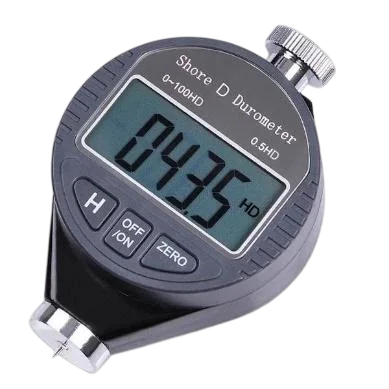
Finetech Engineering is a Shore D hardness tester manufacturer India based in Thane, Maharashtra. Our Shore D Hardness Tester is a durometer instrument paired with a precision test stand. It is built to measure how hard rigid plastics, hard rubber, and ebonite are – a property called indentation hardness.
Shore hardness is the fastest and most widely used method to check how hard a rubber or plastic material is. It takes less than 15 seconds per reading, needs no complicated sample preparation (just a flat surface), and gives you a clear number between 0 and 100. Zero means the material is very soft, and 100 means it is very hard.
The test works like this: a pointed tip (called an indenter) is pressed into the surface of the material under a set spring force. The depth of that indent is converted into a Shore hardness number. Shore A uses a flatter tip for soft materials. Shore D uses a sharper tip and a stronger spring – that is why it is the right choice for rigid plastics and hard rubber.
Feature | Shore A | Shore D |
Indenter Shape | Truncated cone, 35° angle, 0.79 mm flat tip | Sharp cone, 30° angle, 0.1 mm spherical tip |
Spring Force | 822 g (8.06 N) at full deflection | 4536 g (44.5 N) at full deflection |
Best For | Soft to medium rubber, elastomers, TPE, flexible PVC, foam, silicone | Rigid plastics, hard rubber, ebonite, thermoplastics, semi-rigid materials |
Typical Materials | Natural rubber, SBR, NBR, EPDM, silicone, PU foam, TPE/TPR, soft PVC | PP, PE-HD, ABS, nylon, polycarbonate, POM, hard PVC, acrylic, polystyrene, hard rubber |
Standards | ISO 868, ASTM D2240 Type A, IS 3400 Part 5 | ASTM D2240 Type D, ISO 868 |
When to Use | When the material is soft enough to indent with your thumbnail | When Shore A reading is above 90, or when the standard specifies Shore D |
Material | Shore A | Shore D | Notes |
Soft silicone rubber | 20–40 | – | Very soft, gel-like |
Rubber bands, flexible tubing | 30–50 | – | Everyday rubber |
Tyre tread compound | 55–75 | – | Medium hardness NR/SBR |
Shoe sole (rubber/PU) | 50–80 | – | Depends on application |
EPDM gasket / seal | 40–70 | – | Varies with compound |
Hard rubber / ebonite | 90–100 | 40–70 | Test both scales in this overlap zone |
Polypropylene (PP) | – | 70–80 | Rigid thermoplastic |
Polyethylene (HDPE) | – | 60–70 | Semi-rigid thermoplastic |
ABS | – | 75–85 | Common engineering plastic |
Nylon (PA6, PA66) | – | 75–85 | Engineering plastic |
Polycarbonate (PC) | – | 80–90 | Tough transparent plastic |
Acetal / POM | – | 80–90 | High-stiffness engineering plastic |
Hard PVC (rigid) | – | 75–85 | Pipes, profiles, fittings |
Parameter | Specification |
Product Name | Shore D Hardness Tester (Durometer with Test Stand) |
Durometer Type | Shore D (Shore A also available separately) |
Measurement Range | 0–100 Shore D |
Resolution | 0.5 or 1 Shore unit (model-dependent) |
Display | Digital LCD with peak hold function |
Indenter | Hardened steel, 30° cone with 0.1 mm radius spherical tip (per ASTM D2240 Type D) |
Spring Force | 4536 g (44.5 N) at full deflection |
Test Stand | Precision operating lever, adjustable height, perpendicular contact and consistent loading |
Specimen Requirements | Minimum 6 mm thick, flat and parallel surfaces, free of texture or curvature |
Standards Compliance | ASTM D2240, ISO 868, IS 3400 Part 5, DIN 53505 |
Calibration | Calibration blocks supplied; traceable calibration service available |
Power | Battery-operated – no mains power required |
Construction | Steel frame, powder coated, with durometer mounting bracket |
Certification | ISO 9001:2015 certified manufacturing |
Manufacturer Location | Thane, Maharashtra, India |
Test stand included – always. Many competitors sell the handheld durometer on its own and charge extra for the test stand. As a Shore D durometer with test stand India manufacturer, Finetech includes the precision test stand with every laboratory durometer – because ASTM D2240 Shore D hardness tester and ISO 868 Shore hardness tester India standards require it for valid laboratory results.
Digital display with peak hold. No analogue needle to read, no guesswork. The digital display captures the peak hardness reading automatically, so results are the same regardless of who is doing the test.
Hardness button moulds available. For rubber testing, the sample should be a standard hardness button moulded to a specific thickness. Finetech makes the hardness button mould and the hydraulic press to produce them – everything you need from one supplier.
Both Shore A and Shore D from one manufacturer. If your lab tests both rubber (Shore A) and plastics (Shore D), both instruments come from Finetech. They fit the same test stand and are calibrated and serviced by the same team – making us your single-source hardness tester for rubber and plastic India supplier.
Local support from a hardness tester manufacturer Thane Maharashtra. We are based in Thane, Maharashtra. Getting a quote, ordering spare parts, or booking a calibration check is fast and straightforward – no long waits or international shipping.
Calibration and AMC support. We supply calibration test blocks for in-house checks and offer professional traceable calibration services. AMC plans include periodic calibration checks and durometer inspection.
| Product | Why Related |
For moulding standard Shore A/D hardness test buttons |
|
For compression moulding hardness buttons and other test specimens |
|
Complementary tensile and flexural testing |
|
Complementary abrasion resistance testing for rubber |
|
Complementary compression set testing for rubber seals |
|
Browse all specimen preparation equipment |


















All Equipments & specimen preparation products can be customised as per requirements.