







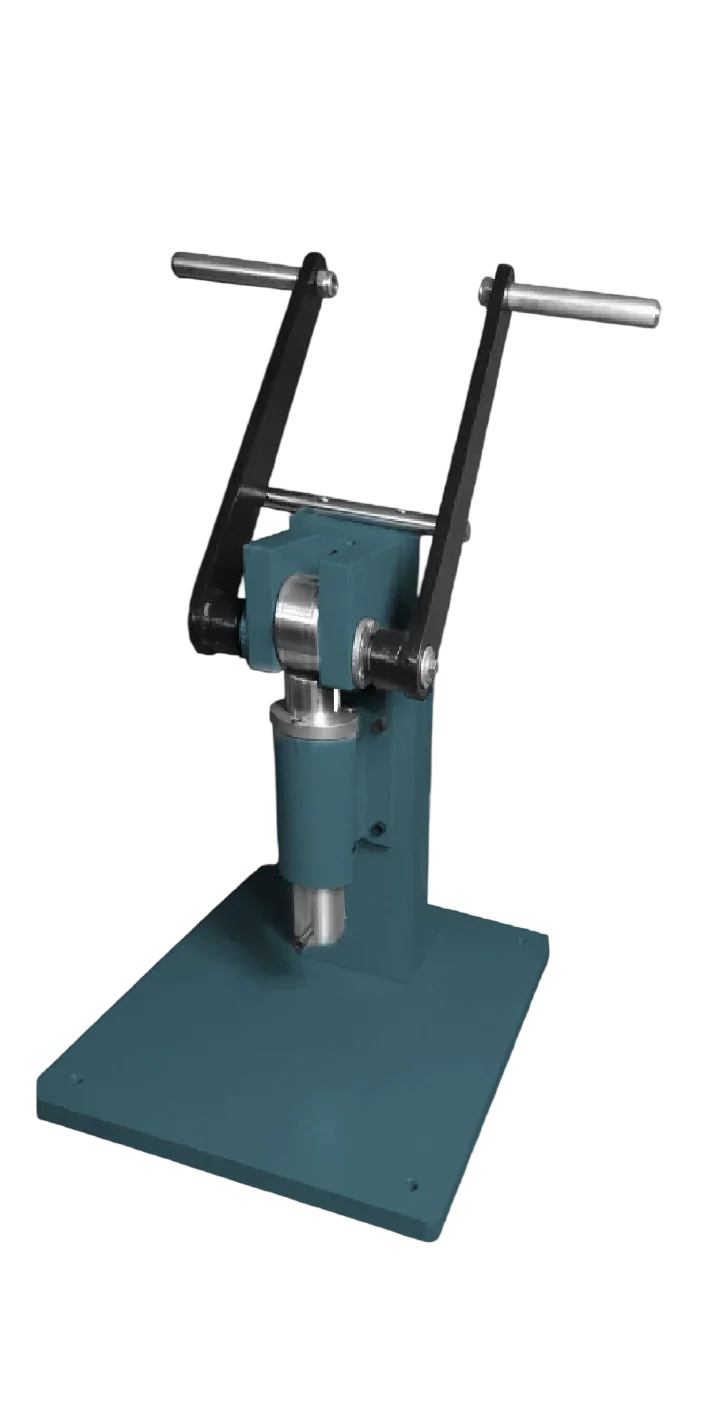
The Finetech Engineering Manual Press for Lab Specimen Preparation is a hand-operated specimen cutting press designed for laboratories that need a simple, reliable, and affordable tool for preparing test specimens from rubber, plastic, paper, textile, leather, and other sheet materials. As a trusted bench press machine for laboratory India manufacturer, we supply this press to QC labs, educational institutions, factory testing stations, and field testing setups across the country.
The operator positions a cutting die on the material, places it on the press platen, and pulls the lever handle (or turns the wheel) to apply downward force. The die cuts through the material, producing a clean specimen ready for testing. There are no motors, no pumps, no compressors, and no power cables. The Finetech manual press for lab specimen preparation works anywhere – in a fully equipped QC lab, a factory-floor testing station, a field setup, or a college teaching laboratory.
As a bench press machine for laboratory India specialist, Finetech Engineering builds this press from mild steel with a powder-coated finish – the same manufacturing quality as our pneumatic and hydraulic presses. The manual press for lab specimen preparation is the right choice for labs that cut a small number of specimens per day (typically under 20-30) and where the materials being cut are not excessively thick or hard.
Choose the manual press when:
Consider upgrading when:
| Feature | Manual Press | Pneumatic Press | Hydraulic Press (Manual) |
| Power Source | Manual press for lab specimen preparation – hand lever/wheel, zero power | Compressed air (6–8 bar) | Hydraulic hand pump |
| Cutting Force | Low–medium | Medium–high | High (15–30 tonnes) |
| Speed per Cut | Slow – manual effort | Fast – single-stroke | Moderate – pump strokes |
| Best Daily Volume | Under 20–30 specimens | 50–200+ specimens | 20–80 specimens |
| Operator Fatigue | High at volume | Minimal | Low |
| Consistency | Variable – depends on operator | Excellent – same force every stroke | Good – depends on pump strokes |
| Compression Moulding | No | No | Yes (with heated platens) |
| External Power Needed | None | Compressed air | None (non-heated model) |
| Maintenance | Virtually zero | Low (air connections only) | Low (hydraulic seals, oil) |
| Contamination Risk | None | None | Possible (hydraulic oil) |
| Relative Cost | ₹ Bench press machine for laboratory India – lowest cost | ₹₹ (mid-range) | ₹₹₹ (highest) |
| Parameter | Specification |
| Product Name | Manual Press for Lab Specimen Preparation – Hand-Operated Specimen Cutting Press (Bench Press Machine for Laboratory India, Finetech Engineering) |
| Operation | Manual – lever handle or hand wheel mechanism |
| Cutting Force | Operator-dependent – sufficient for soft to medium-hardness materials up to ~6 mm |
| Platen / Table Size | Standard: 150 × 150 mm or 200 × 200 mm (model-dependent) |
| Maximum Specimen Thickness | Up to ~4–6 mm (material and hardness dependent) |
| Compatible Cutting Dies | All Finetech specimen dies – manual press for lab specimen preparation: dumbbell, tear, crescent, round, rectangular, notch |
| Frame Construction | Mild steel, powder coated |
| Mounting | Bench press machine for laboratory India – tabletop, bench-mounted or clamped |
| Power Supply | None required – fully manual operation |
| Weight | Lightweight – easily portable |
| Maintenance | Virtually zero – occasional lubrication of lever mechanism only |
| Certification | ISO 9001:2015 certified manufacturing |
Works anywhere, always. No electricity, no air supply, no hydraulic fluid. The Finetech manual press for lab specimen preparation is the simplest, most reliable specimen preparation tool you can own. Pull the lever and cut.
The ideal bench press machine for laboratory India. Compact tabletop footprint, bench-mountable design, portable enough to move between stations. As a bench press machine for laboratory India, it fits any lab bench – no floor space needed.
Compatible with every Finetech die. All our dumbbell, tear, crescent, round, rectangular, and notch cutters fit the manual press for lab specimen preparation. The same dies also fit our pneumatic and hydraulic presses – no die replacement when you upgrade.
Lowest cost of ownership. Lowest purchase price, zero operating cost, virtually zero maintenance. The bench press machine for laboratory India with the best total cost of ownership over 5-10 years.
Built to the same quality as our powered presses. ISO 9001:2015 certified manufacturing, powder-coated steel frame, precise platen alignment. The manual press for lab specimen preparation is affordable, not cheap.
| Product | Why Related |
Upgrade for speed and consistency – for 50+ specimens/day |
|
Upgrade for high force and compression moulding capability |
|
Most commonly used die with the manual press |
|
For tear strength specimen preparation |
|
For compression set and hardness specimens |
|
For film, paper, and textile strip specimens |
|
Browse all available cutting dies and moulds |


















All Equipments & specimen preparation products can be customised as per requirements.
Yes — and this is one of the key advantages of choosing Finetech. All three presses (manual, pneumatic, hydraulic) accept the same cutting dies. When you upgrade, your existing die investment carries forward. The manual press then becomes a backup or secondary cutting station.