







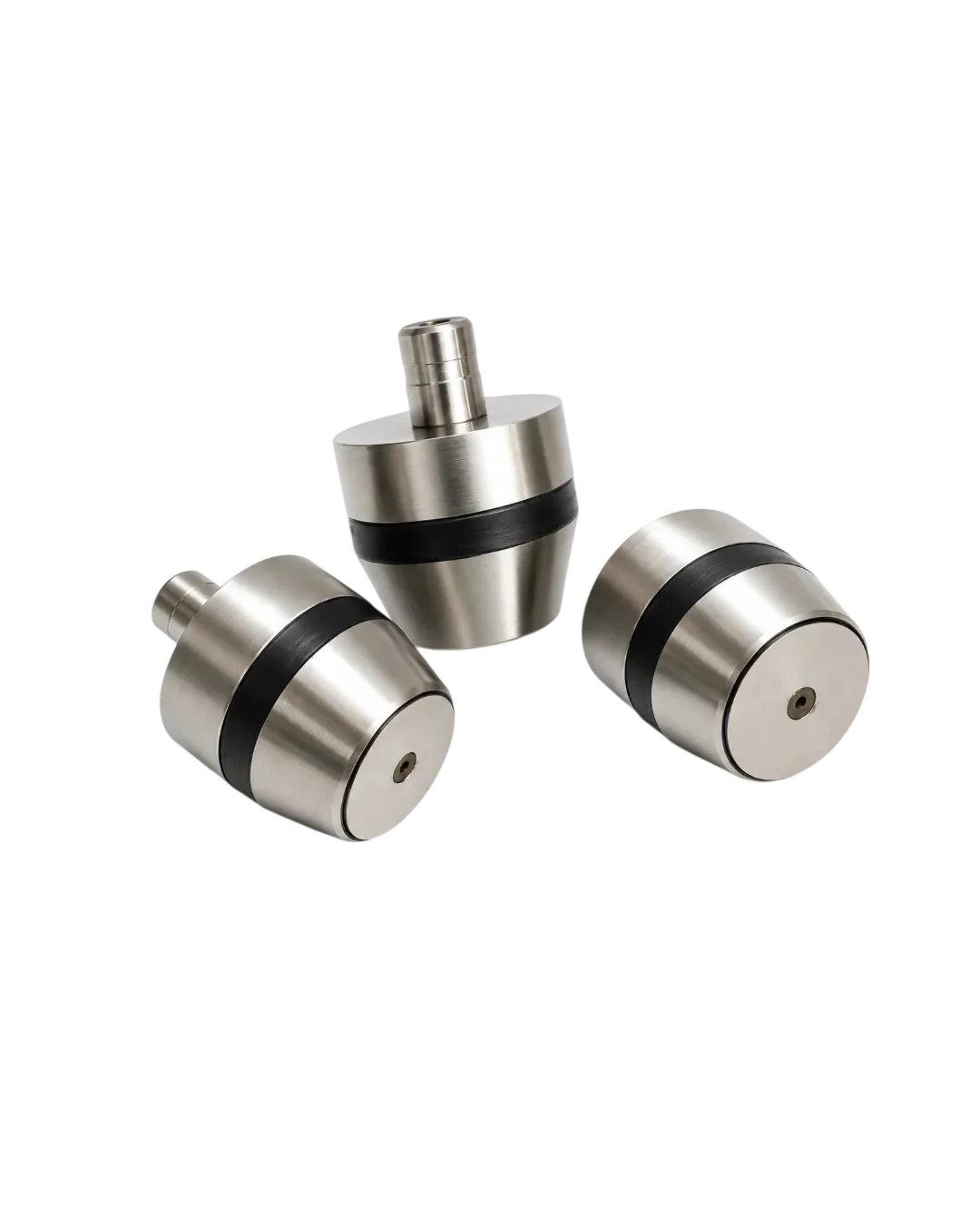
The Finetech Engineering Round Specimen Cutter India is a precision cylindrical die used to cut circular disc specimens from flat sheets of rubber, plastic, paper, and other materials. Round specimens are required for a wide range of tests – compression set, hardness (Shore A/D), density, specific gravity, burst strength, and more. As a specialist disc specimen cutter manufacturer India, we manufacture every cutter from hardened tool steel to ensure long edge life and consistent specimen quality.
The circular punch cutter for rubber works by pressing a sharp-edged cylindrical blade through the test sheet, producing a clean disc of the exact diameter specified by the relevant testing standard. ASTM D395 specifies that the die should be rotated in a drill press or similar device with light cutting pressure and soap lubrication to minimise cupping of the cut edges. Alternatively, the cutter can be used with a hydraulic or pneumatic press for faster throughput.
As a full-range circular die cutter for lab India supplier, Finetech manufactures round cutters in the standard diameters required by all major compression set, hardness, and paper testing standards, as well as custom diameters to your specific requirements. Each cutter includes a spring-loaded ejector pin that pushes the cut specimen out of the die cavity without damaging the edges – critical for compression set testing where even minor edge distortion affects the measured thickness and invalidates results.
Test / Application | Diameter (mm) | Standard | Material |
Compression set (standard – Method A & B) | 29.0 ± 0.5 | ASTM D395 Type 1, ISO 815 Type A | Rubber, elastomers |
Compression set (small specimen) | 13.0 ± 0.5 | ASTM D395 Type 2, ISO 815 Type B | Rubber, elastomers |
Hardness testing (Shore A / Shore D buttons) | As per moulded button – typically 29–36 mm | ASTM D2240, ISO 868 | Rubber, plastic |
Density / specific gravity | Approx. 25–40 mm (lab-specific) | ASTM D297, ISO 2781 | Rubber, plastic |
Burst strength of paper / board | Per instrument clamping diameter – typically 31.5 mm | ISO 2758, ASTM D3786, TAPPI T403 | Paper, paperboard |
DIN abrasion test (if cut from sheet) | 16 ± 0.2 | DIN 53516, ISO 4649 | Rubber |
Moisture / conditioning discs | Custom (25–50 mm common) | Various | Plastic, rubber, paper |
Ash content / LOI (muffle furnace prep) | Custom | ASTM D5630 | Plastic, rubber |
Standard | Type | Diameter (mm) | Specimen Thickness (mm) | Application |
ASTM D395 | Type 1 | 29.0 ± 0.5 | 12.5 ± 0.5 | Compression set – Method A & B |
ASTM D395 | Type 2 | 13.0 ± 0.2 | 6.3 ± 0.3 | Compression set – Method B only |
ISO 815 | Type A | 29.0 ± 0.5 | 12.5 ± 0.5 | Compression set (equivalent to ASTM D395 Type 1) |
ISO 815 | Type B | 13.0 ± 0.5 | 6.3 ± 0.3 | Compression set (equivalent to ASTM D395 Type 2) |
DIN 53516 / ISO 4649 | Standard | 16.0 ± 0.2 | ~6 (varies) | DIN abrasion specimen (if cut from sheet) |
IS 3400 | As specified | 29 or as specified | 12.5 or as specified | Indian standard for rubber testing |
ISO 2758 / ASTM D3786 | Per instrument | 31.5 (Mullen) | N/A (paper thickness) | Burst strength testing of paper |
Custom | Any | Any diameter to order | Any | Density, moisture, ash content, special tests |
Parameter | Specification |
Product Name | Round (Circular) Specimen Cutter |
Standard Diameters | 13 mm, 16 mm, 29 mm, 31.5 mm, 36 mm |
Custom Diameters | Any diameter manufactured to order |
Standards Supported | ASTM D395, ISO 815, ASTM D2240, ISO 868, DIN 53516, ISO 4649, ISO 2758, ASTM D3786, IS 3400, ASTM D297, ISO 2781 |
Blade Material | Hardened tool steel (EN-31 / equivalent) |
Blade Hardness | 50–56 HRC |
Cutting Edge | Precision ground circular edge. Perpendicular interior walls for consistent specimen diameter. |
Ejector Pin | Spring-loaded ejector pin included for clean specimen removal |
Body Material | Mild steel (MS) body |
Operation | Drill press (rotary, with soap lubrication) per ASTM D395, or Hydraulic / Manual / Pneumatic Press |
Surface Treatment | Chrome plated or powder coated (model-dependent) |
Certification | NABL-traceable dimensional certification available |
Ejector pin included. Every Finetech round specimen cutter India comes with a spring-loaded ejector pin that pushes the specimen out of the die cavity without damaging edges. Edge distortion is a common problem with cheap cutters – it directly affects compression set thickness measurements.
Full diameter range. As a dedicated disc specimen cutter manufacturer India, we supply 13 mm, 16 mm, 29 mm, 31.5 mm, 36 mm standard diameters – plus any custom diameter to order. One supplier for all your round cutting needs.
Perpendicular interior walls. Our CNC-machined circular die cutter for lab India products have perfectly vertical interior walls, ensuring the specimen diameter is consistent from top to bottom. This means the cutter can be re-sharpened multiple times without altering the specimen dimension.
NABL certification available. Dimensional certification for the internal diameter of every circular punch cutter for rubber product – essential for accredited labs running compression set or hardness testing.
Cross-industry versatility. The same round specimen cutter India serves rubber (compression set), plastic (density/hardness), and paper (burst strength) labs. If you test multiple materials, you may need fewer cutters than you think.
| Product | Why Related |
The testing jig that uses the round specimens cut with this die |
|
For moulding hardness test buttons (Shore A/D) – often tested alongside compression set |
|
For moulding rubber sheets of correct thickness before cutting round specimens |
|
Uses 16mm round specimens if cut from sheet |
|
Uses round paper specimens for burst testing |
|
For tensile testing – labs testing compression set usually also run tensile tests |










All Equipments & specimen preparation products can be customised as per requirements.
A round specimen cutter India (also called a circular die cutter for lab India or disc specimen cutter manufacturer India product) is a cylindrical die that punches disc-shaped specimens from flat sheet material. It produces circular specimens of a precise diameter for compression set, hardness, density, burst strength, and other tests. As a dedicated disc specimen cutter manufacturer India, Finetech Engineering supplies all standard diameters and custom sizes.
29 mm is the most commonly ordered round specimen cutter India diameter. It matches ASTM D395 Type 1 and ISO 815 Type A for compression set testing - the most widely performed round-specimen test in rubber QC labs. It is also suitable for hardness and density specimens.
ASTM D395 recommends using the circular punch cutter for rubber in a drill press or similar rotary device, rotating the cutting edge while pressing down with light force and soap lubrication. This minimises cupping of the cut edges. However, many labs use a hydraulic or pneumatic press for faster throughput - this works well for most rubber compounds. For very soft or tacky materials, the rotary drill press method gives cleaner edges.
After cutting, the specimen sits tightly inside the cylindrical circular die cutter for lab India cavity. Without an ejector pin, operators may pry the specimen out with a tool, damaging the edges. For compression set testing, edge quality directly affects thickness measurement accuracy. The spring-loaded ejector pin pushes the disc out cleanly with no edge distortion.
If the diameter matches, the same round specimen cutter India can be used for both materials. For example, a 29 mm cutter works for rubber compression set (ASTM D395) and can also cut paper discs for certain tests. However, paper is more abrasive on cutting edges than rubber, so dedicated cutters for each material type will maintain sharpness longer.
Yes. As a trusted disc specimen cutter manufacturer India, Finetech Engineering provides NABL-traceable dimensional certification for round cutters, verifying the internal diameter and cutting edge perpendicularity.
Yes. As a circular die cutter for lab India manufacturer with in-house CNC machining, we manufacture round cutters to any diameter. Common custom sizes include 25 mm, 38 mm, 40 mm, and 50 mm. Contact our round specimen cutter India team with your required diameter and standard.
Check the cut edges of your specimens under magnification. If you see cupping (specimen edges curling upward), burrs, or rough edges, the circular punch cutter for rubber or circular die cutter for lab India needs re-sharpening. For compression set specimens, also check if your thickness measurements show increasing variability. Finetech offers re-sharpening services.