







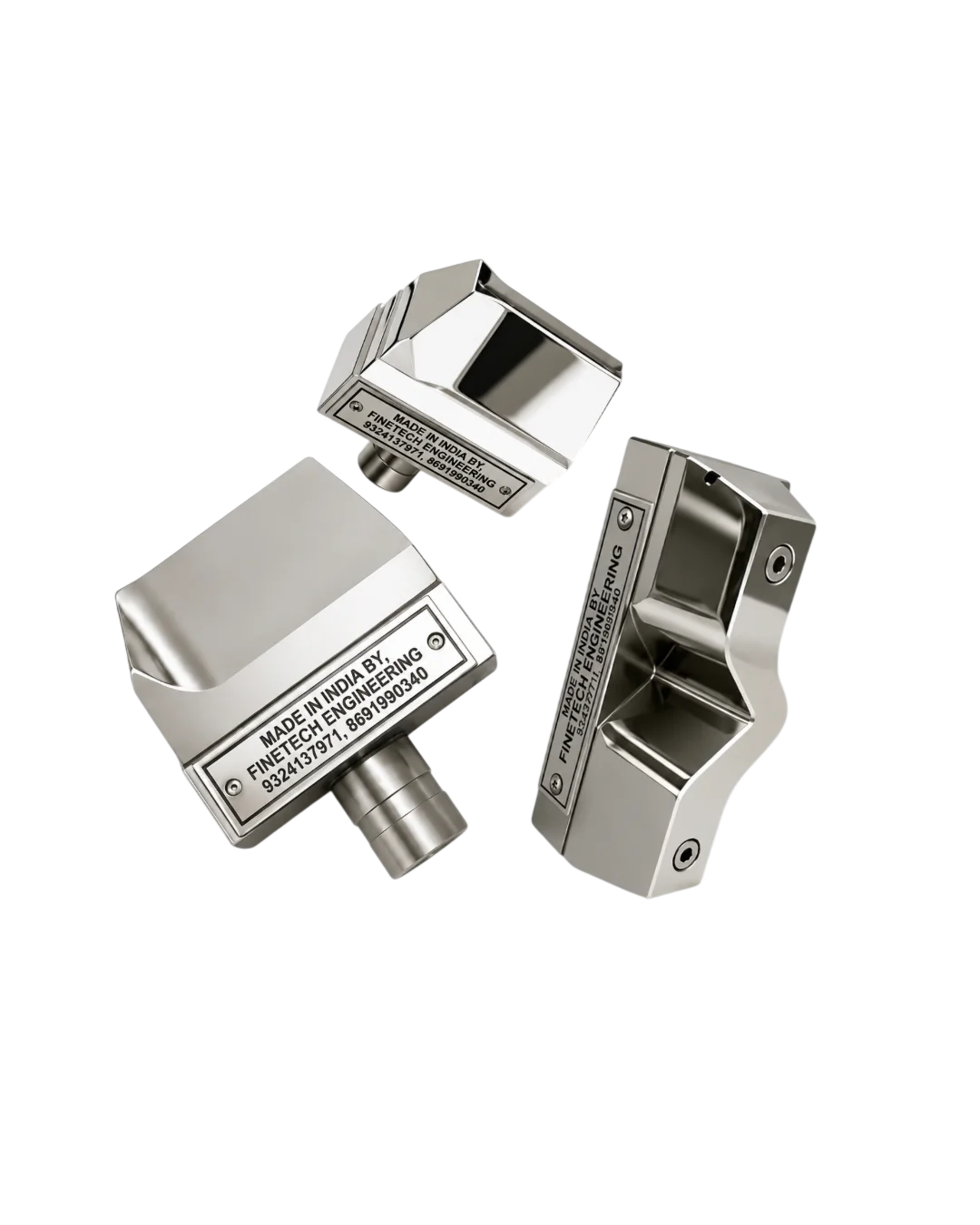
The Finetech Engineering Tear Cutter is a precision die cutting tool used to prepare standardised tear test specimens from vulcanised rubber and thermoplastic elastomer sheets. As a specialist tear cutter manufacturer India, we understand that tear strength testing is one of the most critical evaluations in rubber quality control – because in real-world use, most rubber component failures begin with the initiation and spread of a tear, not a tensile break.
Our ASTM D624 tear specimen cutter India range covers all five specimen geometries (Type A, B, C, T, and CP). The crescent-shaped cutters (Type A and B) measure tear propagation from a pre-cut nick. The angle tear cutter (Type C) measures tear initiation strength from a 90° apex with no pre-cut. The trouser tear cutter India (Type T) produces a two-legged specimen that measures steady-state tear propagation.
As an ISO 34 tear cutter manufacturer, each Finetech rubber tear cutter India is manufactured from hardened tool steel with precision-ground internal cutting edges. The inner faces of the cutting profile are polished to a minimum depth of 5 mm from the cutting edge (as specified by ASTM D624) to ensure clean, burr-free specimens with smooth edges. This level of edge quality is critical – rough or uneven specimen edges create artificial stress concentrations that distort tear strength results.
| Die Type | Specimen Shape | What It Measures | When to Use | Nick Required? |
| Type A | Crescent (no tabs) | Tear propagation | Smaller samples; measures how a tear spreads from a razor nick | Yes – razor nick at inner concave edge |
| Type B | Crescent (with tabs) | Tear propagation | Preferred over Type A when material size allows; gripping tabs improve alignment and reduce slippage | Yes – razor nick at concave edge |
| Type C (Most Common) | Right-angle (90° angle, no nick) | Tear initiation | Evaluates force to start a tear from a sharp corner. Most widely used tear die globally. | No nick – tear starts at 90° apex |
| Type T | Trouser (rectangular with slit) | Tear propagation (steady-state) | Measures continuous tear propagation force. Used for textiles, coated fabrics, and detailed elastomer characterisation. | Slit is part of the die cut |
| Type CP | Constrained path (moulded) | Tear propagation (controlled path) | Thicker legs, pre-defined tear path. Highly reproducible. Used for tough/reinforced compounds. | Moulded specimen – not die-cut |
| Die Type | Overall Length (mm) | Width (mm) | Specimen Shape | Key Feature |
| Type A | Approx. 102 | Crescent profile | Crescent (no tabs) | Nicked at concave edge; no gripping tabs |
| Type B | Approx. 102 | Crescent profile | Crescent (with tabs) | Nicked; gripping tabs for better alignment. Conforms to ISO 34-1 Method C. |
| Type C | Approx. 102 | Right-angle profile | 90° angle with tabs | Un-nicked; tear initiates from 90° apex. Most widely tested geometry. |
| Type T | 150 × 25 | Rectangular | Trouser (two legs) | Includes integral slit cutter. Measures tear propagation. |
| ISO 34-1 Method | Specimen Type | ASTM Equivalent | Description |
| Method A | Trouser | ASTM D624 Type T | Rectangular with longitudinal slit. Legs pulled apart at 50 mm/min. |
| Method B | Angle (right-angle) | ASTM D624 Type C | 90° angle, un-nicked. Tear initiates from apex. Tested at 500 mm/min. |
| Method C | Crescent (nicked) | ASTM D624 Type B | Crescent shape with razor nick. Tear propagation from nick. |
| Parameter | Specification |
| Product Name | Tear Specimen Cutter (Tear Strength Cutting Die) |
| Standards Supported | ASTM D624 (Type A, B, C, T)ISO 34-1 (Method A, B, C)IS 3400 (Part 3)JIS K6252 |
| Types Available | Type A (crescent, no tabs), Type B (crescent with tabs), Type C (90° angle), Type T (trouser) |
| Nicking Device | Integral nicker available for Type A and B (or supplied separately) |
| Blade Material | Hardened tool steel (EN-31 / equivalent) |
| Blade Hardness | 50–56 HRC |
| Cutting Edge Finish | Precision ground and polished. Inner faces perpendicular to cutting edge, polished min. 5 mm from edge per ASTM D624. |
| Wall Thickness | Minimum 5 mm to prevent deformation during cutting |
| Body Material | Mild steel (MS) body with machined handle |
| Operation | Used with Hydraulic Press / Manual Press / Pneumatic Press |
| Certification | NABL-traceable dimensional certification available |
| Custom Sizes | Available as per customer drawing or specific standard requirement |
Complete range under one roof. As a full-range tear cutter manufacturer India, we supply Type A, B, C, T – all manufactured in-house. Plus integral nicking devices for Type A and B. No need to source cutters and nickers from different vendors.
NABL certification available. We provide NABL-traceable dimensional verification for all ASTM D624 tear specimen cutter India and ISO 34 tear cutter manufacturer products – essential for NABL-accredited labs, government tenders, and export compliance.
Polished cutting edges per ASTM D624. Every rubber tear cutter India product features inner faces perpendicular to the cutting edge and polished for a minimum of 5 mm – because rough edges create artificial stress concentrations that invalidate your tear test results.
Dedicated trouser tear cutter. Our trouser tear cutter India (Type T) is precisely dimensioned to both ASTM D624 and ISO 34-1 Method A specifications – with the integral slit cutter machined as part of the die for clean, consistent specimens.
We also make the testing machine. Finetech Engineering manufactures Universal Testing Machines, grips, and presses. We understand the full tear testing workflow – from specimen preparation with our tear cutter to final result – and can supply a complete setup.
Re-sharpening and re-certification. A dull tear cutter produces specimens with ragged edges, leading to inconsistent tear initiation and unreliable results. We offer re-sharpening and NABL re-certification services.










All Equipments & specimen preparation products can be customised as per requirements.