







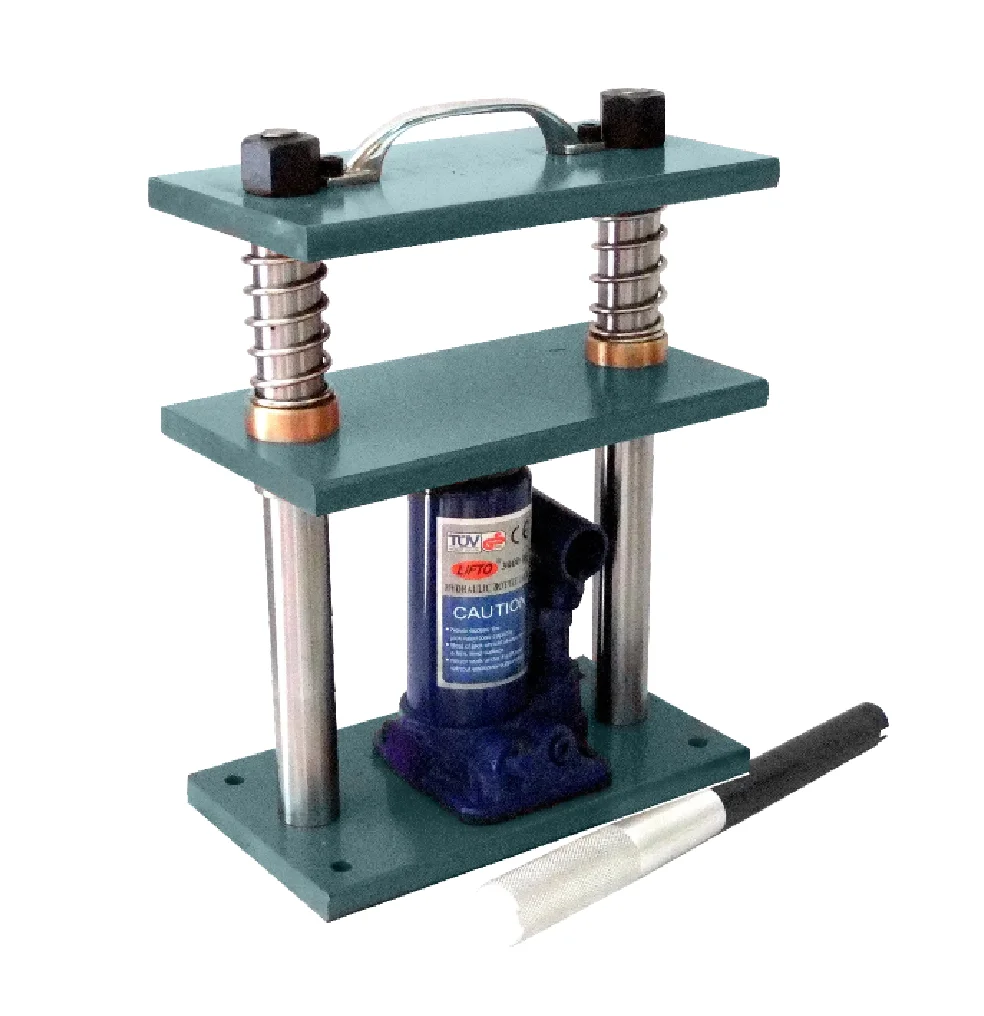
The Finetech Engineering Hydraulic Press (Manual Operation) is a heavy-duty hand-pump hydraulic press designed for two critical functions in a materials testing laboratory: specimen cutting and compression moulding. It delivers significantly higher downward force than a pneumatic or manual press, making it the right choice for cutting specimens from thick rubber sheets, hard engineering plastics, and multi-layer laminates.
For specimen cutting, the hydraulic press provides the controlled, high-tonnage force needed to drive precision cutting dies cleanly through tough materials. ASTM D412 specifies that dumbbell specimens should be die-cut from vulcanised rubber sheets — and for thick or hard compounds, a hydraulic press is the only practical tool for the job. The press accepts all standard Finetech specimen dies (dumbbell, tear, crescent, round, rectangular, notch) and delivers a clean, burr-free cut every time.
For compression moulding, the same press is used with heated platens and test specimen moulds to prepare vulcanised rubber sheets (per ASTM D3182), compression set buttons (per ASTM D395), hardness buttons (per ASTM D2240), DIN abrasion specimens, and thermoplastic test plaques (per ASTM D4703). The hydraulic mechanism provides the uniform clamping force required by these standards, while the heated platens maintain the curing temperature throughout the moulding cycle.
When to use the hydraulic press for cutting (instead of pneumatic or manual):
Common moulding applications:
| Parameter | Specification |
| Product Name | Hydraulic Press (Manual Operation) |
| Operation | Manual hydraulic hand-pump |
| Pressing Force | Up to 15–30 tonnes (model-dependent) |
| Platen Size | Standard: 200 × 200 mm / 300 × 300 mm (model-dependent) |
| Daylight Opening | Adjustable — accommodates moulds of various heights |
| Heated Platens (Optional) | Electrically heated platens with PID temperature controller |
| Temperature Range (Heated) | Ambient to 250°C (for rubber vulcanisation and plastic moulding) |
| Temperature Accuracy | PID controlled, ±2°C |
| Frame Construction | Heavy-duty mild steel, powder coated |
| Pressure Gauge | Hydraulic pressure gauge for force monitoring |
| Pressure Release | Manual release valve for controlled platen return |
| Power Supply | No electrical power for basic (non-heated) model. 230V AC for heated platen model. |
| Compatible Cutting Dies | All Finetech specimen dies: dumbbell, tear, crescent, round, rectangular, notch |
| Compatible Moulds | All Finetech moulds: flat sheet (D3182), compression set (D395), hardness, DIN, Demattia, custom |
| Certification | ISO 9001:2015 certified manufacturing |
| Standard | Application |
| ASTM D3182 | Mixing rubber compounds and preparing standard vulcanised test sheets |
| ASTM D4703 | Compression moulding of thermoplastic test specimens, plaques, or sheets |
| ASTM D395 / ISO 815 | Moulding compression set test buttons |
| ASTM D2240 / ISO 868 | Moulding hardness test buttons |
| DIN 53516 / ISO 4649 | Moulding DIN abrasion test specimens |
| ASTM D430 / ISO 132 | Moulding Demattia flex test specimens |
| ASTM D412 / ISO 37 | Cutting dumbbell specimens from moulded sheets |
| ASTM D624 / ISO 34-1 | Cutting tear specimens from moulded sheets |
| ASTM D256 / ISO 179 | Pressing notch cutters for impact test specimens |
Dual-purpose: cutting + moulding. One machine handles both specimen cutting and compression moulding. No need to invest in separate equipment for each function — saving capital cost and lab floor space.
High force for tough materials. 15–30 tonnes of pressing force cuts cleanly through thick rubber, hard plastics, and multi-layer composites that pneumatic and manual presses cannot handle.
No compressed air required. The manual hydraulic pump operates independently of any external power source (for the non-heated model). Ideal for labs without compressed air lines, mobile testing setups, or locations with unreliable power supply.
Heated platens available. PID-controlled heated platens up to 250°C for vulcanisation of rubber test sheets (ASTM D3182) and compression moulding of thermoplastic plaques (ASTM D4703).
Compatible with all Finetech dies and moulds. Every specimen cutter and test mould we manufacture fits the hydraulic press. One press, complete specimen preparation capability.
Built to last. Heavy-duty steel frame, industrial-grade hydraulic cylinder, and powder-coated finish. Designed for years of daily use in demanding QC and R&D labs.
| Product | Why Related |
| Pneumatic Press | For high-volume, medium-force specimen cutting (air-powered, faster cycle) |
| Manual Press | Budget-friendly option for low-volume, low-force cutting |
| Flat Sheet Mould (ASTM D3182) | For moulding vulcanised rubber sheets — used with this press |
| Compression Set Mould (ASTM D395) | For moulding compression set buttons — used with this press |
| Hardness Button Mould (ASTM D2240) | For moulding Shore A/D test buttons — used with this press |
| Dumbbell Specimen Cutter | Most commonly used die with this press |
| Specimen Cutters & Moulds (Full Range) | Browse all cutting dies and moulds |









Customisation available
The hydraulic press uses hydraulic fluid and a hand pump to generate high force (15–30 tonnes). The pneumatic press uses compressed air (6–8 bar) for faster, lighter-force cutting. The hydraulic press is better for thick/hard materials and compression moulding. The pneumatic press is better for high-speed, high-volume cutting of standard-thickness materials. See the comparison table on our Pneumatic Press page for a detailed feature-by-feature comparison.
Yes — this is the key advantage of the hydraulic press. For cutting, place a cutting die and material on the platen and apply hydraulic pressure. For moulding, install heated platens, place a mould with rubber compound, set the temperature, and apply clamping pressure. The same press serves both functions.
If you only need the press for specimen cutting (driving dies through already-prepared rubber or plastic sheets), you do not need heated platens. If you also need to mould rubber test sheets (ASTM D3182), compression set buttons, or thermoplastic plaques, you need the heated platen option. Specify your requirement when ordering.
Vulcanised rubber (all hardnesses including hard compounds above 80 Shore A), thermoplastic elastomers, rigid and semi-rigid plastics, engineering plastics (nylon, polycarbonate, POM), multi-layer laminates, paper, paperboard, textile, leather, and foam. Essentially any flat sheet material up to the thickness the die can accommodate.
The basic (non-heated) model requires no electrical power — it operates entirely via the manual hydraulic hand pump. The heated platen model requires 230V AC single-phase electrical supply for the platen heaters and temperature controller.
Standard models offer 15 to 30 tonnes of pressing force, depending on the model selected. For most specimen cutting applications, 15 tonnes is sufficient. For compression moulding with large moulds or high-viscosity compounds, 25–30 tonnes may be required. Contact us and we will help you select the right tonnage for your application.
All Finetech test specimen moulds are designed to fit the hydraulic press: flat sheet moulds (ASTM D3182), compression set moulds (ASTM D395), hardness button moulds, DIN abrasion moulds, Demattia flex moulds, and custom moulds. The adjustable daylight opening accommodates moulds of various heights.
Yes. Finetech Engineering offers calibration services for the hydraulic pressure gauge and temperature controller (on heated models), ensuring your press delivers accurate and documented force and temperature for audit compliance.