







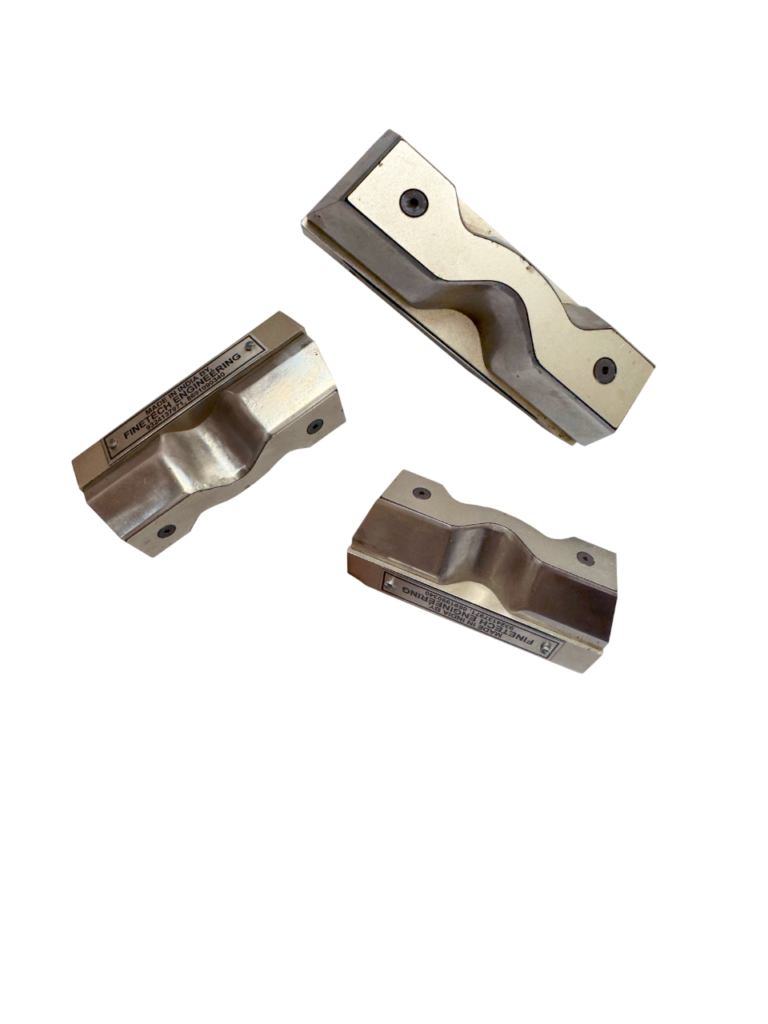
The Finetech Engineering Crescent Specimen Cutter is a precision die used to prepare crescent-shaped tear test specimens from vulcanised rubber and thermoplastic elastomer sheets. The crescent shape is specifically designed for tear propagation testing — measuring how a pre-existing tear grows through a rubber material under tensile load.
Unlike the ASTM D624 Type C angle die (which measures tear initiation from a sharp corner), the crescent cutters (Type A and B) require a small razor nick at the inner concave edge of the specimen before testing. This nick — precisely 0.50 ± 0.05 mm deep per ASTM D624 — creates the controlled stress concentration from which the tear propagates. The force required to propagate this tear, divided by the specimen thickness, gives the tear propagation strength in N/mm or kN/m.
Finetech manufactures both Type A (crescent without gripping tabs — for smaller samples) and Type B (crescent with gripping tabs — preferred for better grip alignment and more consistent results). Both types are available with or without an integral nicking device built into the die. For labs testing high volumes of crescent specimens, the integral nicker ensures every nick is at exactly the same depth and position, dramatically improving repeatability.
Feature | Type A (No Tabs) | Type B (With Tabs) |
Specimen Shape | Crescent only — no gripping tabs | Crescent with extended gripping tabs at both ends |
What It Measures | Tear propagation strength | Tear propagation strength (same property) |
Nick Required? | Yes — 0.50 ± 0.05 mm at inner concave edge | Yes — 0.50 ± 0.05 mm at inner concave edge |
When to Use | When rubber sheet is too small for Type B | Preferred whenever material size allows |
ISO Equivalent | Not directly specified in ISO 34-1 | ISO 34-1 Method C (crescent test piece) |
Grip Alignment | Harder — no tabs to reference against grip faces | Easier — tabs sit squarely in grip faces |
Recommendation | Use only when Type B is not possible | Always preferred when sample size allows |
Method | How It Works | Pros | Cons |
Integral nicker (built into die) | Nicking blade is part of the cutter — nicks simultaneously with the crescent cut | Consistent depth every time. No separate step. Fastest. | Slightly higher die cost. Blade needs periodic replacement. |
Separate nicking apparatus | Standalone device holds cut specimen and guides razor at specified depth | Adjustable. Handles multiple specimens. | Extra step. Higher operator variability risk. |
Manual razor nick | Operator nicks by hand with razor and template | Lowest cost | Highly inconsistent. Not recommended for accredited labs. |
ASTM Standard | ISO Equivalent | Specimen Type | Description |
ASTM D624 Type A | Not directly in ISO 34-1 | Crescent, no tabs, nicked | Tear propagation. For small samples. |
ASTM D624 Type B | ISO 34-1 Method C | Crescent, with tabs, nicked | Tear propagation. Preferred. Modified to conform to ISO 34. |
ASTM D624 Type C | ISO 34-1 Method B | Right angle (90°), un-nicked | Tear initiation — NOT crescent. See Tear Specimen Cutter page. |
Parameter | Specification |
Product Name | Crescent Specimen Cutter (Crescent Tear Die) |
Types Available | Type A (crescent, no tabs)Type B (crescent with gripping tabs) — preferred |
Standards Supported | ASTM D624 Type A & BISO 34-1 Method CIS 3400 Part 3JIS K6252 |
Nicking Device | With integral nicker or without (separate apparatus available) |
Nick Depth | 0.50 ± 0.05 mm (0.020 ± 0.002 inch) per ASTM D624 |
Blade Material | Hardened tool steel (EN-31 / equivalent) |
Blade Hardness | 50–56 HRC |
Cutting Edge Finish | Precision ground and polished. Inner faces perpendicular, polished min. 5 mm from edge. |
Wall Thickness | Minimum 5 mm |
Operation | Used with Hydraulic / Manual / Pneumatic Press |
Specimen Thickness | Standard: 2.0 ± 0.2 mm per ASTM D624 |
Test Speed | 500 ± 50 mm/min (jaw separation rate) |
Certification | NABL-traceable dimensional certification available |
Custom Sizes | Available per customer drawing |
Integral nicker option. Nicking blade built into the die. One press stroke = perfectly nicked crescent. No separate step, no operator variability, no inconsistent nicks.
Both Type A and Type B. We manufacture both variants in-house. Most customers need Type B, but Type A is available for small-sample applications.
NABL certification available. NABL-traceable dimensional certification for die profile and nick depth — essential for accredited labs and government tenders.
Precision nick depth. Integral nicker engineered for exactly 0.50 ± 0.05 mm — the single most important variable in crescent tear testing.Complete tear testing supply. We also manufacture UTMs, grips, hydraulic presses, and flat sheet moulds. One supplier for your entire workflow.
Product | Why Related |
Tear Specimen Cutter (Type C Angle & Type T Trouser) | For tear initiation (Type C) and trouser tear (Type T) |
Dumbbell Specimen Cutter | For tensile testing — most labs need both tensile and tear cutters |
Nicking Apparatus (Standalone) | For labs preferring a separate nicking device |
Universal Testing Machine | Runs the tear test at 500 mm/min |
Hydraulic Press (Manual) | Drives the crescent die through rubber sheet |
Flat Sheet Mould (ASTM D3182) | For moulding rubber sheets from which specimens are cut |










Customisation available
A crescent specimen cutter is a precision die that cuts crescent-shaped (curved) test specimens from rubber or elastomer sheets for tear propagation testing. A razor nick is made at the inner concave edge before testing. When pulled in a UTM, the tear propagates from this nick, and the force (divided by thickness) gives tear propagation strength.
Both produce crescent specimens requiring a razor nick. Type B has gripping tabs at both ends; Type A does not. Type B is preferred because tabs improve alignment in UTM grips, reduce slippage, and produce more consistent results. Type A is for when the rubber sheet is too small for Type B.
The nick creates the controlled starting point for the tear. ASTM D624 specifies 0.50 ± 0.05 mm. Too shallow: tear may not initiate at the intended point (results reflect tensile strength, not tear). Too deep: tear initiates too easily, underestimating actual tear resistance. Consistent nick depth is the biggest factor in reducing scatter in crescent tear data.
For most labs, we recommend the integral nicker. It nicks at the correct depth simultaneously with the crescent cut — one step, consistent every time. Without nicker only if you have a standalone nicking apparatus already.
ASTM D624 Type B corresponds to ISO 34-1 Method C (crescent). The naming is confusing: ISO Method C (crescent) ≠ ASTM Type C (angle). If a customer specifies ISO 34-1 Method C, order the Type B crescent cutter. Die B dimensions were modified from original ASTM D624-54 to conform to ISO 34.
500 ± 50 mm/min for Type A, B, and C specimens per ASTM D624. The specimen typically tears in under one second. Finetech UTMs are pre-configured for this speed.
Yes. NABL-traceable dimensional certification for crescent cutters, including verification of crescent profile dimensions and nick depth (for cutters with integral nicker).
Inspect every 50–100 specimens under magnification. A dull blade produces ragged nicks that increase data scatter. Look for clean, straight nick edges. Replacement nicking blades are available from Finetech Engineering.