







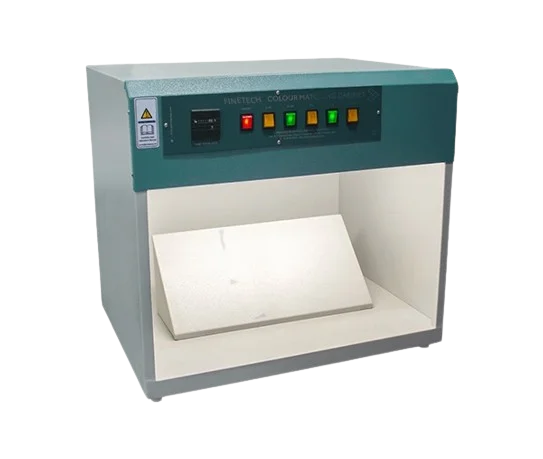
The Finetech Engineering colour matching cabinet manufacturer India delivers a visual colour assessment light booth that provides standardised, repeatable lighting conditions for comparing colours of materials, products, and components. In a world where a slight shade difference between a moulded plastic part and its painted metal counterpart can cause a customer to reject an entire shipment, the colour matching cabinet is the first line of defence in your QC process.
The fundamental problem is that colours look different under different light sources. A plastic housing that matches its reference sample perfectly under factory fluorescent lights may look noticeably different under the customer’s showroom lighting or natural daylight. This phenomenon is called metamerism, and it is the single biggest cause of colour disputes between manufacturers and their customers. The colour matching cabinet eliminates this uncertainty by providing multiple standardised light sources in one controlled viewing booth, so you can check for metamerism before the product ships.
The cabinet interior is finished in neutral grey (Munsell N7) to eliminate colour bias from the surrounding environment. Samples are placed on the flat viewing surface and observed under each light source in sequence: D65 (simulated daylight at 6500K), TL84 (European retail store lighting at 4000K), CWF (US office fluorescent at 4150K), UV (to detect optical brighteners and fluorescent whitening agents), and F/A (incandescent tungsten at 2700K). If two samples match under all light sources, they are a true colour match. If they match under some but not others, metamerism is present and the colour formula needs adjustment.
Light Source | Colour Temperature | What It Simulates | When to Use |
D65 | 6500K | Average north-sky daylight at noon – THE PRIMARY STANDARD for colour assessment | Always – D65 is the default light source. Start every assessment here. |
TL84 | 4000K | European and Asian commercial store lighting (tri-phosphor fluorescent) | Export to Europe/Asia: checking how colours appear in retail environments |
CWF (Cool White Fluorescent) | 4150K | US commercial and office lighting | Export to USA: checking how colours appear in US retail and office settings |
UV (Ultraviolet) | N/A | Black light – reveals optical brighteners and fluorescent whitening agents | Textiles, papers, and plastics that contain optical brightening agents |
F / A (Incandescent) | 2700K | Warm tungsten/filament lighting (household bulbs) | How colours look in home/residential environments |
U30 / TL83 | 3000K | US warm white store lighting | US retail environments with warm lighting |
What is metamerism in colour matching? Metamerism occurs when two colour samples appear to match under one light source but look visibly different under another. This happens because the two samples achieve their colour through different pigment combinations that reflect light differently across the spectrum. Knowing how to detect metamerism in plastic parts before shipment is critical for QC.
Example: A plastic moulding coloured with pigment blend X matches the reference card perfectly under factory fluorescent lights (CWF). The customer inspects the same moulding under daylight (D65) and sees a noticeable green shift. The colour formula is metameric – it matches under CWF but not under D65.
The colour matching cabinet catches metamerism before the product ships. By checking the sample under D65, TL84, CWF, and F in sequence, you identify metameric mismatches in the lab – not at the customer’s receiving dock.
Step 1: Prepare the Viewing Environment
Step 2: Place the Samples
Step 3: Assess Under D65 First
Step 4: Check for Metamerism
Step 5: UV Check (If Applicable)
Parameter | Specification |
Product Name | Colour Matching Cabinet (Visual Colour Assessment Light Booth) |
Light Sources | D65 (6500K), TL84 (4000K), CWF (4150K), UV, F/A (2700K) – up to 6 sources (configurable) |
D65 Illuminance | Approximately 1000–1200 lux on viewing surface (per ASTM D1729) |
Interior Finish | Neutral grey (Munsell N7 or equivalent) on all interior surfaces |
Viewing Area | Approximately 600 × 400 mm (model-dependent; larger models available) |
Viewing Angle | 45° (ASTM D1729 Method A) supported; adjustable sample tilt available |
Lamp Switching | Individual switches for each light source; automatic sequential switching available |
Lamp Hour Meter | Individual elapsed time counter for each light source – tracks usage for replacement scheduling |
Warm-Up Time | None – instant start, no flicker |
Exterior | Steel body, powder coated (neutral colour) |
Power Supply | 230V AC, single phase, 50 Hz |
Standards Compliance | ASTM D1729, ISO 3664, BS 950 Part 1 & 2, DIN 6173, ANSI |
Certification | ISO 9001:2015 certified manufacturing |
Industry | Must Have | Recommended | Why |
Plastics (moulded parts, pipes, packaging) | D65 | TL84, CWF, F/A | Product appears in retail, commercial, and home environments |
Rubber (footwear, automotive parts) | D65 | TL84, F/A | Colour matching of soles, trims, and interior components |
Textiles and garments | D65, UV | TL84, CWF, F/A | UV detects optical brighteners in white fabrics; TL84 for store display |
Automotive (interior, exterior trim) | D65 | TL84, CWF, F/A | Multi-component colour matching (plastic + fabric + paint) |
Printing and packaging | D65 (or D50 per ISO 3664) | F/A, UV | Print proofing, packaging colour consistency, OBA detection |
Paints and coatings | D65 | TL84, CWF, F/A | Metameric matching under multiple end-use environments |
Paper and paperboard | D65, UV | TL84 | UV reveals fluorescent whitening agents in paper |
Ceramics and tiles | D65 | TL84, F/A | Showroom and home lighting simulation |
Up to 6 light sources configurable. D65, TL84, CWF, UV, F/A, U30 – select the sources your industry needs. Most competitors offer only 4 sources. Finetech cabinets can be configured with 4, 5, or 6 sources.
Munsell N7 neutral grey interior. The interior colour matters as much as the light sources. A white or coloured interior reflects colour onto your samples and biases the assessment. Finetech cabinets use calibrated neutral grey on all interior surfaces per ASTM D1729.
Individual lamp hour meters. Lamps degrade with use – a D65 lamp at 2000 hours does not produce the same spectrum as a new one. The built-in hour meters track each lamp independently, so you replace them at the right time for consistently accurate assessments.
Light booth manufacturer India. As a certified colour assessment cabinet manufacturer India, Finetech builds the cabinet, sources calibrated light sources, and provides replacement lamps directly. No intermediaries, no uncertainty about lamp compatibility.
Part of a complete QC solution. Colour is just one property. Finetech also manufactures the UTM (tensile), impact tester, MFI tester, Shore hardness tester, and all specimen preparation equipment. One supplier for your entire QC lab.
| Product | Why Related |
Complementary incoming material QC – colour + MFR checked together on every batch |
|
Complementary mechanical testing |
|
Complementary physical property testing |
|
For conditioning specimens under standardised temperature/humidity |
|
Complementary impact testing |
|
Ash content testing – filler loading affects colour in filled plastics |


















All Equipments & specimen preparation products can be customised as per requirements.