







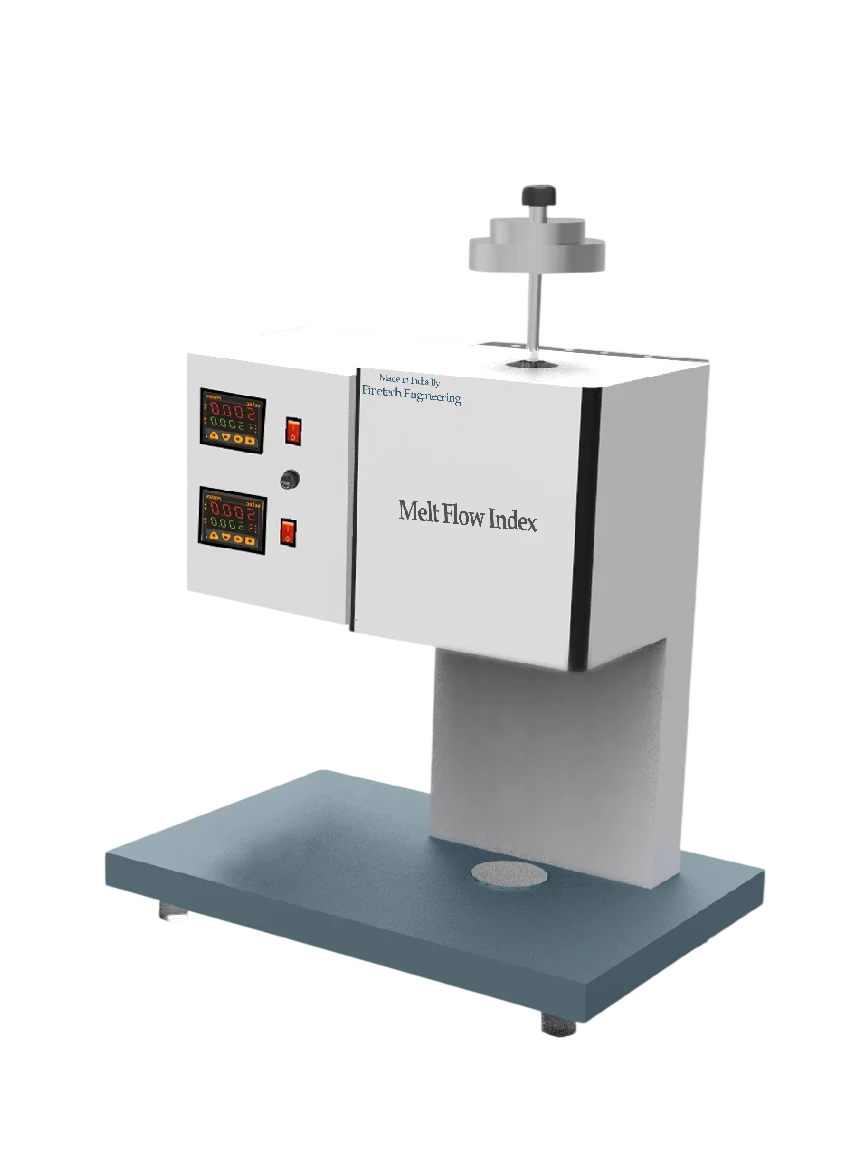
Imagine you order 5 tonnes of polypropylene granules from your supplier. The invoice says Grade X, 230/2.16 MFR = 12 g/10 min. That is what you agreed to buy. But how do you know that is what you got? You cannot tell by looking at the bag. You cannot tell by feeling the granules. You can only tell by melting it, pushing it through a die, and measuring how fast it flows.
That is exactly what the Finetech melt flow index tester manufacturer India product does. It is the fastest, simplest, and most reliable way to verify that the polymer batch you received is the grade you ordered. The test takes 15-20 minutes. A QC lab without this machine is flying blind every time a new delivery arrives.
As a trusted MFI tester manufacturer India and extrusion plastometer manufacturer India, Finetech Engineering builds this instrument – technically called an extrusion plastometer – to measure the Melt Flow Rate (MFR) and Melt Volume-Flow Rate (MVR) of thermoplastic polymers. The principle: granules go into a heated barrel, a calibrated weight presses the piston down, and the molten polymer squeezes through a standard die (2.095 mm bore x 8 mm long). You measure how much material comes out in 10 minutes. That number is the MFR.
MFR tells you about the polymer’s molecular weight and viscosity. High MFR = low viscosity, easy flow = lower molecular weight = typically weaker. Low MFR = high viscosity, stiff flow = higher molecular weight = typically stronger. Every grade of PE, PP, ABS, nylon, and every other thermoplastic has a specified MFR range. Your melt flow rate tester for plastic India machine is how you verify you are in that range before a kilogram of material hits the production line.
Feature | MFR – Melt Mass-Flow Rate | MVR – Melt Volume-Flow Rate |
What it measures | How many grams of molten plastic flow through the die in 10 minutes | How many cubic centimetres of molten plastic flow through the die in 10 minutes |
Result unit | g/10 min | cm3/10 min |
How you get the result | Procedure A: you cut the extrudate strands at timed intervals and weigh them on a balance | Procedure B: the encoded piston measures its own displacement – the machine calculates MVR automatically. Your MFR MVR tester manufacturer India product does this. |
Relationship | MFR = MVR x melt density | MVR = MFR / melt density |
When to use it | General QC, grade verification, batch comparison. What most material datasheets report as ‘MFI’. | Comparing polymers with different densities. More reproducible because no cutting and weighing needed – less operator variability. |
Standard | ASTM D1238 melt flow index tester manufacturer India – Procedure A; ISO 1133-1 Method A | ISO 1133 melt flow index tester manufacturer India – Procedure B / Method B; ASTM D1238 Procedure B |
Equipment needed | Balance (for weighing extrudate strands) + timer | Piston displacement encoder built into the melt flow index tester with PID controller India – automatic calculation |
Step 1: Set the Temperature
Step 2: Load the Polymer
Step 3: Preheat – Do Not Skip This Step
Step 4: Measure the Melt Flow Rate
Step 5: Calculate and Report
Step 6: Clean the Barrel
Polymer | Temperature (deg C) | Load (kg) | Designation | Typical MFR | Standard |
Polyethylene (PE-LD, PE-LLD) | 190 | 2.16 | 190/2.16 | 0.2-50 g/10 min | ASTM D1238 melt flow index tester manufacturer India, ISO 1133 melt flow index tester manufacturer India |
Polyethylene (PE-HD) | 190 | 2.16 or 5.0 or 21.6 | 190/2.16 etc. | 0.1-30 g/10 min | ASTM D1238 melt flow index tester manufacturer India |
Polypropylene (PP) | 230 | 2.16 | 230/2.16 | 0.5-100 g/10 min | ASTM D1238 melt flow index tester manufacturer India, ISO 1133 melt flow index tester manufacturer India |
ABS | 220 | 10.0 | 220/10.0 | 1-40 g/10 min | ISO 1133 melt flow index tester manufacturer India |
Polystyrene (PS, HIPS) | 200 | 5.0 | 200/5.0 | 1-30 g/10 min | ASTM D1238 melt flow index tester manufacturer India |
Nylon (PA6, PA66) | 235 or 275 | 1.0 or 2.16 | 235/1.0 | 5-60 g/10 min | ISO 1133 melt flow index tester manufacturer India |
Polycarbonate (PC) | 300 | 1.2 | 300/1.2 | 5-30 g/10 min | ASTM D1238 melt flow index tester manufacturer India |
PET (Polyester) | 285 | 2.16 | 285/2.16 | 5-60 g/10 min | ISO 1133 melt flow index tester manufacturer India |
POM (Acetal) | 190 | 2.16 | 190/2.16 | 2-40 g/10 min | ASTM D1238 melt flow index tester manufacturer India |
Scenario | MFR Reading | What It Means | What to Do |
Incoming batch matches datasheet | Within plus or minus 10% of datasheet | Correct grade, consistent lot | Accept the batch – release to production |
MFR significantly higher than spec | Higher than expected | Lower molecular weight – possible degradation, wrong grade, or contamination | Hold the batch. Retest. Contact supplier with your MFR data. Request grade certificate. |
MFR significantly lower than spec | Lower than expected | Higher molecular weight – wrong grade or unintended high-MW fraction | Hold the batch. May cause higher injection pressure, filling problems. |
High batch-to-batch variation | Inconsistent lot to lot | Inconsistent supplier QC | Request tighter specification from supplier. Increase incoming inspection frequency. |
MFR increases after moulding | Higher than incoming granules | Thermal degradation during processing | Check barrel temperature, residence time, screw speed, moisture content. |
Regrind / recycled material | Higher than virgin polymer | Degradation from previous heat cycles | Limit regrind ratio. Blend with virgin to control MFR. |
Parameter | Specification |
Product Name | Melt Flow Index Tester Manufacturer India – Melt Flow Rate Tester / Extrusion Plastometer (MFI Tester Manufacturer India, Finetech Engineering, Thane) |
Also Known As | Melt Flow Rate Tester for Plastic India, Extrusion Plastometer Manufacturer India, MFR MVR Tester Manufacturer India, MFI tester |
Measured Values | MFR (g/10 min) and MVR (cm3/10 min) |
Temperature Range | 50 deg C to 400 deg C – covers all standard thermoplastics from PE (190 deg C) to PC (300 deg C) |
Temperature Control | Melt Flow Index Tester with PID Controller India – PID controller with plus or minus 0.2 degrees C accuracy across the full barrel length (per ASTM D1238 Melt Flow Index Tester Manufacturer India and ISO 1133 Melt Flow Index Tester Manufacturer India requirements) |
Standards | ASTM D1238 Melt Flow Index Tester Manufacturer India (Procedure A and B), ISO 1133 Melt Flow Index Tester Manufacturer India (Method A and B) |
Barrel Material | Hardened steel, bore 9.550 mm plus or minus 0.025 mm |
Standard Die | 2.095 mm bore x 8.000 mm length (per ASTM D1238 / ISO 1133). Half-die (4.0 mm) available for high-MFR materials. |
Piston | Hardened steel, 9.475 mm diameter, flat tip |
Weight Set | 0.325, 1.2, 2.16, 3.8, 5.0, 10.0, 12.5, 21.6 kg – complete set included as standard |
MVR Measurement | Encoded piston displacement – automatic MVR calculation (Procedure B) |
Timer | Digital timer with adjustable cut interval and auto-alert |
Preheating Time | Adjustable – 7 min standard (ASTM D1238) / minimum 5 min (ISO 1133) |
Power Supply | 230V AC, single phase, 50 Hz |
Certification | ISO 9001:2015 certified manufacturing. NABL-traceable calibration available. |
PID precision – plus or minus 0.2 degrees C, not plus or minus 2 degrees. MFR is extremely sensitive to temperature – even 1 degree C changes the result by 5-15% depending on the polymer. The Finetech melt flow index tester with PID controller India product maintains plus or minus 0.2 degrees C across the full barrel length, meeting the strictest requirements of both ASTM D1238 melt flow index tester manufacturer India and ISO 1133 melt flow index tester manufacturer India specifications.
Complete weight set included – no extra purchases. All 8 standard weights from 0.325 kg to 21.6 kg are supplied with the extrusion plastometer manufacturer India product. No discovering mid-test that you are missing the 3.8 kg weight for a specific grade.
Both MFR and MVR in one machine. Procedure A (cut-and-weigh MFR) and Procedure B (piston displacement MVR) are both built into the Finetech MFR MVR tester manufacturer India product. MVR is more reproducible because it eliminates the cutting and weighing step.
Built for Indian plastic labs. PE (190/2.16) and PP (230/2.16) are the two most processed plastics in India. The Finetech melt flow rate tester for plastic India is optimised for these daily conditions while covering the full range for all other polymers.
Manufacturer, not reseller. Built at our Thane facility. As your local melt flow index tester manufacturer India, we provide faster spare parts, direct engineering support, and no middleman pricing.
| Product | Why Related |
Complementary tensile and flexural testing |
|
Complementary impact testing – MFI and impact resistance together characterise a plastic grade |
|
Complementary thermal property testing – heat deflection temperature often specified alongside MFR |
|
For ash content/filler content testing of the same compounds |
|
For conditioning hygroscopic polymers (nylon, PET) before MFI testing |
|
Complementary hardness testing – filler loading and molecular weight both affect hardness |
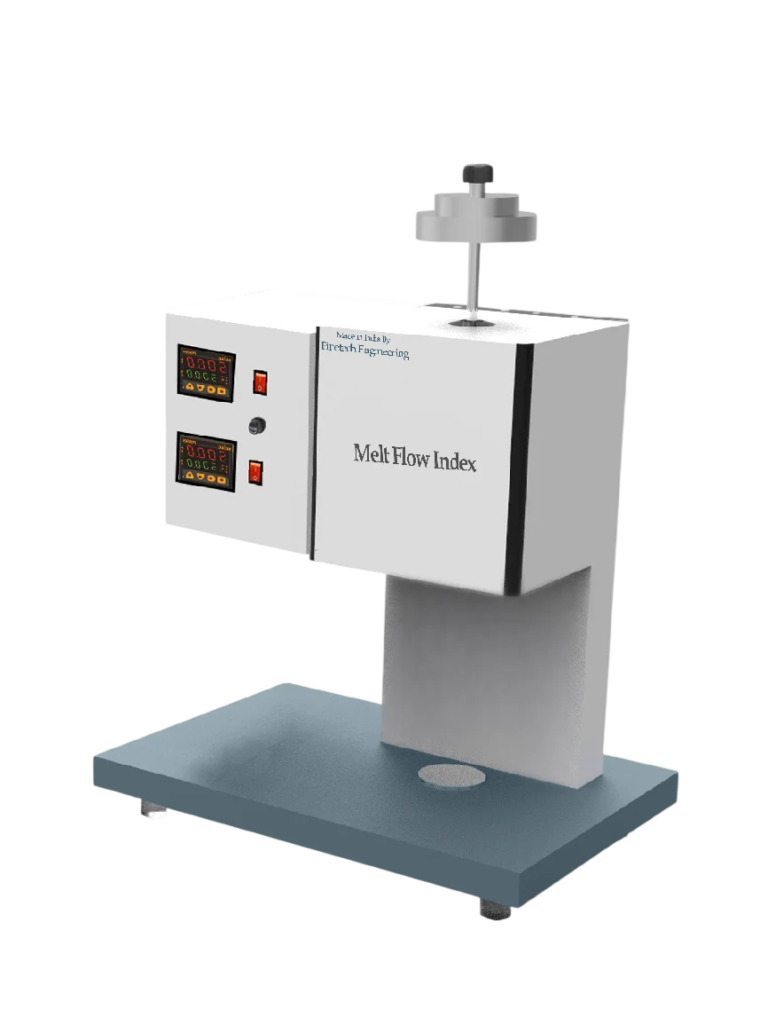


















All Equipments & specimen preparation products can be customised as per requirements.
For a complete answer, see the step-by-step section above - how to do melt flow index test ASTM D1238. In brief: (1) Set barrel temperature to the polymer's required condition. (2) Load 5 g of granules. (3) Preheat 7 minutes. (4) Collect and weigh extrudate strands (Procedure A) or read piston displacement (Procedure B). (5) Calculate MFR = (mass in g / time in min) x 10. (6) Clean the barrel.