







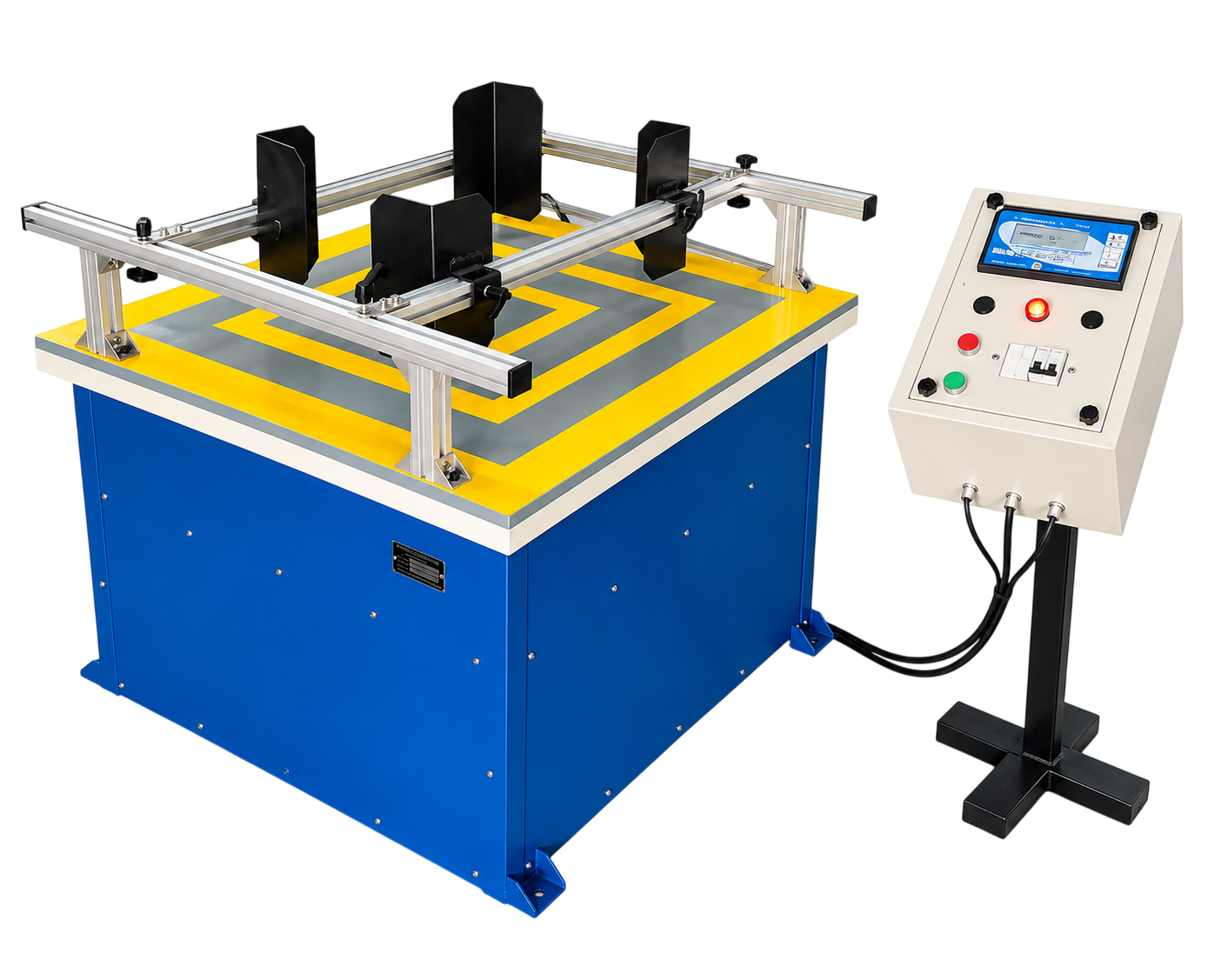
The Finetech Engineering Vibration Tester is a mechanical vibration table designed to simulate the vibrations that packaged products experience during transportation by road, rail, or air. As a dedicated vibration tester manufacturer India, every product that ships – whether a corrugated box of moulded plastic parts from Pune, a carton of pharmaceutical vials from Thane to Chennai, or a pallet of FMCG goods on a cross-country truck – is subjected to continuous vibration throughout the journey. This vibration can cause contents to shift, rattle, compress, crack, or break if the packaging is not designed to absorb and dampen these forces.
The Finetech vibration tester for packaging India replicates these transport stresses in a controlled laboratory environment. The table generates vertical sinusoidal vibrations at adjustable frequencies between 2 and 6 Hz with a fixed amplitude of 25.4 mm – the range that captures the dominant vibration frequencies of truck beds, rail cars, and handling equipment. As a specialist transport simulation vibration tester India manufacturer, the package is placed on the vibrating platform and subjected to a specified duration of vibration, after which the package is opened and inspected for damage.
The Finetech machine is built as a precision ASTM D999 vibration tester manufacturer product – a rigid MS steel frame, cam-driven vibration mechanism for consistent amplitude delivery, side rails for safe specimen placement, and a digital control panel with frequency adjustment and cycle timer. It is designed for packaging QC labs, product development departments, and third-party testing facilities that need to validate packaging to IS 9000, ASTM D999 vibration tester manufacturer spec, ASTM D4169, ISO 2247, and ISTA protocols.
| Problem | What Happens | Industries Affected |
| Product settling | Contents compress and settle, creating empty space. Loose items shift and collide. | FMCG, pharmaceuticals, electronics, food |
| Abrasion damage | Adjacent products rub against each other or against the packaging inner surface. | Glass, ceramics, painted surfaces, consumer electronics |
| Closure failure | Vibration loosens tapes, adhesives, staples, or interlocking flaps. | Corrugated packaging, cartons, shrink-wrapped pallets |
| Fatigue cracking | Repeated vibration cycles cause stress cracking in rigid plastic or glass containers. | Bottles, vials, jars, moulded plastic housings |
| Label / print damage | Friction from vibration smudges, wrinkles, or detaches product labels. | Pharmaceuticals, food, consumer goods |
| Pallet instability | Unit loads shift, lean, or collapse when vibration loosens stretch wrap or strapping. | Palletised goods, warehouse distribution |
| Cushion degradation | Foam or corrugated cushioning loses effectiveness after prolonged vibration. | Electronics, fragile instruments, glassware |
| Standard | Full Name | Key Requirements |
| IS 9000 (Part V/Sec 1) | Packaging – Complete, Filled Transport Packages – Vibration Test | Fixed low-frequency sinusoidal vibration. Vertical motion. Specifies frequency, amplitude, and duration based on package weight and transport mode. The primary Indian standard for packaging vibration testing. |
| ASTM D999 | Standard Test Methods for Vibration Testing of Shipping Containers | Four methods: sinusoidal linear vertical (A1), rotary (A2), single container resonance (B), palletised load resonance (C). Covers filled shipping containers of any form, material, or size. |
| ASTM D4169 | Standard Practice for Performance Testing of Shipping Containers and Systems | Defines 18 distribution cycles simulating different transport modes (truck, rail, air). Vibration is one of several hazard elements – often references ASTM D999 or D4728 for vibration execution. |
| ISO 2247 | Packaging – Complete, Filled Transport Packages – Vibration Tests at Fixed Low Frequency | Sinusoidal vertical vibration at fixed frequency. Equivalent to IS 9000 vibration test section. |
| ISO 8318 | Packaging – Complete Transport Packages – Sinusoidal Vibration Tests Using Variable Frequency | Variable-frequency sweep vibration for resonance identification. |
| ISTA 1A / 2A / 3A | International Safe Transit Association Test Procedures | Distribution simulation test sequences that include vibration as a required element. |
| Parameter | Specification |
| Product Name | Vibration Tester (Vibration Table) |
| Vibration Type | Vertical sinusoidal (mechanical cam-driven) |
| Frequency Range | 2–6 Hz (120–360 cycles per minute), adjustable |
| Amplitude | 25.4 mm (1 inch) fixed |
| Platform Size | Standard: 600 × 600 mm or 750 × 750 mm (larger sizes on request) |
| Maximum Load Capacity | Up to 100 kg (model-dependent; higher capacity models available) |
| Drive Mechanism | Motor-driven cam assembly for consistent amplitude generation |
| Timer | Digital timer with auto-stop for preset test durations |
| Frequency Display | Digital display showing current frequency in Hz or CPM |
| Platform Construction | MS steel platform with vibration-damped bearing block suspension |
| Side Rails | Adjustable side rails on both sides for secure specimen placement |
| Frame Construction | Heavy-duty MS steel frame, powder coated, on rubber vibration-isolation feet |
| Power Supply | 230V AC, single phase, 50 Hz |
| Motor | AC motor with variable speed drive |
| Safety Features | Emergency stop button, overload protection |
| Certification | ISO 9001:2015 certified manufacturing |
Step 1: Test Planning
Step 2: Specimen Preparation
Step 3: Test Execution
Step 4: Post-Test Inspection
IS 9000 compliant as standard. The Finetech vibration tester is built to meet IS 9000 – the Indian packaging vibration standard – plus ASTM D999, ISO 2247, and packaging vibration tester ISTA compliant protocols.
Cam-drive for consistent amplitude. Unlike motor-imbalance designs that drift with load, the Finetech transport simulation vibration tester India cam mechanism delivers a precise 25.4mm amplitude regardless of the package weight on the platform.
Pair with the Finetech Drop Tester. Both machines from one vibration tester manufacturer India means consistent quality, single-source service, and bundled vibration testing machine price India.
Customisable platform sizes. Need a larger platform for palletised loads? As your vibration tester manufacturer India, we build to your dimensions.
Calibration and AMC support. Professional calibration of frequency, amplitude, and timer accuracy, plus Annual Maintenance Contracts. Keeps your vibration tester audit-ready and ISTA/ASTM compliant.
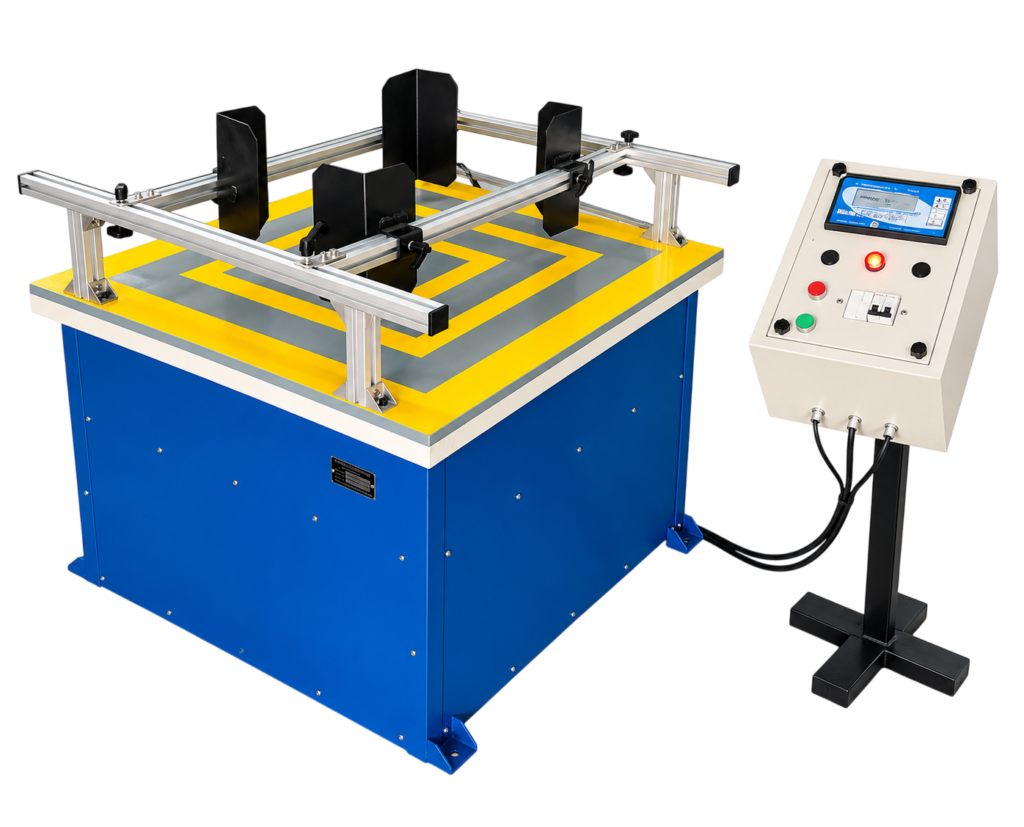










All Equipments & specimen preparation products can be customised as per requirements.