






Finetech Engineering

DIN Abrasion Tester — Rotary Drum Abrader for Rubber Abrasion Resistance Testing

Overview

DIN Abrasion Tester
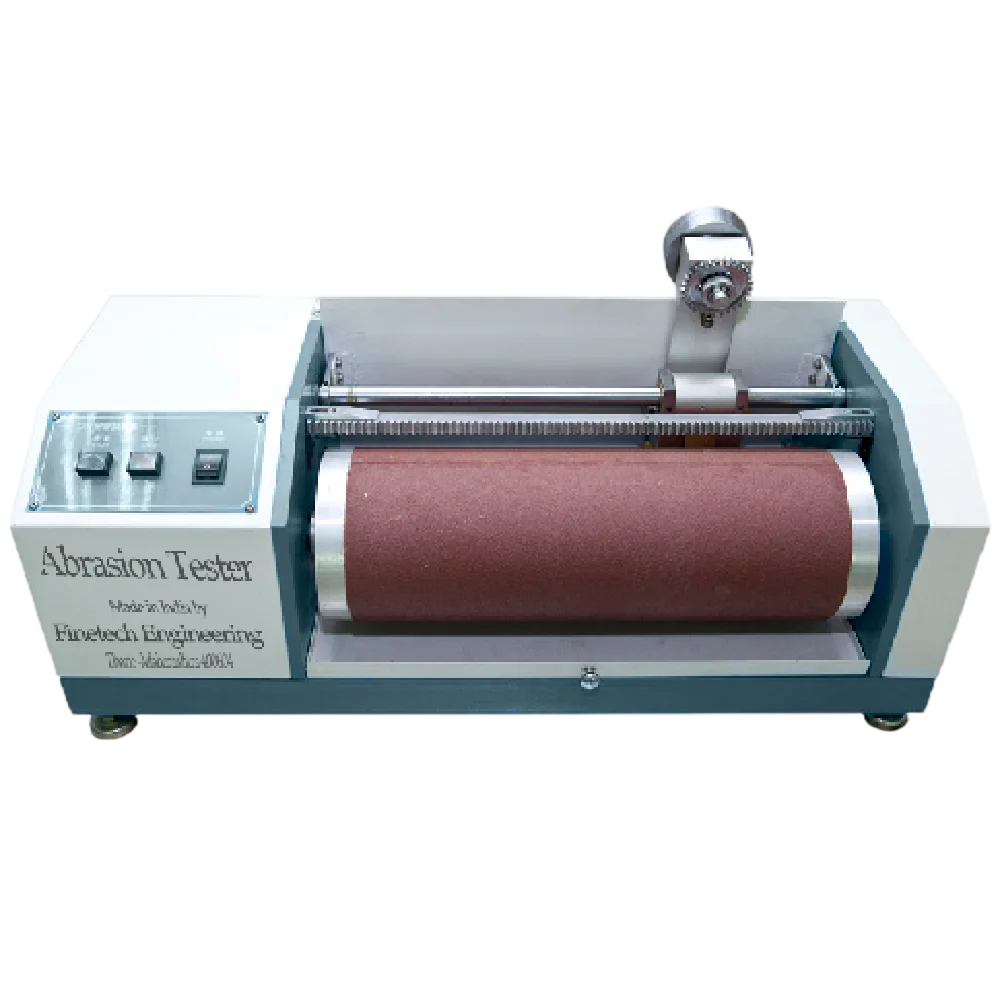
The Finetech Engineering DIN Abrasion Tester is a rotary drum abrader designed to measure the abrasion resistance of vulcanised rubber, thermoplastic elastomers (TPE/TPR), and other elastomeric materials. As a dedicated DIN abrasion tester manufacturer India, we understand that abrasion resistance is one of the most critical properties for rubber products that experience friction and wear in service – tyre treads, conveyor belt covers, shoe soles, seals, gaskets, hose covers, and industrial rollers. As a specialist rubber abrasion tester India manufacturer, Finetech Engineering supplies this equipment for compound development, incoming material inspection, and QC in tyre, footwear, conveyor belt, and general rubber manufacturing. The test principle: a cylindrical rubber specimen (16mm diameter) is pressed against P60 grade abrasive paper on a rotating drum (150mm diameter, 40 rpm). The specimen traverses 40 metres, and mass loss is converted to volume loss. The result – expressed as volume loss in mm3 or as Abrasion Resistance Index (ARI %) – quantifies how well a rubber compound resists wear before it reaches the field. This method, originally defined in DIN 53516, is now harmonised internationally as ISO 4649 abrasion tester manufacturer standard (ISO 4649) and ASTM D5963 – making it the most widely used abrasion test for rubber worldwide. Our DIN 53516 abrasion resistance tester India is trusted by labs testing tyre compounds, footwear soles, conveyor belts, and rubber goods across India.
How the DIN Abrasion Test Works

Step 1: Specimen Preparation

  • Cut a cylindrical specimen: 16 +/-0.2mm diameter, minimum 6mm thick – use a 16mm round specimen cutter with hydraulic/pneumatic press
  • Alternatively, mould cylindrical specimens using a DIN abrasion mould – available from your DIN abrasion tester manufacturer India
  • Condition specimens at 23 deg C +/-2 deg C for at least 16 hours before testing


Step 2: Pre-Abrasion (Conditioning Run)

  • Mount specimen in holder and run a short conditioning pass over fresh abrasive paper
  • Removes moulding skin, ensures flat uniform contact surface
  • Discard conditioning mass loss – not part of the test result


Step 3: Test Run on the DIN Abrasion Tester

  • Apply specified contact load (10N standard per ASTM D5963 and IS 3400; 5N or 10N per ISO 4649)
  • Run specimen over 40 metres of abrasive path (84 drum revolutions at 40 rpm)
  • Specimen traverses laterally 4.2mm per drum revolution – contact with fresh abrasive surface throughout
  • Rotating method (ISO 4649 Method B): specimen also rotates during traversal for more uniform wear
  • Non-rotating method (ISO 4649 Method A / DIN 53516): specimen holder is fixed – the most widely used method in India


Step 4: Calculate Results

  • Weigh specimen before and after – calculate mass loss (mg)
  • Convert mass loss to volume loss: Volume Loss (mm3) = Mass Loss (mg) / Density (g/cm3)
  • Calculate ARI: ARI (%) = (Volume Loss of Reference Rubber / Volume Loss of Test Rubber) x 100
  • Higher ARI = better abrasion resistance
Specifications

Parameter

Specification

Product Name

DIN Abrasion Tester (Rotary Drum Abrader) – DIN Abrasion Tester Manufacturer India, Finetech Engineering

Standards

DIN 53516 Abrasion Resistance Tester India, ISO 4649 Abrasion Tester Manufacturer (Method A & B), ASTM D5963, SATRA TM174, EN ISO 20344, IS 3400 Part 4

Test Method

Rotating and non-rotating specimen holder

Drum Diameter

150mm

Drum Length

460mm

Drum Speed

40 +/-1 rpm

Peripheral Speed

0.32 m/s

Abrasive Paper Grade

P60 (60 grit aluminium oxide)

Abrasion Distance

40m (84 drum revolutions) or 20m (42 revolutions) selectable

Lateral Feed

4.2mm per drum revolution

Contact Load

10N (standard per ASTM D5963); 5N also available per ISO 4649

Specimen Diameter

16 +/-0.2mm

Specimen Thickness

6-15mm (minimum 6mm)

Power Supply

230V AC, single phase, 50 Hz

Certification

ISO 9001:2015 certified manufacturing

Understanding Your Results
Metric Formula What It Means
Volume Loss (mm³) Mass Loss (mg) ÷ Density (g/cm³) The volume of rubber worn away during the test. Lower = better abrasion resistance.
Abrasion Resistance Index (ARI %) (Volume Loss of Reference ÷ Volume Loss of Test) × 100 How the test rubber compares to the standard reference rubber. Higher = better. ARI of 100% means equal to reference; >100% means better than reference.
Relative Volume Loss Volume Loss of Test ÷ Volume Loss of Reference Ratio comparison. Values <1.0 indicate better abrasion resistance than reference.

Typical volume loss values (for reference):

  • Standard reference rubber (IRB #1 or equivalent): 180–220 mg loss under 10 N / 40 m
  • Good tyre tread compound: 80-120mm3 volume loss (ARI 150-250%) – a well-performing rubber abrasion tester India result
  • Footwear sole compound: 100–200 mm³ (application-dependent)
  • Conveyor belt cover: 80–150 mm³
  • Seals and gaskets: varies widely depending on hardness and compound type
Applications
Industries Served
Why Choose the Finetech DIN Abrasion Tester?

Both rotating and non-rotating as standard. Many competitors offer only non-rotating. The Finetech DIN abrasion tester supports both ISO 4649 Method A and Method B out of the box – no optional upgrades needed.

Complete specimen preparation from the same manufacturer. As your full-range abrasion resistance testing equipment manufacturer, we also supply the 16mm round specimen cutter, DIN abrasion mould, and hydraulic press. One supplier for the entire rubber wear testing machine India workflow.

Consumables supply. Standard reference rubber slabs and P60 abrasive paper – available directly from Finetech. No need to source from multiple suppliers for your DIN 53516 abrasion resistance tester India setup.

IS 3400 Part 4 compliance. In addition to DIN, ISO, and ASTM standards, our rubber abrasion tester India meets IS 3400 Part 4 – important for Indian government tenders and BIS-required testing.

Calibration and AMC support. Professional calibration of drum speed, contact load, and lateral feed, plus Annual Maintenance Contracts. As your DIN abrasion tester manufacturer India, we keep your machine audit-ready.

Related Products

Product

Why Related

Round Specimen Cutter (16mm)

Cuts the 16mm cylindrical specimens for the Finetech DIN abrasion tester

DIN Abrasion Mould

For direct moulding of cylindrical abrasion test specimens

Hydraulic Press

For pressing the round cutter through vulcanised rubber sheets – part of the rubber wear testing machine India setup

Compression Set Apparatus

Complementary rubber property testing

Demattia Flex Tester

Complementary flex crack resistance testing

Universal Testing Machine

Complementary tensile and tear testing – complete abrasion resistance testing equipment manufacturer range

Specimen Cutters & Moulds (Full Range)

Browse all Finetech specimen preparation tools


Common Questions

Frequently Asked Questions

A DIN abrasion tester (also called a rotary drum abrader or rubber abrasion tester India) is a laboratory instrument that measures how well a rubber or elastomer material resists abrasive wear. A cylindrical rubber specimen (16mm diameter) is pressed against P60 sandpaper on a rotating drum under a known load. After traversing 40 metres, the specimen is weighed to determine volume lost. Lower volume loss = better abrasion resistance. As a DIN abrasion tester manufacturer India, Finetech Engineering supplies this instrument to tyre, footwear, conveyor belt, and rubber goods testing labs across India.
All three standards describe the same fundamental test. DIN 53516 is the original German standard. ISO 4649 is its international harmonisation - an ISO 4649 abrasion tester manufacturer product adds a rotating specimen method (Method B). ASTM D5963 is the American version, equivalent to DIN 53516 / ISO 4649 Method A. The Finetech DIN 53516 abrasion resistance tester India complies with all three.
In the non-rotating method (Method A / DIN 53516), the specimen holder is fixed and the specimen traverses the drum without rotating. In the rotating method (ISO 4649 Method B), the specimen also rotates during traversal - producing more uniform wear and reduced variability. Most Indian labs use the non-rotating method for their rubber wear testing machine India. The rotating method is increasingly specified by international and export customers.
A rubber abrasion tester India like the Finetech DIN abrasion tester is used to measure how much rubber is worn away under frictional contact - quantifying the abrasion resistance of the compound. This is critical for products that experience wear in service: tyre treads, conveyor belt covers, shoe soles, seals, hose covers, and industrial rollers. The abrasion resistance testing equipment manufacturer result (volume loss in mm3 or ARI %) helps compound developers and QC teams select and verify materials that last longer in the field.
ARI (%) = (Reference Volume Loss / Test Volume Loss) x 100. An ARI above 100% means your compound is more abrasion-resistant than the reference rubber. This is the most meaningful way to report DIN abrasion tester results because it eliminates variability from abrasive paper batch differences.
A cylindrical specimen, 16mm +/-0.2mm diameter, minimum 6mm thick. Specimens are die-cut from vulcanised rubber sheets using a 16mm round cutter and press, or directly moulded using a DIN abrasion mould. Finetech - your DIN abrasion tester manufacturer India - manufactures both the round cutter and the mould.
A rubber wear testing machine India is another name for a DIN abrasion tester or rubber abrasion tester India. The terms are used interchangeably across industries. As an abrasion resistance testing equipment manufacturer, Finetech Engineering supplies this instrument under all these names - the machine, its test principle, and its results are the same: measuring the volume of rubber worn away under standardised abrasive contact per DIN 53516, ISO 4649, and ASTM D5963.
Yes. Finetech supplies P60 grade abrasive paper rolls sized for the 150mm x 460mm drum, and standard reference rubber compound slabs with certified volume loss values. These are the two consumables needed for every DIN abrasion tester test. Contact us for pricing.
The DIN abrasion tester is designed primarily for vulcanised rubber and thermoplastic elastomers. As a specialist rubber abrasion tester India manufacturer, Finetech Engineering also confirms it can be used for PU elastomers, rubber-bonded cork, and soft PVC. It is not suitable for rigid plastics or metals.