






Finetech Engineering

Grips & Fixtures

Grips and fixtures for Universal Testing Machines. Roller grips for rubber & elastomers, wedge grips for rigid plastics & metals, pneumatic grips for high-throughput labs. Compression, flexural & peel fixtures. ASTM D412, D638, D882. Manufacturer in Thane, India.

Overview

Grips and fixtures are the critical link between your Universal Testing Machine and the specimen. The wrong grip choice causes slippage, premature jaw-break failures, misaligned loads, and unreliable test data. The right grip transfers load cleanly into the specimen, keeps it centred, and ensures that failure happens in the gauge section — not at the jaws.

Finetech Engineering manufactures a complete range of grips and fixtures designed for the materials and standards most commonly tested in Indian QC and R&D labs: rubber (ASTM D412, ISO 37), plastics (ASTM D638, D882, ISO 527), paper (TAPPI T494, ISO 1924), textile, leather, and composites. From self-tightening roller grips for high-elongation rubber to wedge grips for rigid engineering plastics, our grips are built to match the material, not force the material to match the grip.

Every Finetech grip is designed for use with our Universal Testing Machines but is also compatible with most standard UTMs from other manufacturers. Interchangeable jaw faces allow you to switch between materials in seconds, and our grips are supplied with the mounting hardware to fit your machine.

Grip Types — Which Grip Do You Need?
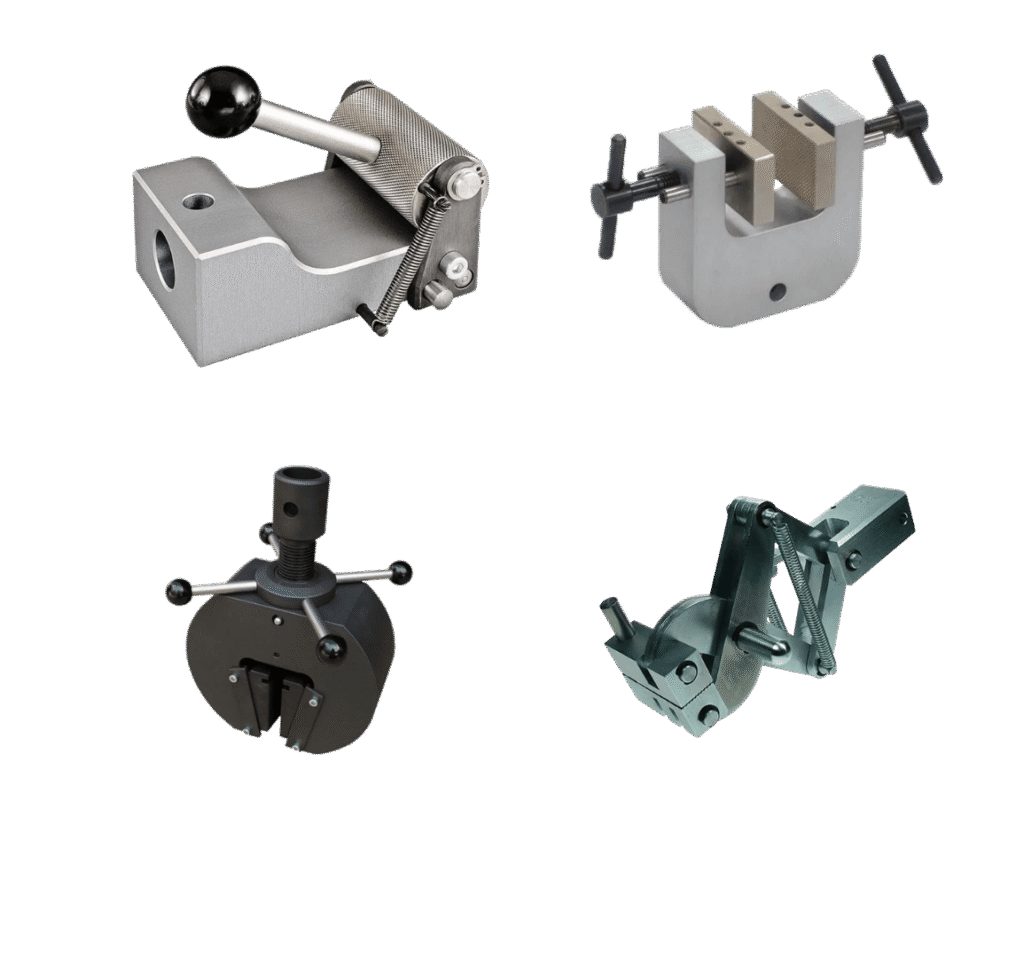
Roller grips — also called eccentric roller grips or self-tightening grips — are the standard choice for rubber, elastomers, and high-elongation materials. The specimen passes between a flat jaw face and an eccentric roller. As the UTM applies tensile load, the roller rotates and tightens automatically, increasing grip force in proportion to the applied load. This self-tightening action prevents slippage without crushing the specimen.

Best for:

  • Vulcanised rubber (NR, SBR, NBR, EPDM, CR, silicone) — dumbbell and strip specimens
  • Thermoplastic elastomers (TPU, TPE)
  • Soft and flexible plastics (LDPE, LLDPE films, stretch films)
  • Foam, leather, and textile (low to medium force)
  • Any material with high elongation at break (>100%)


Standards:

  • ASTM D412 / ISO 37 — tensile testing of vulcanised rubber
  • ASTM D882 — tensile testing of thin plastic films
  • ASTM D624 / ISO 34-1 — tear testing of rubber
  • ASTM D3574 — tensile testing of flexible foams
2. Wedge Grips (Self-Tightening / Mechanical Wedge)
Wedge grips use angled jaw surfaces that slide inward as tensile load increases, progressively tightening on the specimen. This self-tightening action is powerful enough to hold rigid plastics, metals, and composites without pre-loading to extreme clamping forces. The specimen is inserted between the wedge faces, and as the test begins, the grip locks tighter with every increment of load.

Best for:

  • Rigid plastics (PP, PE-HD, PVC rigid, ABS, nylon, polycarbonate, POM, PEEK)
  • Metals and metal alloys (when tested on higher-capacity UTMs)
  • Fibre-reinforced composites and laminates
  • Any material with low elongation and high tensile strength


Standards:

  • ASTM D638 / ISO 527 — tensile testing of rigid plastics
  • ASTM D695 / ISO 604 — compression testing (with compression fixtures)
  • ASTM D790 / ISO 178 — flexural testing (with flexural fixtures)
3. Pneumatic Grips (Air-Actuated)
Pneumatic grips use compressed air to clamp the specimen with a controlled, repeatable force. The operator inserts the specimen, presses a switch (hand switch or foot pedal), and the air-actuated jaws close with a preset clamping pressure. Every specimen is gripped at exactly the same force, eliminating operator-to-operator variation.

Best for:

  • High-throughput QC labs that run 50+ tests per day — pneumatic grips save time on every test
  • Labs where multiple operators run the same UTM — removes clamping force variability
  • Thin films, foils, and flexible materials where consistent low clamping force prevents crushing
  • Any material where grip force consistency is more important than ultimate holding power


Air supply:

  • Requires compressed air at 4–6 bar (60–85 psi)
  • Can be supplied with hand switches or foot pedal activation
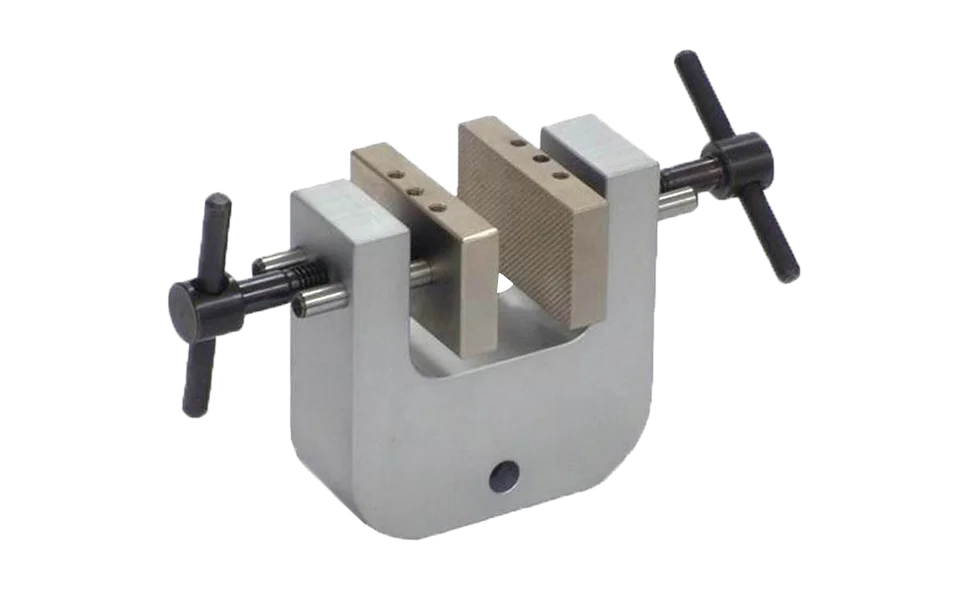
4. Manual Vise Grips (Screw-Tightened)

Manual vise grips are the simplest and most affordable grip type. The operator inserts the specimen between the jaw faces and tightens a screw or lever to clamp. Clamping force depends on how tightly the operator turns the screw.

Best for:

  • Low-volume labs with occasional testing
  • Educational and teaching labs
  • Budget-conscious setups where roller or wedge grips are not yet justified
  • Quick checks and in-process testing where ultimate accuracy is not critical
5. Compression Platens

Flat circular or square platens for compression testing. The specimen is placed between two parallel platens, and the UTM drives them together. Used for compression strength, compressive modulus, and crush testing.

Standards:

  • ASTM D695 / ISO 604 — compression of rigid plastics
  • ASTM D575 — compression of rubber
  • IS 3400 Part 2 — compression of vulcanised rubber
6. Flexural (Bend Test) Fixtures
Three-point and four-point bending fixtures for flexural strength and flexural modulus testing. The fixture consists of two lower support spans and one (3-point) or two (4-point) upper loading noses. Span length is adjustable.

Standards:

  • ASTM D790 / ISO 178 — flexural testing of plastics
  • ASTM D747 — stiffness of plastics by cantilever beam
7. Peel Test Fixtures
Fixtures for 90° and 180° peel testing of adhesives, laminates, tapes, and coated materials. One end of the specimen is gripped; the other is peeled at a controlled angle.

Standards:

  • ASTM D903 — peel strength of adhesive bonds
  • ASTM D1876 — T-peel test for adhesives
  • IS 4201 — peel test for rubber-to-metal bonds
Which Grip Do I Need? — Selection Guide by Material & Test
I’m Testing… Specimen Type Recommended Grip Why
Vulcanised rubber — tensile Dumbbell (ASTM D412 Die C) Roller Grips Self-tightening handles high elongation (300–800%) without slipping
Vulcanised rubber — tear Angle/trouser/crescent tear piece Roller Grips Same self-tightening advantage for tear specimens
Rigid plastic — tensile Dumbbell (ASTM D638 Type I) Wedge Grips High clamping force for low-elongation, high-strength materials
Plastic film — tensile Rectangular strip (ASTM D882) Roller Grips or Pneumatic Grips Roller for standard volume; pneumatic for high throughput or thin films
Paper / paperboard — tensile 15 mm strip (ISO 1924) Pneumatic Grips or Roller Grips Consistent low clamping force prevents crushing paper
Rubber-to-metal bond — peel Bonded test piece Peel Fixture + Roller Grip Peel fixture holds the bonded assembly; grip holds the rubber tab
Rigid plastic — compression Cylinder or block Compression Platens Flat parallel platens for uniform compression loading
Rigid plastic — flexural Rectangular bar Flexural (3-Point Bend) Fixture Adjustable span supports per ASTM D790
Textile / fabric — tensile Strip or grab specimen Pneumatic Grips Consistent clamping on soft, flexible, easily-crushed materials
Foam / sponge rubber Strip specimen Roller Grips Gentle self-tightening without crushing open-cell materials
Adhesive tape — peel Tape on substrate Peel Fixture (90° or 180°) Controlled peel angle per ASTM D903
Jaw Face Options
All Finetech grips accept interchangeable jaw faces. The right jaw face prevents slippage without damaging the specimen.
Jaw Face Type Surface Best For
Smooth (Flat) Polished steel Soft materials where serrations would cut or mark the specimen — thin films, foils, soft rubber
Rubber-Coated Steel face with bonded rubber layer Thin plastic films, paper, tissue — gentle grip without crushing
Serrated (Fine) Fine cross-hatch pattern General purpose — rigid plastics, medium-hardness rubber, textiles
Serrated (Coarse / Diamond-Knurled) Aggressive diamond pattern High-strength or slippery materials — hard plastics, composites, metals
Vee-Insert V-groove channel Round specimens — wires, rods, tubes, O-rings
General Specifications
Parameter Details
Grip Types Available Roller (self-tightening), Wedge (self-tightening), Pneumatic (air-actuated), Manual Vise (screw), Compression Platens, Flexural Fixtures, Peel Fixtures
Force Range 0.5 kN to 100 kN (grip-type and model dependent)
Jaw Face Options Smooth, rubber-coated, fine serrated, coarse serrated, diamond-knurled, Vee-insert
Jaw Face Width 25 mm, 50 mm, or as required
Specimen Thickness Range 0.1 mm (films) to 25 mm+ (depending on grip jaw opening)
Mounting Standard pin or bolt mounting — compatible with Finetech UTMs and most other manufacturers
Pneumatic Air Supply (if applicable) 4–6 bar (60–85 psi)
Construction Hardened steel jaws, alloy steel body, corrosion-resistant finish
Certification ISO 9001:2015 certified manufacturing
Applications
Industries Served
Why Choose Finetech Engineering Grips?

Matched to the machine. We manufacture both the UTM and the grips. That means guaranteed compatibility, correct load path alignment, and no third-party adaptor issues.

Matched to Indian testing needs. Our grip range is designed around the materials and standards most tested in Indian labs — rubber per ASTM D412 and IS 3400, plastics per ASTM D638 and IS 527, paper per ISO 1924. We know what works because we supply the complete testing workflow.

Interchangeable jaw faces. Switch between smooth, rubber-coated, serrated, and Vee-insert faces in seconds. One grip body, multiple material capabilities.

Free application support. Not sure which grip to choose? Tell us your material, standard, and specimen shape. We will recommend the right grip, jaw face, and mounting — no charge, no obligation.

Part of a complete testing solution. UTM + grips + specimen cutters + moulds + presses + calibration + AMC — all from one manufacturer. One purchase order, one service provider.

Related Products
Product Why Related
Universal Testing Machine (UTM) The machine these grips are designed for
Dumbbell Specimen Cutter Cuts the specimens the grips hold during tensile tests
Tear Specimen Cutter Cuts tear specimens for ASTM D624 tear testing
Rectangular Strip Cutter Cuts film and strip specimens for ASTM D882 / ISO 1924
Hydraulic Press For cutting specimens and moulding test sheets
Pneumatic Press For high-volume specimen cutting before testing
Specimen Cutters & Moulds (Full Range) Complete range of cutting dies and moulds
Common Questions

Frequently Asked Questions

We manufacture roller grips (self-tightening, for rubber and elastomers), wedge grips (self-tightening, for rigid plastics and metals), pneumatic grips (air-actuated, for high-throughput labs), manual vise grips (screw-tightened, entry-level), compression platens, flexural (3-point and 4-point bend) fixtures, and peel test fixtures. Each type is available in multiple force ratings.
Roller grips (also called eccentric roller grips or self-tightening grips). Rubber specimens elongate significantly during tensile testing — often 300–800%. Standard clamped grips would either slip or crush the rubber. Roller grips self-tighten proportionally as the load increases, maintaining grip without damage. This is the industry-standard grip type for ASTM D412 and ISO 37 rubber tensile testing.
For rigid plastics (ASTM D638), use wedge grips with serrated jaw faces. The wedge mechanism self-tightens as load increases, which is essential for high-strength, low-elongation materials. For thin plastic films (ASTM D882), use roller grips with smooth or rubber-coated jaw faces, or pneumatic grips for high-volume labs.
This is usually a jaw face problem. If serrated jaws are cutting into the specimen at the grip edge, switch to smooth or rubber-coated jaw faces. If the clamping force is too high, reduce it (use pneumatic grips with adjustable pressure, or switch from wedge to roller). If the grip is misaligned, the load is not axial — check alignment. Contact us with details and we will troubleshoot your specific setup.
Yes. Finetech grips are designed for our UTMs but are compatible with most standard universal testing machines from other manufacturers. We supply mounting adaptors as needed. When ordering, specify your UTM make, model, and the crosshead mounting configuration (pin diameter, bolt pattern, or thread size) and we will ensure a proper fit.
Pneumatic grips are an investment that is justified when: (1) your lab runs 50+ tests per day and speed matters, (2) multiple operators use the same UTM and you want consistent clamping force regardless of who operates it, or (3) you test thin, delicate materials (films, paper, tissue) where precise and gentle clamping force prevents crushing. For most labs starting out, roller or wedge grips are sufficient.
Smooth faces for soft materials that serrations would damage (thin films, soft rubber, foam). Rubber-coated faces for paper, tissue, and ultra-thin films. Fine serrated faces for general-purpose use with most plastics and medium-hardness rubber. Coarse serrated or diamond-knurled faces for high-strength, slippery materials (hard plastics, composites, metals). Vee-insert faces for round specimens (wire, rod, tubing). We supply the most appropriate jaw faces with each grip order.
Both. We supply grips as standalone accessories (for labs that already have a UTM and need replacement or additional grips) and as part of a complete UTM package. Grips can also be ordered separately at any time after the UTM purchase.