







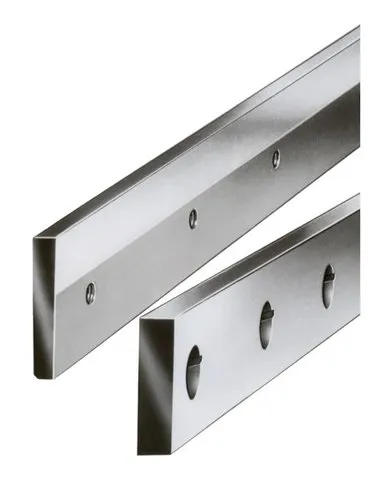
A shear knife does one thing: it cuts metal. As a trusted shear knives manufacturer India and sheet metal shearing blades manufacturer India, Finetech knows that a hydraulic shear drives an upper blade against a fixed lower blade with enormous force – 20 tonnes, 50 tonnes, 200 tonnes – and the metal plate between them is sheared in a single clean stroke. The quality of that cut depends almost entirely on the quality of the shear knife: its steel grade, hardness, edge geometry, and straightness.
On “what steel grade for shear knife stainless mild steel”: the wrong steel chips after 500 cuts on stainless. As a certified D2 shear blades manufacturer India and H13/Cr12MoV specialist, Finetech recommends D2 for general fabrication, H13 for heavy-duty thick plate, Cr12MoV for mixed-metal service centres – delivering 5,000–50,000 cuts before rotation or re-sharpening.
Finetech is a leading guillotine shear blades manufacturer India and hydraulic shear machine blades India supplier. We manufacture 2-edge blades (for swing beam shears where the blade arcs through the cut) and 4-edge blades (for guillotine shears where the blade moves straight down – rotate 4 times before re-sharpening). Steel grades: D2, H13, Cr12MoV, 6CrW2Si, and SKD-11 – selected for your metal type, plate thickness, and cutting volume.
Tip: Understanding the “what is 2-edge vs 4-edge shear knife difference”: a 4-edge guillotine shear knife gives you 4 cutting edges per blade. When one edge dulls, unbolt, rotate 90°, retighten – fresh edge immediately. Four edges = four times the service life before re-sharpening.
Feature | 2-Edge (Swing Beam Shear) | 4-Edge (Guillotine Shear) |
Cutting Edges | 2 (flat side cutting edges) | 4 (all four long edges are ground) |
Machine Type | Swing beam / pendulum shear | Hydraulic guillotine shear |
Blade Motion | Arc (the blade swings through the cut) | Straight vertical drop |
Edge Rotation | Flip once (2 edges) | Rotate 4 times (4 edges) |
Service Life per Blade | 2× re-sharpen interval | 4× re-sharpen interval |
Typical Thickness | 6–30 mm | 6–50 mm |
Best For | Lighter gauge cutting, lower force | Heavy gauge, thick plate, high volume |
Steel Grade | Hardness | What It Cuts Best | Strengths | Weaknesses |
D2 (Cr12Mo1V1 / SKD-11) | HRC 58–62 | Mild steel, aluminium, copper, galvanised sheet, thin stainless | Excellent wear resistance, long edge life, good all-rounder | Less impact-tough than H13; can chip on very thick plate |
H13 | HRC 48–54 | Thick plate (>10 mm), stainless steel, high-strength steel, hot shearing | Exceptional toughness and impact resistance; heat-resistant | Lower wear resistance than D2; shorter edge life on thin sheet |
Cr12MoV | HRC 58–62 | Mixed metals — fabrication shops cutting steel, stainless, and aluminium on the same machine | Good balance of wear and toughness; versatile | Not as specialised as D2 (wear) or H13 (toughness) |
6CrW2Si | HRC 56–60 | Hot shearing, medium-strength steel, galvanised sheet | Contains tungsten — heat-resistant; good for hot-strip lines | Not suitable for stainless or high-strength alloys |
9CrSi | HRC 57–59 | Thin cold-rolled sheet, aluminium, copper, leather, plastic | Budget-friendly; adequate for light-gauge work | Wears quickly on stainless and thick plate |
The simple guide to “what steel grade for shear knife stainless mild steel”: D2 if you mostly cut mild steel and aluminium under 10 mm. H13 if you cut thick plate or stainless above 10 mm. Cr12MoV if your shop cuts a mix of everything. Tell us your metal types and thicknesses and we will recommend the best grade.
Parameter | Specification |
Product Name | Shear Knives (Sheet Metal Shearing Blades) |
Blade Types | 2-edge (swing beam), 4-edge (guillotine), rotary shear blades |
Maximum Blade Length | 4,000 mm+ (single piece) |
Cross-Section Sizes | Various — matched to machine bed (common: 60×20 mm, 75×25 mm, 100×30 mm, etc.) |
Steel Grades | D2, H13, Cr12MoV, 6CrW2Si, 9CrSi, SKD-11 |
Heat Treatment | In-house hardening, tempering, and stress-relieving; HRC 48–62 depending on grade |
Edge Grinding | CNC surface ground on all cutting edges; straightness ±0.03 mm/m |
Mounting Holes | Drilled and counterbored to machine specification |
Surface Finish | Fine ground on all faces; mirror polish on cutting edges available |
Tolerances | Length ±0.05 mm; cross-section ±0.02 mm; straightness ±0.03 mm/m |
Compatible Machines | Amada, LVD, Accurpress, Durma, Boschert, Baykal, Indian OEM machines |
Certification | ISO 9001:2015 |
Note: On shear knife clearance setting sheet metal cutting: the gap between upper and lower blade is critical for cut quality. Typical clearance is 5–10% of material thickness. Too little clearance = excessive force and blade damage. Too much = burr-heavy cuts and poor edge quality. Finetech can advise on optimal clearance settings for your material.
For Amada LVD Accurpress shear blade replacement India or any brand – tell us: (1) your shearing machine brand and model, (2) blade dimensions (length × width × thickness), (3) 2-edge or 4-edge, (4) metals and thicknesses you cut. We will recommend the right steel grade and quote within 24 hours.
WhatsApp: +91 93241 37971 | Email: info@finetechengineer.com | Contact Us
Material matched to your metal – trusted D2 shear blades manufacturer India and H13/Cr12MoV specialist. D2, H13, or Cr12MoV – selected based on what you cut and how thick. We do not sell one grade for all jobs.
4-edge blades for maximum service life. Rotate 4 times before re-sharpening. Each edge delivers thousands of clean cuts. 4× the life per blade.
Compatible with major machine brands. Amada, LVD, Accurpress, Durma, Baykal, and all Indian OEM shears. Send us the machine model and we will match the blade dimensions.
CNC ground for straightness. Blades up to 4,000 mm+ ground to ±0.03 mm/m straightness. A straight blade = a straight cut across the full sheet width.
Re-sharpening service. Send worn blades to our Thane facility. We re-grind all cutting edges to original spec. Turnaround: 5–7 working days.
Manufacturer, not trader – best shear knives price India replacement direct from our Thane facility. Blades forged, heat-treated, ground, and inspected at our Thane facility. Direct factory pricing, quality accountability, and fast replacement.
Product | Why Related |
Paper guillotine blades for paper cutting applications | |
Other straight-edge cutting tools | |
Rotary slitting blades for coil and sheet slitting | |
Full range of knives and blades for metal processing | |
Full range by geometry | |
Find blades matched to your specific industry |








Customisation available
Answering “what is 2-edge vs 4-edge shear knife difference”: a 2-edge blade has two cutting edges (used in swing beam shears where the blade swings through the cut). A 4-edge blade has all four long edges ground as cutting edges (used in guillotine shears where the blade drops vertically). The 4-edge blade gives 4× the service life per blade.
For stainless steel up to 6 mm, D2 (HRC 60–62) works well. For stainless above 6 mm or high-strength stainless (304, 316), use H13 for its superior toughness and impact resistance. Stainless steel work-hardens during shearing – H13 resists the chipping that this causes in harder but more brittle steels like D2.
Yes. Tell us the machine brand (Amada, LVD, Accurpress, Durma, or any Indian OEM) and model number. We will match the blade dimensions (length, width, thickness, hole pattern) to your machine’s specification. Alternatively, send a worn blade as a sample and we will reverse-engineer a replacement.
This depends on the blade material, the metal being cut, and the plate thickness. D2 on mild steel 3 mm: 10,000–50,000 cuts per edge. D2 on stainless steel 6 mm: 2,000–10,000 cuts per edge. H13 on thick plate 12 mm+: 5,000–20,000 cuts per edge. A 4-edge blade gives you 4× these numbers before re-sharpening.
Yes. Send worn blades to our Thane facility. We CNC re-grind all cutting edges to original spec and return. Turnaround: 5–7 working days. Most shear knives can be re-sharpened 3–5 times before replacement.
The correct shear knife clearance setting sheet metal cutting: typical clearance is 5–10% of material thickness. For example, 3 mm mild steel needs 0.15–0.30 mm clearance. Too little overloads the blade; too much creates excessive burr. Contact us for specific clearance recommendations for your material type and thickness.