






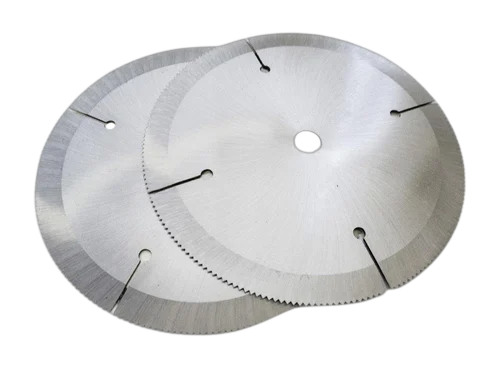
Understanding “what is circular blade used for industrial”: the circular blade is the most widely used industrial cutting tool in the world. As your trusted circular blades manufacturer India, Finetech manufactures blades that rotate continuously, matching the speed of modern production lines – film extrusion at 200 m/min, paper converting at 500 m/min, metal coil slitting at 100 m/min. No other blade shape matches their throughput and re-sharpening economy.
Answering “what is difference between shear cut and crush cut slitting”: a circular blade cuts by one of three methods. As your trusted shear slitting blades manufacturer India, Finetech explains: shear cut has two opposing blades overlap like scissors for a clean cut on both sides; crush cut has the blade press material against a hardened anvil roller; score cut partially penetrates the material against a soft roller, creating a weakened line that separates under tension.
As a leading circular slitter blades manufacturer India and round cutting blades manufacturer India, Finetech manufactures from 20 mm to 1,000 mm outer diameter in D2 tool steel, HSS (M2), stainless steel (SS 420/440C for food), and solid or tipped tungsten carbide. Every blade is CNC-turned and ground to ±0.005 mm on thickness and ±0.002 mm on flatness – because 0.01 mm out of flat means vibration, wavy cuts, and uneven wear.
| Slitting Method | How It Works | Cut Quality | Best For | Edge Type |
| Shear cut | Upper and lower blades overlap slightly; material is scissored between them | Excellent – clean, burr-free edges on both sides | Paper, film, foil, metal coil, textile – quality-critical applications | Smooth, ground bevel |
| Crush cut | Single blade presses material against hardened anvil roller | Good top side; rougher bottom side | Film, non-woven, tissue, corrugated – non-critical edge quality | Smooth, sharp circumferential edge |
| Score cut | Blade partially penetrates material against soft (rubber) roller; material separates under web tension | Variable – depends on material and score depth | Film, laminate, and labelling – where full cut is not desired | Smooth, very sharp edge |
OD Range | Typical ID | Applications | Industries |
20–50 mm | 8–20 mm | Razor slitting of thin films, label slitting, edge trim | Packaging, labels, flexible film |
50–150 mm | 20–50 mm | Standard slitting of paper, film, foil, textile | Packaging, paper, textile, converting |
150–300 mm | 50–100 mm | Heavy-duty slitting of thick film, corrugated, rubber sheet | Corrugated, rubber, heavy packaging |
300–600 mm | 100–200 mm | Metal coil slitting, large-format paper slitting | Steel service centres, paper mills |
600–1,000 mm | 200–400 mm | Heavy metal coil slitting, wide-web converting, food processing | Metalworking, large-scale converting, food |
| Material | Hardness | Edge Life | Best For | Re-Sharpenable? |
| D2 tool steel | HRC 58–62 | Long | Paper, packaging film, textile, rubber, corrugated – the industry workhorse | Yes (5–10 cycles) |
| HSS (M2) | HRC 62–65 | Very long | High-speed slitting, synthetic fibres, abrasive materials, BOPP | Yes (5–10 cycles) |
| Stainless steel (SS 420/440C) | HRC 52–58 | Moderate | Food processing – meat, cheese, bakery, vegetable | Yes (3–5 cycles) |
| Tungsten carbide (solid) | HRC 85–92 | Extremely long | Highly abrasive materials (coated paper, fibre cement, metallised film, metal coil) | Limited (specialist grinding required) |
| Tungsten-carbide-tipped | HRC 85–92 (tip) | Very long | Paper and film where carbide edge is needed but solid carbide cost is too high | Yes (tip re-grind) |
Parameter | Specification |
Product Name | Circular Blades (Rotary Slitter Knives / Round Cutting Blades) |
OD Range | 20 mm to 1,000 mm |
ID (Bore) | To machine specification (standard and custom) |
Thickness Range | 0.1 mm (razor slitters) to 30 mm (heavy rotary knives) |
Thickness Tolerance | ±0.005 mm |
Flatness Tolerance | ±0.002 mm |
Edge Types | Smooth bevel, toothed, serrated, micro-serrated, perforated, scalloped |
Bevel Profiles | Single bevel, double bevel, dish (concave), flat, custom angles |
Steel Grades | D2, M2 (HSS), O1, SAE 52100, SS 420/440C, tungsten carbide (solid and tipped) |
Heat Treatment | In-house vacuum/atmosphere hardening; HRC 52–92 depending on grade |
Surface Treatments | Mirror polish, chrome, TiN, DLC coating, anti-stick coating |
Keyways / Drives | Keyway, pin drive, hex bore, splined bore – to machine specification |
Custom Capability | Any OD, ID, thickness, edge profile, and material to drawing or sample |
Certification | ISO 9001:2015 |
20 mm to 1,000 mm in one facility – trusted metal coil slitting blades manufacturer India and full-range circular blade partner. From miniature razor slitters for label converting to large-format rotary knives for steel coil slitting – one manufacturer covers your entire circular blade range.
Flatness to ±0.002 mm. A flat blade runs true on the arbor. An out-of-flat blade vibrates, produces wavy edges, and wears unevenly. Our CNC grinding achieves the flatness that high-speed converting lines demand.
Matched shear-cut pairs. For shear slitting, the upper and lower blades must be ground as a matched pair with precise OD, ID, and bevel geometry. Finetech grinds and supplies matched pairs ready for installation.
Re-sharpening service. Send worn circular blades back. We re-grind the cutting edge and verify flatness. A quality D2 blade survives 5–10 re-sharpening cycles – dramatically reducing your cost per cut.
Manufacturer, not trader – best circular blades price India slitter direct from our Thane facility. CNC-turned, ground, and heat-treated at our Thane facility. Faster delivery, competitive pricing, and real technical support for blade selection.
Product | Link |
For guillotine and straight-cut applications | |
For bread, foam, and fibrous materials | |
For controlled tear-off lines | |
For food and FMCG packaging cutting applications | |
For specialised paper cutting requirements | |
Full range by geometry |







All Equipments & specimen preparation products can be customised as per requirements.
Answering “what is circular blade used for industrial”: a circular blade (rotary slitter knife) is a disc-shaped cutting tool that rotates continuously to slit, cut, trim, score, or perforate materials including film, paper, foil, textile, metal coil, rubber, and corrugated board. It is the highest-throughput industrial cutting tool, matching the speeds of modern production lines.
Answering “what is difference between shear cut and crush cut slitting”: shear cut uses two opposing blades (upper and lower) that overlap like scissors, producing a clean edge on both sides. Crush cut uses a single blade pressing material against a hardened anvil, producing one clean edge and one rougher edge. Shear is preferred for quality-critical applications; crush is simpler for non-critical trimming.
Provide: outer diameter (OD), inner diameter (ID/bore), thickness, edge type (smooth, toothed, serrated), bevel profile (single, double, dish), material being cut, and slitting method (shear, crush, score). If you have a worn blade, sending it as a sample is the easiest way to get an exact replacement.
A D2 or HSS circular blade can typically be re-sharpened 5–10 times before the OD reduces below the usable minimum for your machine. Each re-sharpening costs a fraction of a new blade, making the total cost per cut very competitive over the blade’s full life.
Tungsten carbide lasts longest (5–20× D2) but costs the most. D2 tool steel is the best value for 70–80% of applications. HSS (M2) sits between D2 and carbide – better edge life than D2, lower cost than carbide.
Yes. For shear slitting, we grind and supply matched upper/lower blade pairs with controlled overlap geometry. The pair is matched for OD, ID, thickness, and bevel angle to ensure clean shear cuts.