







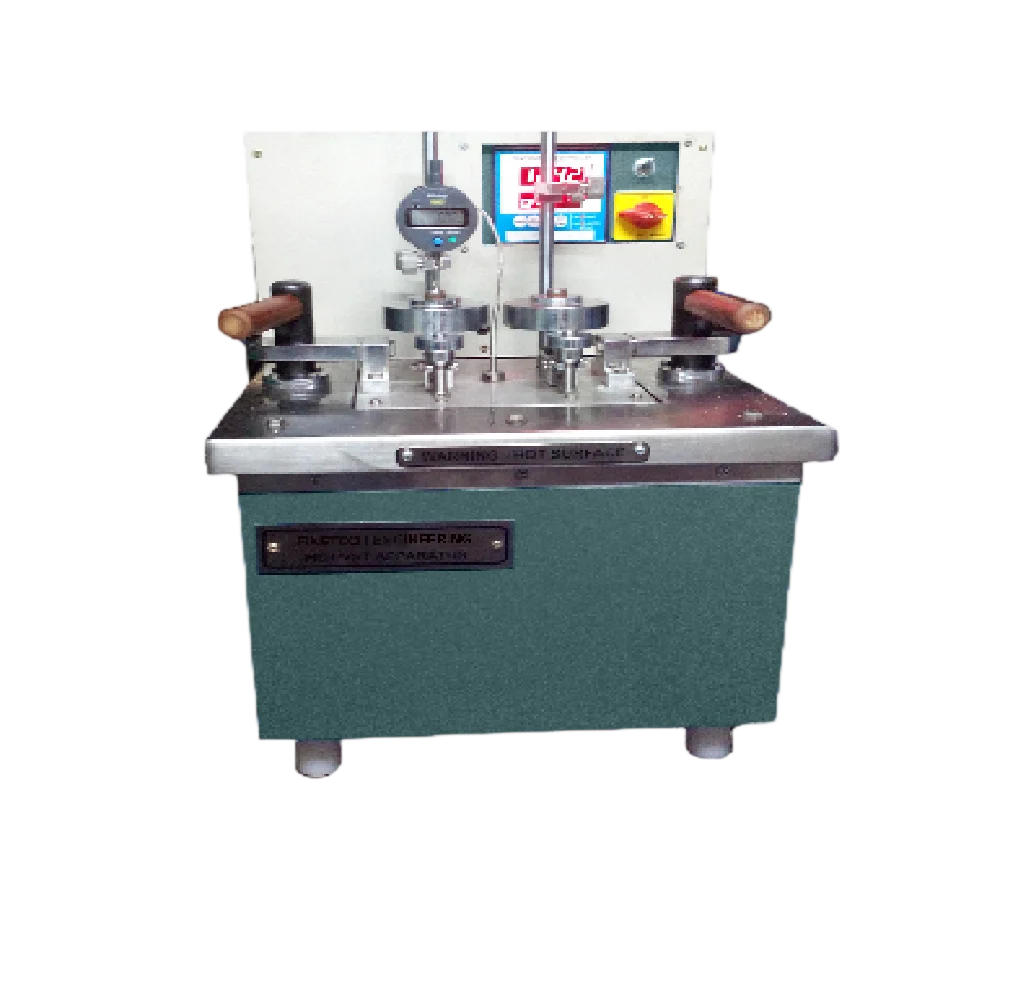
Understanding “what is heat deflection temperature plastic” and “what is Vicat softening point plastic”: the Finetech Engineering HDT / VSP Apparatus is a dual-function thermal testing machine measuring both of these critical thermal properties. These two values tell you the maximum temperature at which a plastic part can operate under load without deforming. Every plastic material datasheet includes HDT and VSP values, and every product design engineer uses them to determine whether a material is suitable for a given operating temperature.
The heat deflection temperature tester India works as follows. Here is the HDT vs Vicat softening point difference plastic: HDT measures the temperature at which a plastic bar deflects by a specified amount (0.25 mm per ASTM D648, or 0.34 mm per ISO 75) under a constant flexural stress; VSP measures the temperature at which a flat-ended needle penetrates 1 mm into a plastic specimen under a constant load. Both use the same rising-temperature oil bath ramped at 50°C/h or 120°C/h.
The Finetech HDT VSP apparatus manufacturer India combines both test types in a single oil bath with multiple stations – the most versatile thermal resistance testing equipment plastic India available. A typical configuration has 2 HDT stations and 2 VSP stations, allowing you to run 4 tests simultaneously.
Tip: HDT and VSP are among the first thermal properties checked when evaluating a new plastic material. The Finetech ASTM D648 HDT tester India and ASTM D1525 Vicat softening point tester India form the thermal core of any plastic testing lab. Along with MFI (flowability) and impact strength, they form the trio that material selectors use to qualify plastics for temperature-sensitive applications.
Feature | HDT (Heat Deflection Temperature) | VSP (Vicat Softening Point) |
What It Measures | Temperature at which plastic deflects under flexural load | Temperature at which a needle penetrates 1 mm under load |
Test Method | 3-point bending of a bar specimen in oil bath | Flat-ended needle pressed into flat specimen in oil bath |
Physical Meaning | Stiffness retention under load at temperature | Softening/beginning of flow under point load |
ASTM Standard | ASTM D648 | ASTM D1525 |
ISO Standard | ISO 75-1, ISO 75-2, ISO 75-3 | ISO 306 |
Specimen – ASTM | 127 × 13 × 3.2 mm (edgewise) | Flat, 3–6.5 mm thick, ≥10 mm square |
Specimen – ISO | 80 × 10 × 4 mm (flatwise) | Flat, ≥4 mm thick, ≥10 mm square |
Applied Load (ASTM) | 0.455 MPa (Method A) or 1.82 MPa (Method B) | 10 N or 50 N |
Heating Rate | 120°C/h | 50°C/h or 120°C/h |
End Point | Deflection = 0.25 mm (ASTM) or 0.34 mm (ISO) | Penetration = 1 mm |
Typical Values – PP | ~55–70°C (Method A) | ~85–155°C |
Typical Values – ABS | ~90–110°C (Method A) | ~95–115°C |
Typical Values – Nylon 6 | ~55–80°C (unfilled), ~200°C+ (33% GF) | ~200–220°C |
Key insight: HDT is load-dependent (different loads give different HDT values – always report the load used). VSP is less sensitive to specimen geometry and is a more direct measure of when the material begins to soften. Both are needed for a complete thermal characterisation.
Note: ASTM D648 positions the specimen edgewise (13 mm dimension vertical). ISO 75 positions it flatwise (10 mm width horizontal). This orientation difference means ASTM and ISO HDT values for the same material are NOT directly comparable without a correlation study.
Parameter | Specification |
Product Name | HDT / VSP Apparatus (Heat Deflection Temperature & Vicat Softening Point Tester) |
Tests Supported | HDT (Heat Deflection Temperature) + VSP (Vicat Softening Point) |
Station Configuration | 2 HDT + 2 VSP (standard); 3+3, 4+0, 0+4 available on request |
Heating Medium | Silicone oil (high flash point) |
Oil Bath Capacity | Approximately 15 litres |
Temperature Range | Ambient to 300°C |
Temperature Control | PID controller with digital display and RAMP/RATE RISE system |
Heating Rates | 50°C/h and 120°C/h (both per ASTM and ISO requirements) |
Heating Power | 1.5 kW |
Stirrer | Vertical base-mounted motorised stirrer with speed regulator for uniform temperature |
Oil Chamber Construction | Inside: SS; outside: MS body |
Deflection/Penetration Measurement | Mitutoyo/Baker make JO2 model dial gauge |
HDT Applied Loads | Standard: 1 kg weight (other loads available optionally per standard requirements) |
VSP Applied Forces | 10 N and 50 N |
HDT Specimen (ASTM) | 127 × 13 × 3.2 mm, mounted edgewise |
HDT Specimen (ISO) | 80 × 10 × 4 mm, mounted flatwise |
VSP Specimen | Flat, 3–6.5 mm thick, minimum 10 × 10 mm |
Standards | ASTM D648, ASTM D1525, ISO 75-1/2/3, ISO 306 |
Power Supply | 230V AC, single phase, 50 Hz |
Certification | ISO 9001:2015 certified manufacturing |
Material | HDT at 0.45 MPa (°C) | HDT at 1.8 MPa (°C) | VSP (°C) |
Polypropylene (PP) unfilled | 100–120 | 55–70 | 140–155 |
Polypropylene (30% talc filled) | 130–145 | 100–120 | 150–160 |
ABS | 98–110 | 88–102 | 95–115 |
Nylon 6 (unfilled) | 160–185 | 55–80 | 200–215 |
Nylon 66 (33% GF) | 250+ | 250+ | 255–260 |
Polycarbonate (PC) | 130–140 | 125–135 | 145–155 |
HDPE | 70–80 | 43–55 | 120–130 |
PVC rigid | 65–80 | 55–70 | 75–85 |
POM (Acetal) | 155–165 | 100–110 | 160–175 |
PET (unfilled) | 65–75 | 60–70 | 170–180 |
Note: These are indicative ranges. Actual values depend on grade, additives, filler content, crystallinity, and processing. Filled and reinforced grades have dramatically higher HDT values than unfilled grades. Always test your specific material.
Dual test in one machine – your Finetech HDT VSP apparatus manufacturer India choice. HDT and VSP share the same oil bath, temperature ramp, and PID controller. Two tests, one machine, one oil bath – saving capital cost, lab space, and oil.
Combination stations. Standard 2+2 configuration runs 2 HDT and 2 VSP tests simultaneously. Need more? We offer 3+3 or 4+0 (HDT-only) or 0+4 (VSP-only) configurations.
Precision dial gauges (Mitutoyo/Baker). The deflection and penetration measurements are the actual test data points. Cheap gauges with poor resolution or drift produce unreliable HDT/VSP values. We use Mitutoyo or Baker JO2 model dial gauges as standard.
Motorised stirrer for uniform temperature. Temperature gradients in the oil bath produce different ramp rates at different stations, giving inconsistent results across specimens. The motorised stirrer ensures uniform temperature throughout the bath.
Manufacturer, not trader – best HDT VSP apparatus price India direct from our Thane facility with factory support. Built at our Thane facility. We control the oil bath construction, station machining, controller integration, and final calibration. Direct factory support.
Calibration and AMC support. Temperature ramp rate verification, dial gauge calibration, load weight certification, and scheduled oil change – all covered under AMC.
| Product | Why Related |
Complementary thermal/flow property testing – MFI + HDT + VSP form the core thermal QC trio |
|
Complementary mechanical property testing |
|
Complementary impact testing |
|
For pipe reversion testing – another thermal test for plastics |
|
For ash content testing – filler loading affects HDT significantly |
|
For conditioning specimens before testing |


















All Equipments & specimen preparation products can be customised as per requirements.
HDT measures the temperature at which a plastic bar deflects under a flexural load – it indicates the material’s stiffness retention at temperature. VSP measures the temperature at which a needle penetrates 1 mm into a flat specimen – it indicates when the material begins to soften. HDT is load-dependent (different at 0.45 MPa vs 1.8 MPa). VSP is less specimen-dependent and gives a more direct softening indication. Both are needed for complete thermal characterisation.
Method A (0.45 MPa / 66 psi) uses a lower stress and gives a higher HDT value. Method B (1.82 MPa / 264 psi) uses a higher stress and gives a lower HDT value. The choice depends on your application: Method B is more conservative and is used when the part experiences significant structural load at temperature. Always report the stress level with your HDT value – an HDT without the load information is meaningless.
Yes – that is the key advantage of the Finetech HDT/VSP apparatus. Both tests use the same oil bath and temperature ramp. The HDT stations have 3-point bend fixtures with deflection gauges, while the VSP stations have needle penetration fixtures with penetration gauges. Run both tests simultaneously on different stations.
Silicone oil with a high flash point (>200°C) is standard. The oil must be thermally stable, non-reactive with plastic specimens, and transparent enough to observe the specimens during the test. We can supply or recommend the appropriate grade.
Glass fibres dramatically increase the stiffness of nylon at elevated temperatures. Unfilled nylon softens rapidly above its glass transition temperature (~50–60°C for PA6), so the HDT (especially at 1.8 MPa) is low. Glass fibres resist the deflection even above the matrix softening temperature, pushing the HDT above 250°C. This is why HDT is so important for material selection in automotive under-bonnet applications.
For HDT: cut rectangular bars (127 × 13 × 3.2 mm for ASTM, or 80 × 10 × 4 mm for ISO) from moulded plaques or finished parts. Condition at 23°C/50% RH for at least 40 hours per ASTM D618. For VSP: prepare flat specimens at least 3 mm thick and 10 mm square. Conditioning is the same.
Yes. The Finetech thermal resistance testing equipment plastic India meets the requirements of ASTM D648, ASTM D1525, ISO 75, and ISO 306. We provide calibration certificates for the temperature ramp rate, dial gauges, and applied loads that support NABL accreditation.