







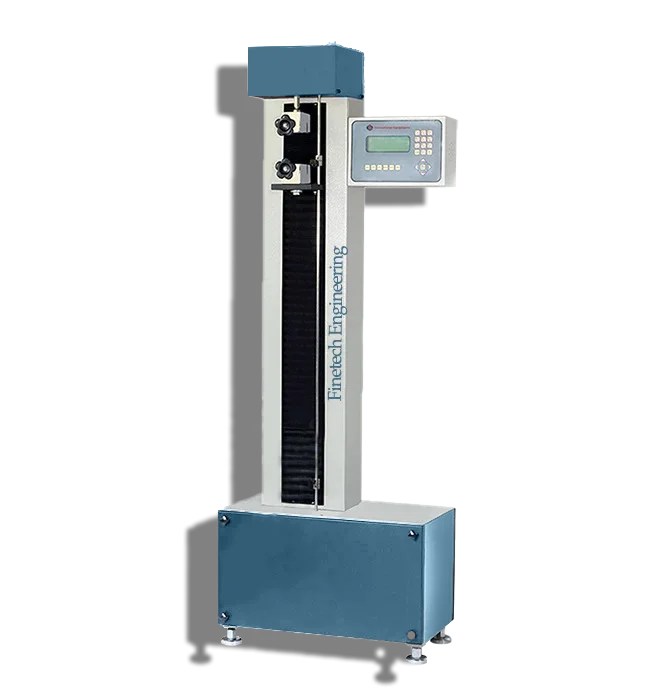
The Finetech Engineering Universal Testing Machine (UTM) is an electromechanical materials testing system and the most versatile UTM machine India for tensile, compression, flexural, peel, and tear testing of rubber, plastic, paper, textile, leather, adhesives, and composite materials. As a dedicated universal testing machine manufacturer India, we engineer every machine to be the single most important instrument in any QC or R&D lab.
As a specialist tensile testing machine India manufacturer, the Finetech UTM applies a controlled force to a specimen at a precise crosshead speed, while simultaneously measuring the applied load and deformation. It is equally capable as a compression testing machine India and a flexural testing machine manufacturer India product – simply swap the grips and fixtures.
As a universal testing machine for plastic rubber in India, the Finetech UTM handles rubber dumbbell specimens per ASTM D412 with roller grips, rigid plastic Type I specimens per ASTM D638 with wedge grips, thin film strips per ASTM D882, and paper strips per ISO 1924. As a tensile strength testing machine manufacturer India and UTM machine manufacturer Thane, we configure the right grip set for your primary material from day one.
| Material | Specimen | Standard | Grip Type |
| Vulcanised rubber | Dumbbell (Die C) | ASTM D412, ISO 37 | Roller grips |
| Rigid plastics (1–14 mm) | Dumbbell (Type I–V) | ASTM D638, ISO 527 | Wedge grips |
| Thin plastic film (<1 mm) | Rectangular strip | ASTM D882 | Roller or pneumatic grips |
| Paper / paperboard | 15 mm strip | ISO 1924, TAPPI T494 | Pneumatic or roller grips |
| Textile / fabric | Strip or grab method | ISO 13934-1, ASTM D5035 | Pneumatic grips |
| Leather | Dumbbell specimen | ISO 3376 | Roller grips |
| Adhesive bond (lap shear) | Bonded assembly | ASTM D1002, D3163 | Wedge grips |
| Rubber – tear strength | Angle/trouser/crescent | ASTM D624, ISO 34-1 | Roller grips |
| Material | Standard | Fixture |
| Rigid plastics | ASTM D695, ISO 604 | Compression platens |
| Vulcanised rubber | ASTM D575, IS 3400 | Compression platens |
| Foam / cellular rubber | ASTM D3574 | Compression platens |
| Corrugated packaging | ASTM D642 | Compression platens |
| Material | Standard | Fixture |
| Rigid plastics | ASTM D790, ISO 178 | 3-point flexural fixture |
| Fibre-reinforced plastics | ASTM D790, ASTM D7264 | 3-point or 4-point fixture |
| Material | Standard | Fixture |
| Adhesive tapes | ASTM D903, ASTM D3330 | Peel fixture (90° or 180°) |
| Laminates / flexible packaging | ASTM F904 | Peel fixture |
| Rubber-to-metal bonds | IS 4201 | Peel fixture + roller grip |
| Parameter | Specification |
| Machine Type | Electromechanical (screw-driven, dual column) |
| Force Capacities Available | 5 kN, 10 kN, 20 kN, 50 kN |
| Load Cell Accuracy | Class 0.5 (or better) per ISO 7500-1 / ASTM E4 |
| Crosshead Speed Range | 1–500 mm/min (adjustable in software) |
| Crosshead Travel | Up to 1000 mm (model-dependent – higher for rubber testing) |
| Drive System | AC servo motor with precision ball screw |
| Control System | Microprocessor-based with PC software interface |
| Software | Windows-based testing software with real-time load-displacement curve display |
| Data Output | Tensile strength, yield strength, elongation at break, modulus, flexural strength, compressive strength, peel strength, tear strength |
| Report Generation | Automatic test reports with curves, statistics (mean, SD, min, max), and raw data export (CSV/Excel) |
| Grip Mounting | Standard pin or bolt mount – accommodates roller, wedge, pneumatic grips and all fixtures |
| Extensometer (Optional) | Clip-on contact extensometer or video extensometer for accurate strain measurement |
| Safety Features | Upper/lower travel limits, overload protection, emergency stop button |
| Frame Construction | Rigid dual-column steel frame, powder coated |
| Power Supply | 230V AC, single phase, 50 Hz |
| Certification | ISO 9001:2015 certified manufacturing |
| If You Test… | Typical Max Force | Recommended Capacity |
| Thin rubber (Shore A 30–60), foam, films | 50–200 N | 5 kN |
| Standard rubber dumbbell (ASTM D412 Die C) | 200–1500 N | 5 kN or 10 kN |
| Rigid plastics (ASTM D638 Type I, 3.2 mm thick) | 500–5000 N | 10 kN or 20 kN |
| Paper and paperboard tensile | 50–500 N | 5 kN |
| Textile and non-woven (strip or grab) | 200–2000 N | 5 kN or 10 kN |
| Hard rubber (Shore A >80) or hard plastic | 1000–10000 N | 20 kN |
| Compression testing of rigid plastics | 2000–20000 N | 20 kN or 50 kN |
| Flexural testing of thick plastic bars | 500–5000 N | 10 kN or 20 kN |
| Engineering plastics (nylon, PC, POM, PEEK) | 2000–15000 N | 20 kN or 50 kN |
| Fibre-reinforced composites | 5000–50000 N | 50 kN |
| Material / Test | Grip Type | Why |
| Rubber – tensile & tear | Roller grips (self-tightening) | Handles 300–800% elongation without slipping |
| Rigid plastic – tensile | Wedge grips (self-tightening) | High clamping for low-elongation, high-strength specimens |
| Thin films – tensile | Roller grips or pneumatic grips | Gentle clamping prevents crushing; pneumatic for high volume |
| Paper – tensile | Pneumatic or roller grips | Consistent low force to avoid crushing paper |
| Any material – compression | Compression platens | Flat parallel surfaces for uniform compression |
| Any material – flexural | 3-point bend fixture | Adjustable span per ASTM D790 / ISO 178 |
| Adhesives – peel | Peel fixture (90° / 180°) | Controlled peel angle per ASTM D903 |
Complete testing ecosystem. As your universal testing machine manufacturer India and UTM machine manufacturer Thane, Finetech supplies UTM + grips + specimen cutters + moulds + presses + calibration + AMC. One supplier, guaranteed compatibility.
Built for Indian testing labs. Our UTM machine India is designed for ASTM D412 (rubber), ASTM D638 (plastics), IS 3400 (BIS compliance), and ISO 527 (export-oriented manufacturers). The perfect tensile testing machine India for the standards your auditors demand.
One machine: tensile + compression + flexural. The Finetech universal testing machine serves as your tensile testing machine India, compression testing machine India, and flexural testing machine manufacturer India product all in one frame – just swap grips and fixtures.
Competitive UTM machine price India. As a direct manufacturer, our UTM machine price India is competitive against both domestic and imported equipment. The tensile strength testing machine manufacturer India you can afford. Contact us for a model-specific quote.
Calibration and AMC support. Professional calibration with certificates and AMC plans. Keeps your universal testing machine audit-ready.
| Product | Why Related |
Essential accessories – roller, wedge, pneumatic grips; compression, flexural, peel fixtures |
|
Cuts the dumbbell specimens tested on the UTM |
|
Cuts tear specimens for ASTM D624 tear testing on the UTM |
|
Cuts film strips for ASTM D882 testing on the UTM |
|
Cuts notches for Izod/Charpy impact specimens |
|
For cutting specimens and moulding test sheets fed to the UTM |
|
Complete range of cutting dies and moulds |
|
Complementary impact testing alongside UTM tensile testing |
|
Complementary melt flow testing – often paired with UTM in plastic QC labs |


















All Equipments & specimen preparation products can be customised as per requirements.
Yes. Every UTM purchase includes installation, commissioning, and operator training at your site. We train your team on machine operation, grip changes, software use, test setup for your specific standards, and basic troubleshooting. Additional training sessions can be arranged under AMC.