







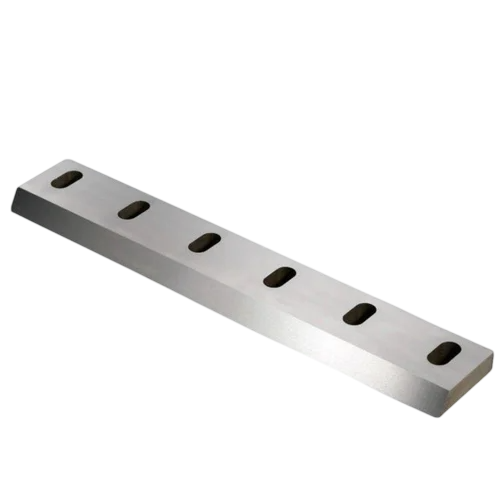
As a trusted guillotine blades manufacturer India, Finetech delivers precision straight-line cuts through stacks of material – 1,000-sheet reams, finished books, and 10 mm steel plate in one stroke. The defining characteristic: ground on all 4 edges. That is the 4-edge guillotine blade paper cutter rotate India principle – when one edge dulls, unbolt, rotate to the next edge, retighten. Four times the service life before the blade goes to the grinder.
Answering “why does paper cut come out fuzzy rough edge”: a dull blade crushes paper fibres instead of slicing them. As your trusted paper cutting blades manufacturer India, Finetech controls all three quality factors: edge sharpness (mirror-finish grind), straightness (CNC surface-ground to ±0.03 mm/m), and material hardness (steel grade matched to your substrate) – eliminating fuzzy edges, tapered cuts, and premature dulling.
We manufacture guillotine blades up to 4,500 mm long and supply Polar guillotine blade replacement India, Perfecta Wohlenberg Schneider guillotine blade India replacements, and all Indian-made machine blades. We also manufacture guillotine-type blades for sheet metal shearing (see our Shear Knives page for heavy metalworking applications).
| Feature | Paper Guillotine Blade | Metal Guillotine Blade |
| Material Cut | Paper, board, card, labels, corrugated | Mild steel, stainless, aluminium, copper sheet |
| Cut Action | Vertical shear through a clamped stack | Vertical shear through a clamped sheet/plate |
| Cutting Force | Low–medium (paper is soft) | Very high (metal requires extreme force) |
| Steel Grade | D2 or HSS (M2) – hardness and edge retention | D2, H13, or Cr12MoV – toughness under impact |
| Edge Geometry | Very sharp, fine bevel (18–22°) | Slightly blunter bevel (25–30°) for impact resistance |
| Typical Length | 500–1,500 mm (printing house), up to 3,000 mm (paper mill) | 500–4,500 mm (steel service centre) |
| 4-Edge Standard? | Yes – standard for paper guillotines | Yes for hydraulic guillotine shears; 2-edge for swing beam |
| Material | Hardness | Cuts Best | Typical Life per Edge |
| D2 tool steel (standard) | HRC 58–62 | Uncoated paper, cardboard, corrugated, thin sheet metal | 5,000–20,000 cuts |
| HSS (M2) | HRC 62–65 | Coated paper, laminated paper, recycled paper, synthetic media | 10,000–40,000 cuts |
| Tungsten-carbide-tipped | HRC 85–92 (tip) | Highly abrasive substrates (recycled board, fibre cement, sand paper) | 20,000–100,000 cuts |
| H13 (for metal) | HRC 48–54 | Thick plate, stainless, hot shearing | 2,000–10,000 cuts |
| Parameter | Specification |
| Product Name | Guillotine Blades (Paper & Metal Guillotine Knives) |
| Maximum Length | 4,500 mm (single piece) |
| Cross-Section | Varies by machine – common: 100 × 10 mm, 90 × 8 mm, 80 × 10 mm |
| Cutting Edges | 4 (ground on all 4 long edges) |
| Steel Grades | D2, M2 (HSS), O1, H13, Cr12MoV, tungsten-carbide-tipped |
| Heat Treatment | In-house hardening and tempering; HRC 48–65 depending on grade |
| Edge Bevel | Fine bevel (18–22° for paper), standard bevel (25–30° for metal) |
| Surface Finish | CNC ground on all faces; mirror polish on cutting edges |
| Straightness | ±0.03 mm per metre |
| Mounting Holes | Drilled and counterbored to machine specification |
| Compatible Machines | Polar, Perfecta, Wohlenberg, Schneider, Adast, Itoh, Challenge, Indian OEMs |
| Certification | ISO 9001:2015 |
4-edge economy – the 4-edge guillotine blade paper cutter rotate India advantage: 4× life per blade. Every blade is ground on all 4 long edges. Rotate 4 times before re-sharpening. 4× the service life per blade = lowest cost per cut.
Replacement for all major brands. Polar, Perfecta, Wohlenberg, Schneider, Adast, Itoh, Challenge, and all Indian paper cutters. Tell us the machine model – we match the dimensions.
CNC ground straightness. Blades up to 4,500 mm ground to ±0.03 mm/m. A straight blade = a square cut across the full stack width. No tapered cuts, no waste.
Mirror-polished cutting edge – solves “why does paper cut come out fuzzy rough edge” forever. A polished edge slices paper fibres cleanly. A rough edge tears them, leaving a fuzzy, unprofessional cut. Our edges are polished to mirror finish.
Manufacturer, not trader – trusted guillotine blades manufacturer India at Thane facility. Ground and heat-treated at our Thane facility. Direct factory pricing, fast replacement delivery, and re-sharpening service.
Product | Why Related |
For other straight-edge cutting applications | |
For rotary slitting of paper, film, and metal | |
For heavy-duty metal guillotine and shearing applications | |
Full range of paper cutting solutions | |
Full range by geometry | |
Find blades matched to your industry |








All Equipments & specimen preparation products can be customised as per requirements.
So you can rotate the blade 4 times (one rotation per edge) before sending it for re-sharpening. Each edge gives thousands of clean cuts. This multiplies the blade’s service life by 4 and delays the cost and downtime of re-sharpening.
Yes. We manufacture replacement blades for Polar and all other major paper cutter brands. Tell us the machine model number and we will match the blade dimensions (length, width, thickness, hole pattern). We keep common Polar sizes in stock for fast delivery.
D2 tool steel (HRC 58–62) is the standard for most paper cutting. If you cut coated paper, recycled paper, or laminated board (which are abrasive), upgrade to HSS (M2) for 2–3× longer edge life. Tungsten-carbide-tipped blades are for extreme-abrasion applications like recycled corrugated board.
If the cut edge of the paper shows fuzz, fibres, or slight tearing instead of a clean slice, the blade is dull. Rotate to a fresh edge. If all 4 edges are used, send the blade for re-sharpening. A visual inspection under magnification will show whether the edge has nicks or chipping.
Answering “what is difference between guillotine blade and shear knife”: both are straight blades that cut with a vertical stroke. A guillotine blade for paper is optimised for sharpness (fine bevel, high hardness) because paper is soft but abrasive. A shear knife for metal is optimised for toughness (blunter bevel, impact-resistant steel) because metal is hard and shearing forces are enormous. Finetech manufactures both.
Yes. Send worn blades to our Thane facility. We CNC re-grind the cutting edge to mirror finish and verify straightness. Turnaround: 3–5 working days. Most blades can be re-sharpened 5–10 times (in addition to the 4 edge rotations).