







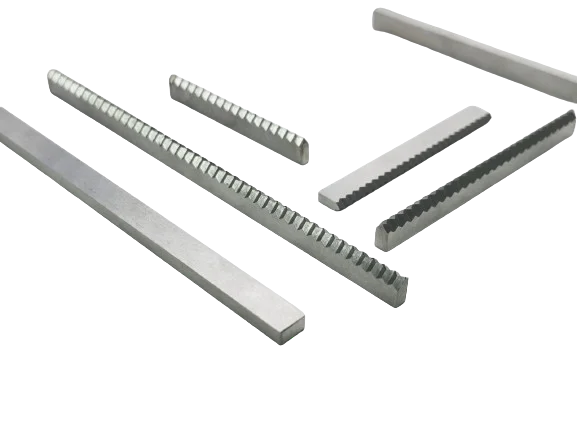
Understanding “what is a machine knife industrial cutting”: a straight blade (also called a machine knife, flat knife, or industrial knife) is the most fundamental and versatile industrial cutting tool. As a trusted industrial flat knives manufacturer India, Finetech manufactures rectangular pieces of hardened steel designed to cut in a linear motion – guillotine knives in paper mills, cross-cut blades in packaging lines, chopping knives in food factories, shear blades in steel service centres, and sheeter knives in corrugated plants.
Finetech Engineering manufactures straight blades up to 4,500 mm long in a single piece. We grind all four edges to precision tolerances, drill mounting holes to your machine’s bolt pattern, and heat-treat to the hardness required for your specific application. From a 50 mm food-portioning blade in food-grade stainless steel to a 3,000 mm paper sheeter knife in tungsten-carbide-inlaid tool steel, we manufacture the full range.
As a leading machine knives manufacturer India and granulator blades manufacturer India, Finetech controls what makes one straight blade different from another: the steel grade (edge life and toughness), the edge geometry (bevel angle, single or double bevel), and dimensional accuracy (a blade 0.1 mm out of straight over 1,000 mm will produce uneven cuts) – all controlled at our Thane facility.
Blade Type | What It Does | Typical Sizes | Used In |
Guillotine knife | Cuts stacked paper/board in a single vertical shear stroke | 500–4,500 mm length | Polar, Perfecta, Wohlenberg, Itoh, Indian cutters |
Sheeter knife | Cuts continuous paper web into individual sheets at high speed | 500–3,000 mm | Sheeters in paper mills and large printing plants |
Circular slitter (top/bottom pair) | Slits paper rolls into narrower rolls on slitter-rewinders | OD 50–800 mm | Rewinder slitter-rewinders in paper mills and converters |
Three-knife trimmer blades | Trims 3 sides of bound books/magazines in a single pass | Standard sizes per machine model (SDY-1, SDY-2) | Muller Martini, Kolbus, Wohlenberg trimmers in binderies |
Rewinder bottom knife | Fixed anvil knife against which the top slitter rotates | Per machine specification | Paper rewinders |
Chipper knife | Chips waste paper trim and rejected sheets into pulpable pieces | 200–1,000 mm | Chippers at paper mills and printing plants |
Core cutter blade | Cuts paper cores (cardboard tubes) to width before winding | OD 100–400 mm | Core cutting machines |
Perforating blade | Creates tear lines in paper, tickets, forms, labels | Per application | Perforating units on printing and converting lines |
| Paper Type | Abrasiveness | Recommended Blade Material | Expected Life Between Sharpenings |
| Uncoated woodfree (bond, offset) | Low–medium | D2 tool steel (HRC 58–62) | 5,000–15,000 cuts per edge |
| Coated art paper (gloss, matt, silk) | Medium–high | HSS M2 (HRC 62–65) | 10,000–30,000 cuts per edge |
| Newsprint | Low | D2 tool steel | 10,000–20,000 cuts |
| Kraft paper, brown paper | Medium | D2 tool steel | 5,000–15,000 cuts |
| Recycled paper/board | High (contaminants) | HSS M2 or carbide-tipped | 5,000–20,000 cuts |
| Adhesive labels, stickers | Very high (adhesive + coating) | Tungsten-carbide-tipped or inlaid | 15,000–50,000 cuts |
| Laminated paper/board | Very high (abrasive + adhesive) | Tungsten-carbide-tipped | 20,000–60,000 cuts |
| Corrugated board | High (recycled fibre) | D2 or HSS | 3,000–10,000 cuts |
| Tissue paper | Low | D2 (or stainless for hygiene applications) | 10,000–25,000 cuts |
| Symptom | Likely Cause | Fix |
| Fuzzy or fibrous edges on cut paper | Blade is dull; wrong bevel angle; blade material too soft for the paper type | Re-sharpen or replace blade; check bevel angle (18–22° for paper); upgrade material if dull too quickly |
| Bottom sheets in stack cut poorly | Cutting stick worn or wrong material; blade not penetrating deep enough | Replace cutting stick; adjust blade depth setting |
| Paper shifts during cut (inaccurate dimensions) | Clamp pressure too low; back gauge not calibrated; paper stack too high | Increase clamp pressure; calibrate back gauge; reduce stack height |
| Blade chips or nicks after few cuts | Blade too hard for the application; hidden contaminants in recycled paper | Use D2 or HSS instead of brittle carbide for standard paper; screen recycled paper for staples/clips |
| Blade dulls in 1–2 days on coated paper | Carbon steel blade on abrasive coated paper; wrong material selection | Upgrade to D2 or HSS; coated paper destroys carbon steel edges rapidly |
| Adhesive residue building up on blade | Cutting adhesive labels or laminated sheets; no anti-stick coating | Apply silicone spray before cutting; upgrade to a blade with chrome or TiN anti-stick coating |
| Cut is not square across the full width | Blade is bent or not straight; blade not seated correctly in the machine | Check blade straightness; reseat blade and tighten mounting bolts evenly |
| Machine Brand | Models We Supply | Blade Types Available |
| Polar | Polar 66, 78, 92, 115, 137, 155, 176 | Guillotine knives (all 4-edge sizes), cutting sticks |
| Perfecta (Seypa) | Perfecta 76, 92, 115, SEYPA 92, 115 | Guillotine knives, trimmer blades |
| Wohlenberg | Wohlenberg 44, 76, 92, 115, 137 | Guillotine and trimmer knives |
| Schneider / Senator | Senator 78, 92, 115 | Guillotine knives |
| Muller Martini | 3-knife trimmers | Three-knife trimmer blade sets |
| Itoh | Itoh 72, 92, 115 | Guillotine knives |
| Challenge | Challenge 305, Champion, Titan | Guillotine knives |
| Adast | Adast Maxima 80, 92 | Guillotine knives |
| Indian machines | Sudarshan, Lineomatic, SDY-1, SDY-2, and all Indian-made cutters | Guillotine knives, trimmer blade sets |
| Parameter | Specification |
| Guillotine Knife Length | Up to 4,500 mm (single piece) |
| Circular Slitter OD | 50 mm to 800 mm |
| Steel Grades | D2 (AISI), M2 HSS, SAE 52100, O1, carbide-tipped, carbide-inlaid |
| Heat Treatment | In-house hardening and tempering; HRC 58–65 (steel), 85–92 (carbide tip) |
| Edge Bevel | 18–22° (fine, for paper); custom angles available |
| Edge Finish | CNC ground to mirror polish – critical for clean fibre cuts |
| Straightness | ±0.03 mm per metre (guillotine and sheeter knives) |
| Surface Treatments | Chrome plating, TiN coating, anti-adhesive coating (for labels/laminates) |
| Mounting | Drilled and counterbored to machine specification; standard Polar/Perfecta/Wohlenberg patterns in stock |
| Certification | ISO 9001:2015 |
Mirror-polished cutting edge – solves “why paper cut comes out fuzzy fibre edges” permanently. A polished edge slices through paper fibres cleanly. A rough-ground edge tears them, leaving fuzzy edges and paper dust. Every Finetech paper knife is CNC ground to mirror finish on the cutting edge.
Material matched to your paper. Uncoated paper → D2. Coated paper → HSS. Laminates and labels → carbide-tipped. We specify the right material based on what you cut – not the cheapest to manufacture.
Replacement for all major brands. Polar, Perfecta, Wohlenberg, Schneider, Muller Martini, Itoh, Challenge, Adast, and all Indian machines. Tell us the model – we match the blade.
4-edge guillotine knives. Rotate 4 times before re-sharpening. Each edge gives thousands of clean cuts. Lowest cost per cut in the industry.
Re-sharpening service. Send worn blades to our Thane facility. We CNC re-grind to mirror finish and verify straightness. Turnaround: 3–5 working days. Most blades survive 5–10 re-sharpening cycles.
Manufacturer, not trader – trusted paper trimmer knives manufacturer India and complete paper blade partner. Ground and heat-treated at our Thane facility. Direct factory pricing, faster delivery than imported blades, and real technical support for blade selection.
Product | Why Related |
Full guillotine blade range for paper and metal cutting | |
Rotary slitter blades for paper and film | |
Sheeter, trimmer, and cross-cut knives | |
Tear lines and perforation for paper and labels | |
Find blades matched to your specific industry | |
Full range by blade geometry |









All Equipments & specimen preparation products can be customised as per requirements.
HSS (M2, HRC 62–65) is the best balance of edge life and cost for coated paper. Coated paper contains clay and latex particles that abrade the cutting edge rapidly. HSS holds its edge 2–3 times longer than D2 on coated stock. For extremely abrasive coated boards or daily high-volume cutting, consider carbide-tipped paper cutting blade India options.
Yes. We manufacture Polar guillotine blade replacement India for all Polar models including Polar 66, 78, 92, 115, 137, 155, and 176. Tell us the model number and we will match the blade dimensions (length, width, thickness, hole pattern). Common Polar sizes are kept in stock for fast delivery.
The most common cause is a worn cutting stick — not a dull blade. The cutting stick provides the support surface for the bottom of the stack. When it is grooved or compressed, the blade cannot make a clean cut through the bottom sheets. Replace the cutting stick first. If the problem persists, check the blade depth setting and blade sharpness.
It depends on the paper type and volume. Uncoated paper on D2: every 5,000–15,000 cuts. Coated paper on HSS: every 10,000–30,000 cuts. When you notice fuzzy edges, increased cutting pressure, or paper dust on the cut stack, rotate to a fresh edge or re-sharpen. Do not wait for the blade to become completely dull — a slightly dull blade damages more paper than a sharp one saves in sharpening cost.
Carbide-tipped blades have a strip of tungsten carbide brazed to the cutting edge of a steel body. Carbide-inlaid blades have the carbide embedded (inlaid) into a groove in the steel body, creating a more robust joint. Both provide dramatically longer edge life than steel alone. Inlaid is more durable for heavy-duty applications; tipped is more common and more cost-effective for standard use.
Yes. We manufacture three-knife trimmer blades for Muller Martini, Wohlenberg, Kolbus, and other book-trimming machines. Sold as matched sets (1 long blade + 2 short blades) ground to the same bevel and finish. Common sizes like SDY-1 (540 × 115 × 10 mm + 420 × 115 × 10 mm) and SDY-2 variants are available.
Yes. For cutting adhesive labels, laminates, and self-adhesive sheets, we offer chrome plating and TiN (titanium nitride) coatings that reduce adhesive buildup on the blade surface. This reduces cleaning frequency, maintains cut quality, and extends blade life.