


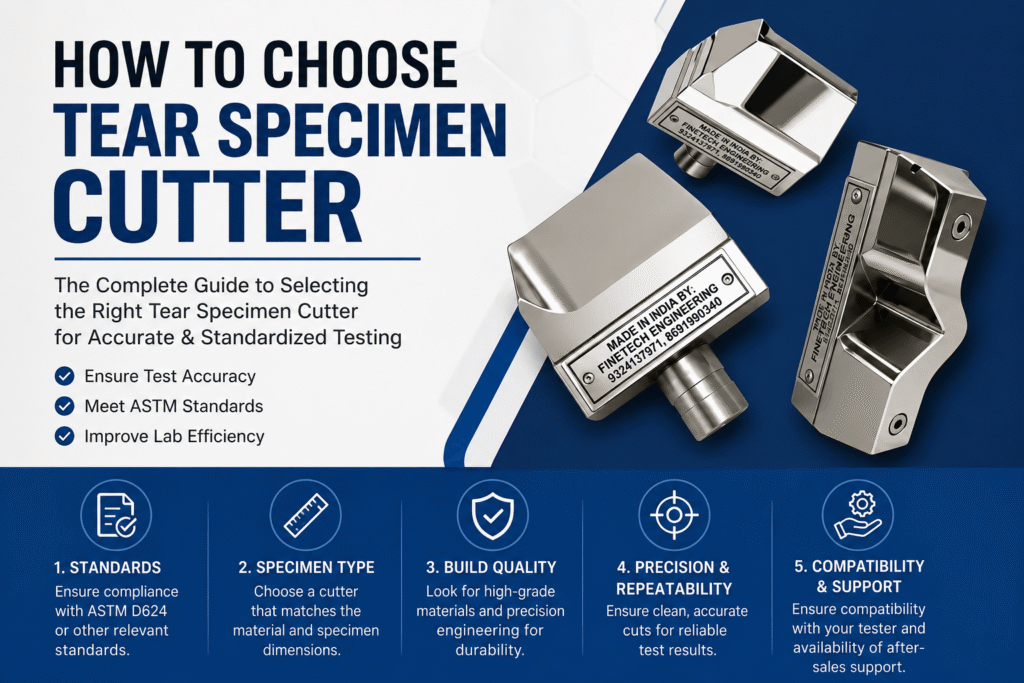
How to Choose a Tear Specimen Cutter: ASTM D624 Type A, B, C, and T Explained
What is the tear strength test for rubber? It measures how easily a rubber compound tears when a crack exists. Tear strength is one of the most critical properties for rubber products – a gasket that tears during installation, a hose cover that splits under bending, a shoe sole that rips at the toe crease are all tear failures prevented by testing with the right tear specimen cutter manufacturer India before the product ships.
But ASTM D624 defines four different tear die types – A, B, C, and T – and each measures a different aspect of tear behaviour. Using the wrong one means you are measuring the wrong property. This guide explains all four types, tells you which one to use for your application, and shows you the dimensions in clear tables.
Why Tear Testing Matters for Rubber Products
Tensile strength tells you how strong rubber is when pulled straight apart. Tear strength tells you how easily rubber tears when a crack or cut already exists. In real life, rubber products almost always fail by tearing from a flaw – a cut, a nick, a moulding defect, a sharp edge – not by uniform tension. That makes tear strength the more realistic predictor of field performance for most applications.
I have seen a rubber seal manufacturer in Pune lose a major automotive contract because their incoming tear test data showed 15% lower values than the customer’s specification. The compound was fine. The problem was that they were using the wrong tear die – Type A instead of Type C. When we supplied the correct Type C die and they re-tested, the values met specification immediately.
The Four ASTM D624 Tear Die Types at a Glance
Die Type | Common Name | Shape | What It Measures | When to Use |
Type A | Crescent (no tabs) | Crescent with nick at inner radius | Tear initiation + propagation from a controlled nick | When specified by customer; older specifications |
Type B | Crescent with tabs | Crescent with grip tabs + nick | Same as A but with tabs for easier UTM gripping | When UTM grips struggle to hold the crescent shape |
Type C | Right-angle (90°) | Right-angle notched specimen | Total tear resistance – initiation + propagation combined | THE DEFAULT – most commonly specified tear die worldwide |
Type T | Trouser | Rectangular strip slit down the centre | Pure tear propagation resistance (no initiation) | Research, compound comparison, peel-type tear |
Let’s go through each die type in detail, starting with the most common one.
Type C - The Right-Angle Tear Die (The Default Choice)
Type C is the standard tear die for most industrial rubber specifications. The specimen looks like an angular tab – a right-angle corner with a defined radius at the inside corner. When the UTM pulls the two legs of the specimen apart, the tear initiates at the inside corner and propagates through the full cross-section.
Type C Dimensions
Parameter | Dimension |
Overall height | 100 mm |
Overall width at top | 19 mm |
Leg width | 12.7 mm |
Inside radius at corner | 0.5 mm |
Thickness | Standard rubber sheet thickness (2–3 mm typical) |
Why Type C is the default – the ASTM D624 Type A Type C tear die difference explained: It measures the total tear resistance of the compound in a single number – both the energy to initiate the tear and the energy to propagate it. Most material datasheets report tear strength using Type C.
Type T - The Trouser Tear Die (For Tear Propagation)
The trouser tear die ASTM D624 Type T India specimen is completely different from the crescent and angle types. It is a rectangular strip with a cut down the centre from one end, creating two “legs” like trouser legs. The UTM grips each leg using roller grips and pulls them apart, propagating the tear along the length of the specimen.
Type T Dimensions
Parameter | Dimension |
Overall length | 150 mm (typical) |
Width | 25 mm |
Slit length | 75 mm (half the specimen length) |
Thickness | Standard sheet thickness |
Type T measures pure tear propagation resistance – no initiation energy. This makes it useful for comparing different compounds’ resistance to ongoing tear growth, such as in hose covers, conveyor belt edges, and shoe sole flex zones where a crack may already exist.
Type A - The Crescent Tear Die (With Nicking Device)
The Type A crescent tear specimen has a curved inner edge (crescent shape) with a small controlled nick cut into the inner radius. The nick acts as the tear initiation point – the UTM pulls the specimen and the tear propagates from the nick.
Type A Dimensions
Parameter | Dimension |
Overall height | 76.2 mm |
Overall width | 25.4 mm |
Inner radius (crescent) | 14.3 mm |
Nick depth | 0.50 ±0.05 mm |
The nick depth is critical. Too deep, and the specimen tears too easily (falsely low values). Too shallow, and the tear may not initiate from the nick (invalid test). The nick must be cut with a precision nicking device – not a razor blade.
Type B - The Crescent Tear Die With Tabs
Type B is essentially the same crescent shape as Type A, but with grip tabs added at each end. These tabs make it easier to mount the specimen in the UTM grips. The test procedure and nick requirement are the same as Type A.
Use Type B when your UTM grips have difficulty holding the curved crescent shape of Type A specimens. The tabs provide flat gripping surfaces.
What Is a Nicking Device and Why Does It Matter?
Types A and B require a controlled nick (small cut) at the inner radius of the crescent specimen. This nick is the predetermined tear initiation point. The nick must be:
- Exactly 0.50 ±0.05 mm deep
- Perpendicular to the specimen surface
- Made with a precision nicking device – a small blade fixture that controls the depth accurately
- Not made with a razor blade, scalpel, or scissors – these produce inconsistent depth and damage the specimen
Finetech supplies nicking devices with the Type A and Type B tear cutters. The nicking device can be integral to the die (cuts the nick during the die-cutting operation) or a separate tool used after die-cutting.
Important: Type C and Type T do NOT require nicking. The tear initiates naturally from the geometric stress concentration (the right-angle corner in Type C, the slit tip in Type T).
ISO 34-1 - How It Maps to ASTM D624
As a trusted ISO 34-1 tear specimen cutter India manufacturer, Finetech covers ISO 34-1, the international standard for tear testing of rubber. It defines its own set of tear specimen geometries. Here is how they relate to ASTM D624:
ASTM D624 | ISO 34-1 Equivalent | Notes |
Type C (right-angle) | Method A (angle test piece) | Very similar geometry. ISO Method A is the most common ISO tear test. |
Type T (trouser) | Method B (trouser test piece) | Same principle. Rectangular strip with slit. |
Type A (crescent) | Method C (crescent) | Similar crescent geometry with nicking. |
Type B (crescent + tabs) | No direct equivalent | ISO does not define a tabbed crescent variant. |
If your export customer specifies ISO 34-1, our ISO 34-1 tear specimen cutter India covers it: Method A is equivalent to ASTM D624 Type C, and Method B is equivalent to Type T. For most practical purposes, the same dies can be used.
Which Tear Die Should You Order? (Decision Flowchart)
Follow these steps to decide which tear die for rubber testing ASTM you need:
- Step 1: Check your customer’s specification. Does it name a specific ASTM D624 die type or ISO 34-1 method?
- Step 2: If yes → order that specific die type. Done.
- Step 3: If the spec just says “tear strength per ASTM D624” without specifying a type → use Type C. It is the industry default.
- Step 4: If the spec says ISO 34-1 without specifying a method → use Method A (equivalent to Type C).
- Step 5: If you need to measure tear propagation specifically (e.g., for compound development) → add Type T to your lab.
- Step 6: If an older spec calls for crescent tear → order Type A (or Type B if your grips need tabs). Also order a nicking device.
For most rubber QC labs: Type C is all you need. It covers the vast majority of customer specifications and material datasheets.
Other Specimen Cutters You May Need
A complete rubber testing lab pairs tear dies with a dumbbell specimen cutter for tensile testing. All Finetech tear dies and dumbbell dies fit the same hydraulic press, pneumatic, or manual press – no separate equipment needed.
Frequently Asked Questions
For the most common question – which tear die for rubber testing ASTM – the answer is Type C (right-angle, also called the rubber tear cutter right angle 90 degree India). It is the default tear die for most industrial rubber specifications worldwide.
Tensile strength measures resistance to being pulled apart uniformly. Tear strength measures resistance to a tear propagating from a flaw or stress concentration. They are different properties. A compound can have high tensile strength but low tear strength, or vice versa.
Only if you use Type A or Type B crescent tear dies. From our ASTM D624 tear die all types A B C T guide: Type C and Type T do not require nicking. The nicking device controls the 0.50 mm nick depth that initiates the tear in crescent specimens.
Yes. All Finetech tear dies and dumbbell dies fit the same pneumatic, hydraulic, or manual press. No separate equipment needed.
This varies enormously. General-purpose NR compounds: 20–40 kN/m. High-tear EPDM: 30–60 kN/m. Silicone rubber: 10–30 kN/m. Always compare against the specific compound’s datasheet value.
Final Thoughts
Knowing how to choose tear specimen cutter rubber comes down to one question: what does your specification require? In most cases, the answer is ASTM D624 Type C or ISO 34-1 Method A. If you are doing research on tear propagation, add the trouser tear die ASTM D624 Type T India. If an older specification calls for crescent tear, use Type A with a nicking device.
Finetech Engineering, a certified tear specimen cutter manufacturer India and ASTM D624 Type C tear die manufacturer India, manufactures tear specimen cutters for all four ASTM D624 types and ISO 34-1 methods. Every die is made from hardened tool steel, precision machined, and supplied with a dimensional inspection certificate. We also manufacture the crescent cutter (Types A and B) with integral or separate nicking devices. All dies are tested using a universal testing machine to verify specimen quality before despatch.
Need a tear specimen cutter? Tell us your standard and type. We’ll confirm dimensions and quote within 24 hours.
WhatsApp: +91 93241 37971 | Email: info@finetechengineer.com | Visit: /specimen-cutters-and-moulds/
– Santhosh Kumar VP, Founder & Managing Partner, Finetech Engineering