







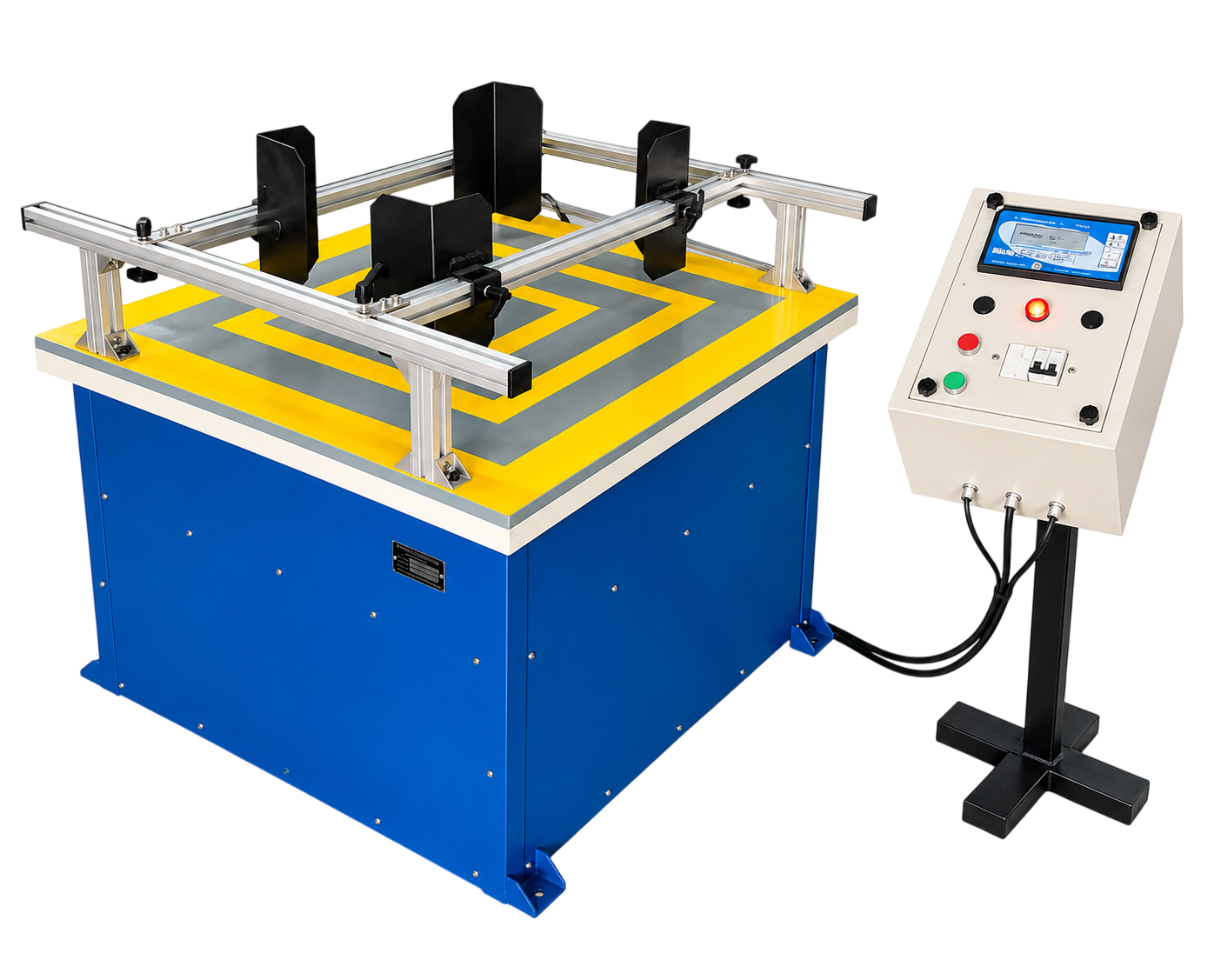
Finetech Engineering is a vibration tester manufacturer Telangana pharma packaging and rubber component testing labs rely on to simulate the vibration a packaged product experiences during road, rail, sea or air transport – before that product ever leaves the factory. Every vibration tester we build is manufactured under ISO 9001:2015 certification and dispatched from our Wagle Estate, Thane factory – manufacturer, not trader.
What is a vibration tester for packaging? A vibration tester is an instrument that mounts a packaged product on a vibrating platform and subjects it to controlled vibration, replicating the cumulative shaking, jostling and resonance a shipment experiences in transit. For Telangana’s pharma packaging sector, centred around Hyderabad, this identifies packaging weaknesses or product damage risk before a shipment reaches its destination – catching a transport-damage problem in the lab is far cheaper than a compromised pharma shipment or a customer damage claim.
As a vibration tester supplier Hyderabad and vibration tester supplier Secunderabad testing labs have used since 2023, we supply vibration testers built to ASTM D999 and ISTA transport simulation protocols. For vibration tester price Telangana enquiries, contact us with your test standard and typical package weight/size, and we will confirm a quotation – every unit is dispatched from our Thane factory configured to your required test profile. On vibration tester cost Telangana enquiries, pricing always tracks your exact test standard and package size rather than a fixed catalogue rate. Buyers who prefer to buy vibration tester online Hyderabad can start that same conversation through our contact form – the quote process is identical either way.
Tip: If your pharma packaging has passed drop testing but you are still seeing field damage or content shifting during actual transport, vibration testing often reveals the gap – drop testing simulates a single sharp impact, while vibration testing simulates the cumulative, resonant shaking of a real transport journey, a genuinely different failure mode.
ASTM D999 vibration test is the primary standard Telangana packaging and product testing labs use to qualify shipping container and packaging durability. An ASTM D999 vibration testing machine for pharma packaging Hyderabad manufacturers order most often is configured exactly this way, since shipment-transport qualification is a routine requirement across that sector:
Step | What Happens |
1. Mount the package | The packaged product is secured on the vibration table exactly as it would be positioned during actual shipment – no additional restraint beyond what the real shipment would have. |
2. Select the test method | ASTM D999 offers repetitive-shock testing (Method A) or resonance testing (Method B), depending on whether the goal is simulating cumulative transport vibration or identifying the package’s resonant frequency. |
3. Set frequency and amplitude | Test parameters are set per the governing specification or, for resonance testing, swept across a frequency range to locate the package’s critical resonant frequency. |
4. Run the test duration | The package is vibrated for the specified duration, which may represent an equivalent transport distance or time. |
5. Inspect for damage | After testing, the package and product are inspected for physical damage, loosened fasteners, content shifting, or packaging failure. |
Note: ASTM D999’s two methods answer different questions: repetitive-shock (Method A) simulates general transport vibration exposure, while resonance testing (Method B) specifically identifies the frequency at which the package vibrates most severely – useful for redesigning packaging to avoid that frequency range in real transport conditions.
ISTA transport simulation testing, from the International Safe Transit Association, differs from a standalone ASTM D999 vibration test in an important way: ISTA procedures combine vibration with other transport hazards – drops, compression, temperature/humidity conditioning – in a defined sequence, aiming to replicate a complete shipping journey rather than testing vibration resistance in isolation. This is especially relevant for Telangana’s pharma packaging sector, where regulatory and customer specifications often call for documented transport-readiness qualification.
ISTA Procedure | Test Approach | Typical Use |
ISTA 1A | Non-simulation integrity test – basic sequence of handling and vibration hazards, no attempt to replicate a specific shipping route | Individual packaged-products up to 150 lb; general baseline packaging qualification |
ISTA 2A | Partial simulation – similar hazard set to 1A but with more rigorous, sequenced test conditions replicating specific transport stresses | Individual packaged-products where a more rigorous qualification than 1A is required, often for pharma or export shipment |
For Telangana’s pharma packaging manufacturers, the practical difference is this: an ASTM D999 vibration test alone verifies vibration resistance specifically, while ISTA transport simulation verifies how the package performs across a realistic combination of transport hazards – vibration plus handling drops plus, in some procedures, compression and climate exposure. Many Telangana pharma packaging qualification programmes use ASTM D999 for focused vibration/resonance characterisation and ISTA procedures for full transport-readiness sign-off.
Note: Confirm which ISTA series and procedure number your customer or regulatory specification requires – ISTA has multiple series (1, 2, 3, 6) covering different package types and rigor levels, and substituting one procedure for another does not satisfy a specification calling for a specific one.
Vibration frequency packaging testing matters because every packaged product has a resonant frequency – a specific vibration frequency at which it shakes most violently for a given input. Transport vehicles (trucks, rail wagons, ships) generate vibration across a range of frequencies, and if a package’s resonant frequency falls within that range, the package experiences amplified shaking far beyond what the raw transport vibration level would suggest.
Resonance search: a Finetech vibration tester can sweep across a frequency range while monitoring the package’s response, identifying the specific frequency at which vibration amplitude peaks. For pharma manufacturers unfamiliar with the term, what is resonance testing in packaging boils down to a targeted frequency sweep – rather than vibrating the package at one arbitrary setting, the test hunts specifically for the frequency at which the carton or crate responds worst.
Why this matters for pharma packaging design: once the resonant frequency is known, packaging engineers can redesign cushioning, bracing or internal packaging to shift the resonant frequency outside the range typically generated by road or rail transport.
Typical truck transport vibration range: road transport in India typically generates significant vibration energy in the 3-60 Hz range, depending on vehicle type, road surface and suspension – packaging engineers commonly aim to keep a package’s resonant frequency outside this range where practical.
Tip: If a product has passed vibration testing at a single fixed frequency but still shows field damage, request a full resonance sweep rather than a single-frequency test – a fixed test frequency can miss the package’s actual resonant frequency entirely, giving a false pass.
Whether your lab is in Hyderabad, Patancheru, IDA Nacharam or Secunderabad, as a vibration tester manufacturer Hyderabad and laboratory equipment manufacturer Telangana plants have sourced from since 2023, we dispatch vibration testers directly from our Wagle Estate, Thane factory – including testing instruments Jeedimetla labs receive on scheduled delivery routes covering that cluster. A vibration tester for pharma packaging shipment qualification Jeedimetla manufacturers depend on and a vibration tester supplier Jeedimetla pharma packaging plants have sourced from directly are, in practice, the same story. As a vibration tester supplier Patancheru chemicals pharma processors also call on, we keep both clusters on the same scheduled delivery route.
Standard | Test Approach | Typical Application |
ASTM D999 Method A | Repetitive-shock vibration – simulates cumulative transport vibration exposure | General shipping container and packaging vibration qualification |
ASTM D999 Method B | Resonance testing – identifies the package’s critical resonant frequency | Packaging design and troubleshooting, identifying frequencies to avoid |
ISTA 1A | Non-simulation integrity test – basic handling and vibration hazard sequence | Baseline packaging qualification for individual packaged-products up to 150 lb |
ISTA 2A | Partial simulation – more rigorous sequenced transport hazard testing | Pharma and export shipment qualification, more rigorous than ISTA 1A |
Manufacturer, not a trader: Every vibration tester is designed, built and calibrated at our Wagle Estate, Thane factory – not resold from another manufacturer.
ISO 9001 certified: Our manufacturing is ISO 9001:2015 certified and our equipment is CE marked.
NABL-traceable calibration: Calibration certificates traceable to national measurement standards, supporting NABL-accredited lab audits and pharma regulatory documentation requirements.
Built to ASTM D999 and ISTA transport simulation protocols: Configured for both repetitive-shock and resonance testing, and for ISTA 1A/2A sequenced hazard procedures.
Scheduled delivery across Telangana: Regular routes covering Hyderabad/Jeedimetla, Patancheru, IDA Nacharam and Secunderabad from our Thane factory.
Installation, calibration and AMC: We commission, train operators and provide annual maintenance contracts across Telangana.
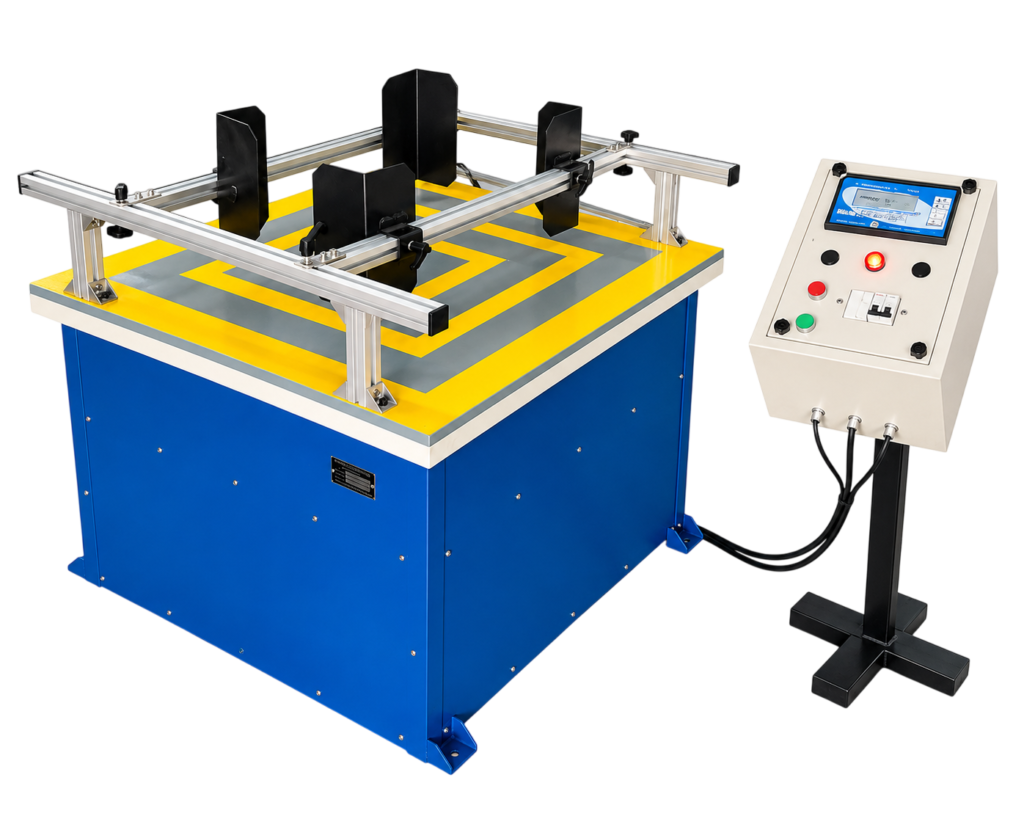


















All Equipments & specimen preparation products can be customised as per requirements.
A vibration tester is an instrument that mounts a packaged product on a vibrating platform and subjects it to controlled vibration, replicating the shaking and resonance a shipment experiences during road, rail, sea or air transport. For Telangana's pharma packaging sector, it identifies packaging weaknesses or product damage risk before a shipment reaches its destination, catching transport-damage problems in the lab rather than as a compromised shipment.
ASTM D999 vibration test procedure: the packaged product is secured on the vibration table as it would be positioned during shipment, then tested using either repetitive-shock vibration (Method A, simulating cumulative transport exposure) or resonance testing (Method B, identifying the package's critical resonant frequency). After the specified test duration, the package and product are inspected for damage, loosened fasteners or content shifting.
ISTA transport simulation combines vibration with other transport hazards - drops, compression, and in some procedures temperature/humidity conditioning - in a defined sequence, replicating a complete shipping journey. ASTM D999 alone tests vibration resistance specifically. ISTA 1A is a baseline non-simulation integrity test for packages up to 150 lb; ISTA 2A adds more rigorous, sequenced testing, often required for pharma or export shipments from Telangana's Hyderabad-based pharma manufacturers.
vibration frequency packaging testing matters because every package has a resonant frequency at which it shakes most violently. Road transport in India typically generates significant vibration energy in the 3-60 Hz range - if a package's resonant frequency falls within this range, it experiences amplified damage risk. A resonance sweep test identifies this frequency, allowing packaging engineers to redesign cushioning or bracing to shift it outside the typical transport vibration range.
We are a manufacturer. As a vibration tester manufacturer Telangana and vibration tester manufacturer India labs have used since 2023, every unit is designed, built and calibrated in-house at our Wagle Estate, Thane facility - not purchased from another manufacturer and resold.