







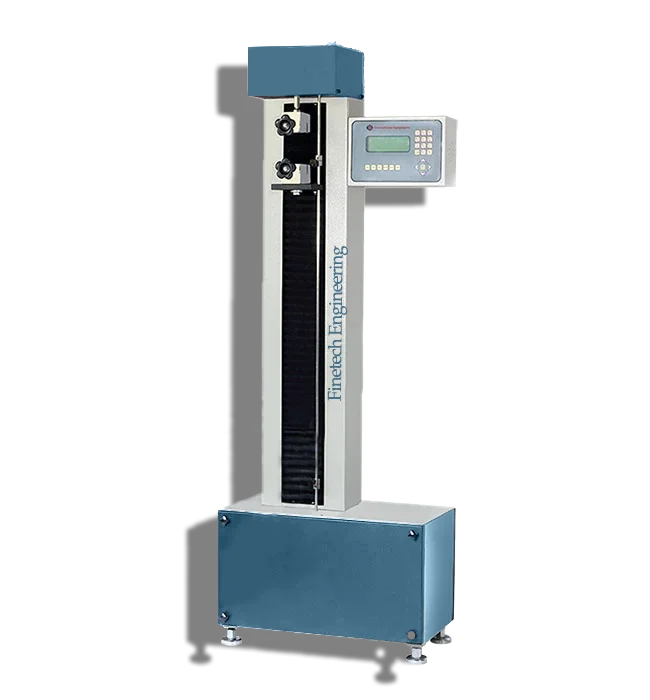
Finetech Engineering is a universal testing machine manufacturer Telangana pharma packaging and rubber component testing labs rely on for accurate tensile, elongation, modulus and compression testing. Every UTM we build is manufactured under ISO 9001:2015 certification and dispatched from our Wagle Estate, Thane factory – manufacturer, not trader.
What is a universal testing machine – a UTM (also called a tensile testing machine) is an instrument that applies a controlled, measured force to a material specimen – usually pulling it apart at a constant rate – while recording the force and displacement throughout the test. From this data, the machine calculates tensile strength, elongation at break, modulus and, with the right fixtures, compression and flexural properties. It is called “universal” because a single machine, fitted with different grips and fixtures, tests multiple material properties rather than needing a separate instrument for each – valuable for Telangana’s pharma packaging labs, centred around Hyderabad, testing both rubber closures and plastic packaging film on the same line.
As a universal testing machine supplier Hyderabad and universal testing machine supplier Secunderabad testing labs have used since 2023, we supply UTMs configured for ASTM D412 and ISO 37 rubber tensile testing, ASTM D638 plastics tensile testing, and IS 3400 Part 1 for Indian-standard rubber physical testing. For UTM machine price Telangana enquiries, contact us with your load capacity and test standard requirements, and we will confirm a quotation – every unit is dispatched from our Thane factory calibrated and ready to commission. Regarding UTM machine cost Telangana specifically, the number always tracks your load capacity and grip requirement, never a flat catalogue figure.
Tip: UTM load capacity matters more than most labs initially budget for – a machine sized only for your current rubber tensile testing may not have the capacity for plastics flexural or compression testing if you expand scope later. Tell us your full expected test range, not just your immediate need, and we will recommend a load cell capacity with reasonable headroom.
UTM machine uses rubber plastics testing spans a wider range of properties than many Telangana labs initially realise – a single, correctly configured UTM covers most of the mechanical property tests both material families require. Understanding what tensile properties matter most for pharma packaging film testing starts with tensile strength and elongation at break – the two measures that most directly predict whether a film survives handling without tearing. Can the same UTM test pharma packaging film and industrial rubber goods on one platform? Yes, provided the correct film grips and rubber dumbbell grips are both on hand for the machine:
| Property Tested | Rubber Application | Plastics Application |
| Tensile strength & elongation | Dumbbell specimen pulled to break – ASTM D412, ISO 37 | Dumbbell or dogbone specimen pulled to break – ASTM D638 |
| Modulus | Stress at a specified elongation (e.g. 100%, 300%) during the tensile pull | Tensile modulus calculated from the initial slope of the stress-strain curve |
| Compression | With compression platens fitted, force required to compress a specimen a set amount | Compressive strength and modulus for rigid plastics |
| Flexural strength | Less commonly tested for rubber | Three-point or four-point bend testing – ASTM D790 |
| Tear strength | With the correct grips, tear specimens (Die A/B/C) can be tested on the same UTM – ASTM D624 | Not typically a UTM test for plastics – usually a dedicated tear tester |
For Telangana’s pharma packaging labs testing rubber closures alongside plastic packaging film and containers, one appropriately specified UTM – with the right grip sets and fixtures – covers tensile, elongation, modulus and compression testing across both material families. A UTM machine for pharma packaging film and container tensile testing built to this specification is what most Hyderabad pharma packaging lines end up ordering once they realise the same instrument also handles their rubber closure qualification.
Note: The grips and fixtures matter as much as the machine itself – a UTM rated for the correct load capacity still needs the correct specimen grips (pneumatic, mechanical wedge, or specialty grips for thin film) to test a given material and specimen type correctly. Confirm your specimen types when specifying a UTM.
ASTM D412 tensile test rubber procedure on a Finetech UTM follows a consistent sequence for Telangana rubber testing labs. An ASTM D412 rubber tensile testing machine for pharma-linked rubber compounds set up this way handles every step without needing a second instrument, which is exactly the configuration Telangana’s pharma-adjacent rubber processors ask us for most:
| Step | What Happens |
| 1. Prepare the specimen | A dumbbell-shaped specimen is cut per the required die (A, B, C or D) from a rubber sheet of appropriate thickness. |
| 2. Mark the gauge length | Bench marks are applied at the specified gauge length to track elongation during the test, either mechanically or via an optical extensometer. |
| 3. Mount in the grips | The specimen is secured in the UTM’s grips, aligned to avoid introducing bending or off-axis loading. |
| 4. Pull at the specified rate | The crosshead moves at the ASTM D412 specified rate (typically 500 mm/min) until the specimen breaks. |
| 5. Record force and elongation | The UTM records the force and displacement throughout, calculating tensile strength at break, elongation at break, and modulus at specified elongation points (e.g. 100%, 300%). |
Note: Crosshead speed significantly affects rubber tensile results – always confirm the exact test rate your specification requires, since rubber’s viscoelastic behaviour means tensile strength and elongation results are not independent of pull rate. Put directly, why is crosshead speed important in rubber tensile testing: because rubber does not respond to a fast pull the same way it responds to a slow one, so the pull rate itself is part of what determines the tensile strength and elongation figures the test produces.
ISO 37 test procedure is broadly similar to ASTM D412 in principle – both pull a dumbbell rubber specimen to break and record tensile strength, elongation and modulus – but differ in specimen dimensions and some procedural details Telangana labs supplying pharma and export customers should know. Stripped down to the essentials, what is the difference between ASTM D412 and ISO 37 rubber tensile test comes down to specimen geometry alone – the test method itself is nearly identical, but the die each standard specifies is a different shape and size:
| Feature | ASTM D412 | ISO 37 |
| Specimen dies | Die A, B, C, D – US convention dimensions | Type 1, 2, 3 – different dimensions from ASTM dies |
| Typical pull rate | 500 mm/min (standard) | 500 mm/min (Type 2, most common) – confirm for other types |
| Reporting convention | Tensile strength in MPa or psi depending on customer | Tensile strength in MPa (standard SI reporting) |
| Typical specification source | US and domestic Indian customers | European, multinational OEM and export customers |
For Telangana rubber labs supplying pharma closure manufacturers and ISO-specifying export customers, the ISO 37 test procedure and ASTM D412 results are not directly interchangeable, since the specimen dimensions differ – always confirm which standard your customer specification names, and use the corresponding dedicated dumbbell cutter and UTM grip setup for that standard. A UTM machine for pharma-linked rubber compound testing Patancheru processors run through faces exactly this same dimensional constraint when a single compound batch needs qualifying against both a domestic and an export-facing specification.
Note: IS 3400 Part 1 (the Indian standard for rubber tensile testing) closely follows ISO 37 dimensions and procedure, making it a practical reference point for Telangana labs supplying both domestic IS-specification customers and ISO-specifying pharma and export customers.
As a universal testing machine manufacturer India pharma packaging and rubber processing industries across Telangana have relied on, our UTMs serve distinct testing needs city by city. Buyers researching a universal testing machine manufacturer India for pharma packaging film testing frequently ask whether we operate as a UTM machine supplier Jeedimetla pharma packaging plants can reach on a predictable schedule – we do, through our regular Telangana delivery route:
| City / Cluster | Primary Industries | UTM Application |
| Hyderabad – Jeedimetla | Pharma packaging, plastics processing, rubber | ASTM D638 plastics tensile testing for pharma packaging film and containers; ASTM D412 for rubber closures and seals |
| Patancheru – Hyderabad | Pharma, chemicals, general industrial rubber and plastics | ASTM D412 and ASTM D638 tensile testing for pharma-linked rubber and plastics manufacturers |
| IDA Nacharam – Hyderabad | General industrial, rubber, engineering plastics | ASTM D412 rubber tensile testing for industrial rubber goods; ISO 37 for export-specified compounds |
| Secunderabad – general industrial belt | Rubber, plastics processing | ASTM D412 and ASTM D638 tensile testing for general rubber and plastics manufacturers |
Whether your lab is in Hyderabad, Patancheru, IDA Nacharam or Secunderabad, as a universal testing machine manufacturer Hyderabad and laboratory equipment manufacturer Telangana plants have sourced from since 2023, we dispatch UTMs directly from our Wagle Estate, Thane factory – including testing instruments Jeedimetla labs receive on scheduled delivery routes covering that cluster.
| Standard | Material | Specimen | Application |
| ASTM D412 | Rubber | Dumbbell, Die A/B/C/D | Tensile strength, elongation, modulus – US/domestic specification |
| ISO 37 | Rubber | Dumbbell, Type 1/2/3 | Tensile strength, elongation, modulus – export/pharma specification |
| IS 3400 Part 1 | Rubber | Dumbbell, per IS dimensions (closely follows ISO 37) | Tensile strength, elongation, modulus – Indian domestic standard |
| ASTM D638 | Plastics | Dumbbell/dogbone, Type I-V | Tensile strength, elongation, modulus for plastics |
Manufacturer, not a trader. Every UTM is designed, built and calibrated at our Wagle Estate, Thane factory – not resold from another manufacturer.
ISO 9001 certified. Our manufacturing is ISO 9001:2015 certified and our equipment is CE marked.
NABL-traceable calibration. Calibration certificates traceable to national measurement standards, supporting NABL-accredited lab audits and pharma regulatory documentation requirements.
Built for both rubber and plastics testing. Configured for ASTM D412, ISO 37, IS 3400 Part 1 (rubber) and ASTM D638/D790 (plastics), with the correct grips and fixtures for each.
Scheduled delivery across Telangana. Regular routes covering Hyderabad/Jeedimetla, Patancheru, IDA Nacharam and Secunderabad from our Thane factory.
Installation, calibration and AMC. We commission, train operators and provide annual maintenance contracts across Telangana.
| Product | Why Related |
Essential accessories – roller, wedge, pneumatic grips; compression, flexural, peel fixtures |
|
Cuts the dumbbell specimens tested on the UTM |
|
Cuts tear specimens for ASTM D624 tear testing on the UTM |
|
Cuts film strips for ASTM D882 testing on the UTM |
|
Cuts notches for Izod/Charpy impact specimens |
|
For cutting specimens and moulding test sheets fed to the UTM |
|
Complete range of cutting dies and moulds |
|
Complementary impact testing alongside UTM tensile testing |
|
Complementary melt flow testing – often paired with UTM in plastic QC labs |


















All Equipments & specimen preparation products can be customised as per requirements.