







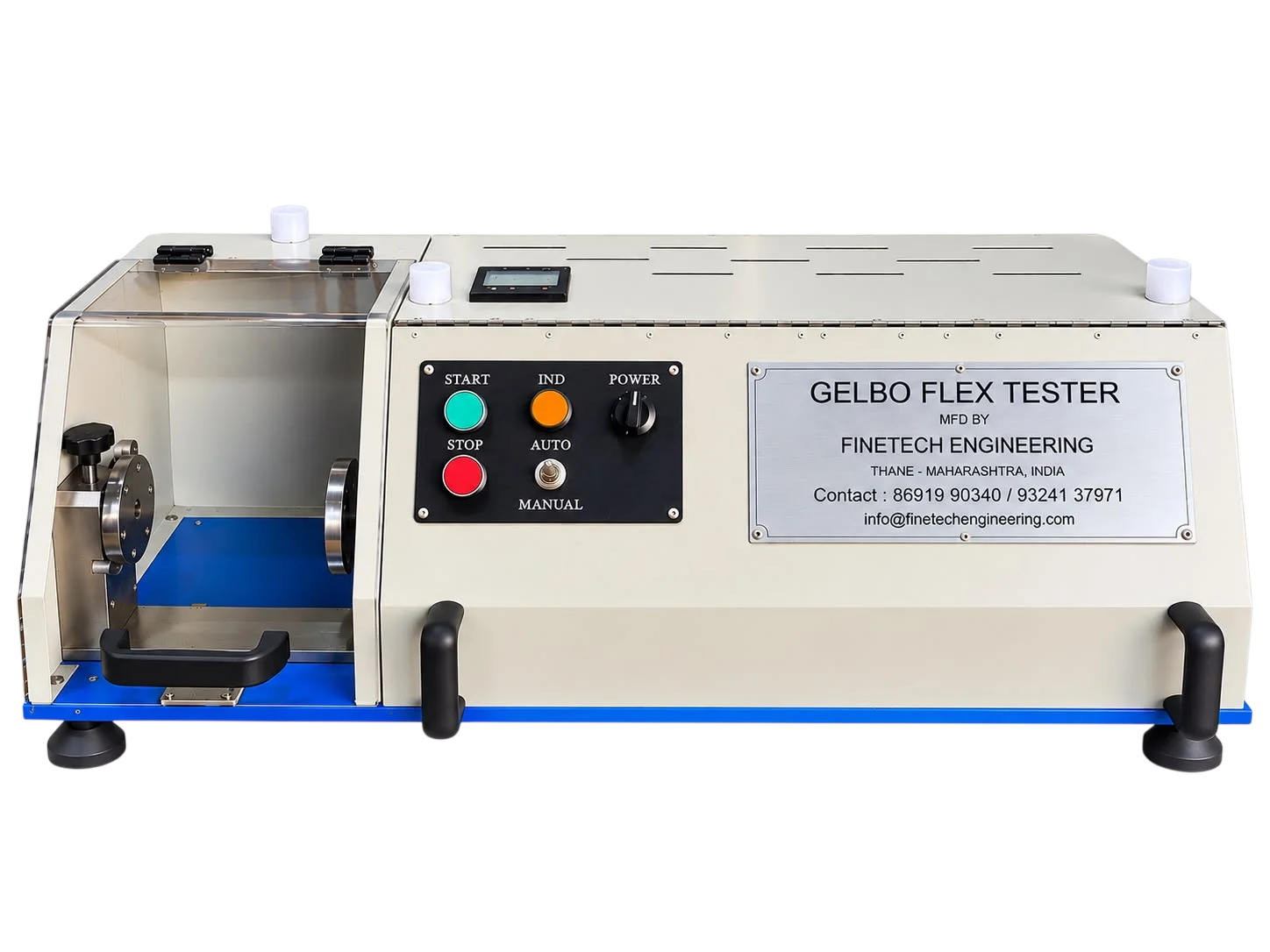
The Finetech Engineering Gelbo Flex Tester simulates the repeated twisting and crushing that a flexible package goes through during filling, cartoning, transport and handling on the shelf. As a gelbo flex tester manufacturer India converters and brand owners buy from directly, we build this machine for one QC question that a fresh-off-the-line barrier test cannot answer: will the laminate still hold its barrier after the pouch has been handled hundreds of times? For labs looking for a flexible packaging film testing machine for pinhole and flex crack work, the Gelbo is the machine that creates that flex damage in a controlled, repeatable way so that a pinhole count or barrier test can then reveal it.
Answering ‘what is gelbo flex test’ in one line: a film specimen is formed into a cylinder, held between two mandrels, and repeatedly twisted through 440° and compressed. The conditioning cycle is defined by the gelbo flex tester ASTM F392 practice, and the damage it creates – flex cracks and pinholes – is then measured by a pinhole count or by a barrier test such as oxygen transmission rate (ASTM D3985) or water vapour transmission rate (ASTM F1249). What does a Gelbo flex tester measure, strictly speaking? Nothing directly – the Gelbo applies the standardised flex, and the pinhole count or barrier loss measured afterwards is the actual result.
That is why the Gelbo is the standard flex durability tester for flexible packaging – retort pouches, aluminium foil laminates, metallised BOPP, PET/PE and nylon/PE co-extruded films, medical pouches and blister lidding. A barrier film can pass an OTR check straight off the laminator and still fail after 900 flex cycles; the Gelbo finds that problem before your customer does. It sits alongside the other flexible packaging testing equipment India film labs rely on, such as the Dart Impact Tester for puncture and the Universal Testing Machine for tensile and seal strength. Add the Gelbo and you have a practical starting point for the packaging QC lab equipment for laminate and pouch testing India labs assemble, with flex durability covered alongside puncture and tensile strength.
Tip: The gelbo flex tester conditions films, not rubber. For flex-cracking of vulcanised rubber use the Demattia Flex Tester (ASTM D430, ASTM D813, ISO 132) or the Ross Flex Tester (ASTM D1052). For impact puncture of film use the Dart Impact Tester (ASTM D1709, ISO 7765-1).
ASTM F392 defines five conditions that differ only in flex type and cycle count. Here is the full ASTM F392 condition A vs condition E comparison, with B, C and D in between:
| Condition | Flex Type | Cycles | Time at 45 cpm | Commonly Chosen For |
| A | Full flex | 2,700 | 60 min | Tough co-extruded PE and nylon/PE films |
| B | Full flex | 900 | 20 min | General barrier laminates, PET/PE pouches |
| C | Full flex | 270 | 6 min | Metallised films, thinner laminates |
| D | Full flex | 20 | ~27 s | Foil laminates, quick screening |
| E | Partial flex (twist only) | 20 | ~27 s | Aluminium foil structures that cannot survive full flex |
Note: The ‘Commonly Chosen For’ column is general guidance only. Always run the condition named in your customer’s specification or your internal QC plan. Answering ‘which ASTM F392 condition should I use for aluminium foil laminate’: the table points to Condition D for quick screening or Condition E (partial flex) where full flex would destroy the foil structure, with your specification still having the final say.
Tip: Answering ‘how many cycles in gelbo flex test’: it depends on the condition – 2,700 for A, 900 for B, 270 for C, and 20 for D and E. You set the count on the controller and the machine stops on its own at the end of the run. Answering ‘how long does a Gelbo flex test take’: at 45 cycles per minute that is about 60 minutes for Condition A, 20 for B, 6 for C and roughly 27 seconds for D and E – plus the time for pinhole counting or barrier testing afterwards.
ASTM F392 conditions the film; it does not grade it by itself. After flexing, laboratories follow one of two evaluation routes. In a pinhole flex test for barrier films, coloured turpentine is applied to the flexed area resting on white paper, and every stain spot that bleeds through is counted as a pinhole. For barrier-critical packaging, the flexed specimen goes for oxygen or water vapour permeation testing and the result is compared against an unflexed control from the same roll. The Gelbo is barrier film flex crack testing equipment in the conditioning sense only: it creates the flex damage in a standard, repeatable way, while the permeation measurement itself is carried out on separate instruments.
| Evaluation Method | What It Shows | Reference Standard |
| Pinhole count (coloured turpentine) | Number of through-holes in the flexed area | ASTM F392 (pinhole evaluation) |
| Oxygen transmission rate (OTR) | Loss of oxygen barrier after flexing | ASTM D3985 |
| Water vapour transmission rate (WVTR) | Loss of moisture barrier after flexing | ASTM F1249 / ASTM E96 |
| Parameter | Specification |
| Product Name | Gelbo Flex Tester (Flex Durability Tester for Flexible Barrier Materials) |
| Test Practice | ASTM F392 / F392M – Conditions A, B, C, D (full flex) and E (partial flex) |
| Flex Action | Twisting plus horizontal compression (full flex) |
| Twisting Angle | 400° or 440° (model dependent) |
| Stroke / Compression Distance | 80 mm or 155 mm horizontal travel (model dependent) |
| Flexing Rate | 45 cycles per minute |
| Specimen Size | 280 × 200 mm (11 × 8 in) |
| Mandrel Diameter | 90 mm (3.5 in), stainless steel |
| Initial Mandrel Spacing | 180 mm (7 in) |
| Cycle Counter | Digital preset counter (micro-controller), 0-99,999, auto-stop at set count |
| Specimen Clamps | Ring clamps that hold the film firmly without trapping air pockets |
| Drive | Motor-driven cam/crank mechanism with fixed twist geometry: 1/2 HP, 1440 RPM gear motor with 45 rpm output, controlled by a Delta-make drive |
| Power Supply | 230 V AC, single phase, 50 Hz |
| Dimensions (approx.) | 1000 mm (W) × 390 mm (D) × 340 mm (H) |
| Certification | ISO 9001:2015, CE |
Key rule: Gelbo for flex cracking of films. Dart impact for puncture of films. Demattia and Ross for flex cracking of rubber. Put another way, Gelbo flex vs dart impact test for packaging film is not a competition: the Gelbo checks whether a film survives repeated flexing, while the Dart Impact Tester checks how it withstands a single puncturing impact, so a QC plan that needs both answers needs both instruments.
| Feature | Gelbo Flex Tester | Dart Impact Tester | Demattia Flex Tester | Ross Flex Tester |
| What It Tests | Flexible barrier films and laminates | Plastic films and thin sheets | Vulcanised rubber strips | Rubber and shoe-sole bars |
| Mechanism | Repeated 440° twist + compression | Single free-falling dart | Repeated bending of grooved strip | Pierced bar bent over a mandrel |
| Result | Pinholes or barrier loss after N cycles | F₅₀ in grams | Crack grade / crack growth | Cut growth vs cycles |
| Standard | ASTM F392 | ASTM D1709, ISO 7765-1 | ASTM D430, ASTM D813, ISO 132 | ASTM D1052 |
Full and partial flex in one machine. As a flex crack resistance tester for films, it runs every ASTM F392 condition from A to E – no second machine needed for foil laminates.
Fixed twist geometry. The twist angle (400° or 440°, by model) and stroke are set by the drive mechanics, so repeatability comes from the machine, not from operator adjustment.
Preset counter with auto-stop. Set 20, 270, 900 or 2,700 cycles and walk away – a 60-minute Condition A run needs no supervision.
Manufacturer, not trader. Every unit is built and calibrated at our Wagle Estate factory. Labs searching for a gelbo flex tester Thane or Mumbai side can book a live demonstration before ordering. As an ASTM F392 flex durability tester supplier India converters can deal with directly, we sell from the factory, not through a distributor.
Direct pricing and service. The gelbo flex tester price India buyers receive from Finetech Engineering carries no trading margin, with spare mandrels, calibration and AMC from the same team that built the machine. For Gelbo flex testing machine cost India enquiries, the figure always depends on counter type, spare mandrel sets and calibration scope, so we quote against your exact configuration rather than a list price.
Complete your flexible packaging testing equipment India lab line-up with these Finetech Engineering instruments:
| Product | Why Related |
Impact puncture of films (ASTM D1709) |
|
Film tensile (ASTM D882) and seal strength (ASTM F88) |
|
Conditioning specimens before flexing |
|
Cutting film strips for tensile testing |
|
Flex cracking of rubber (ASTM D430) |
|
Cut growth of rubber soles (ASTM D1052) |
|
Flex endurance of thin rubber components |
|
Drop testing of filled pouches and cartons |
|
Transport simulation of packed goods |
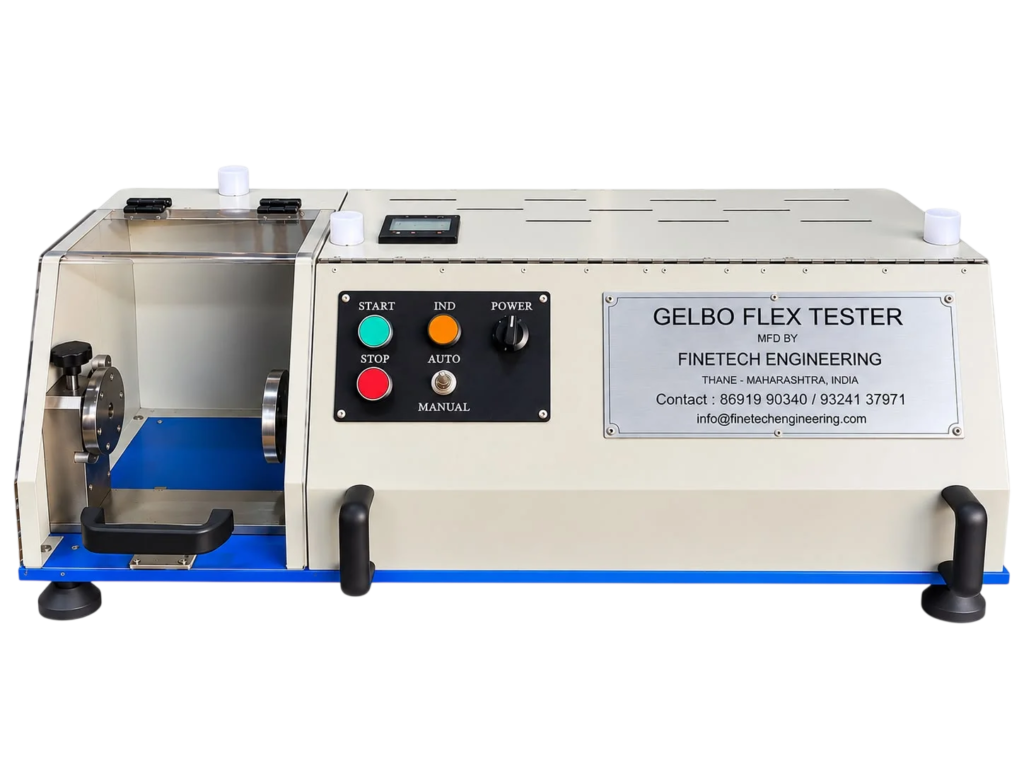


















All Equipments & specimen preparation products can be customised as per requirements.