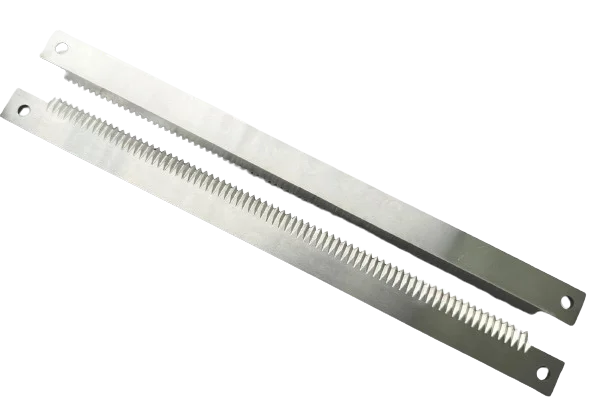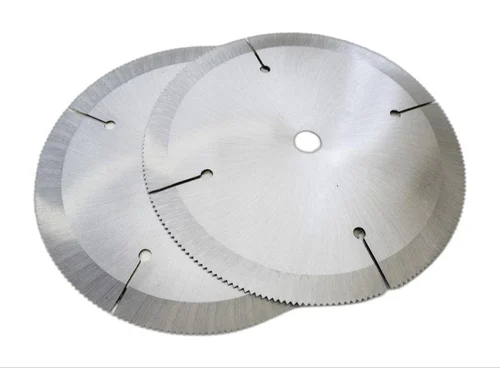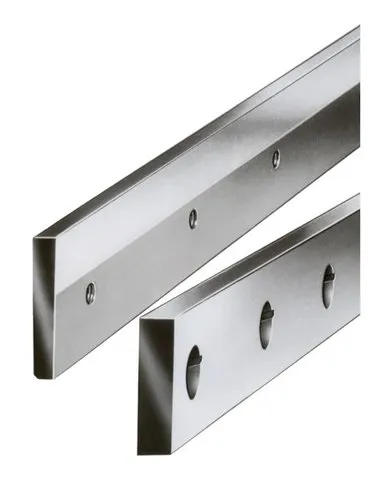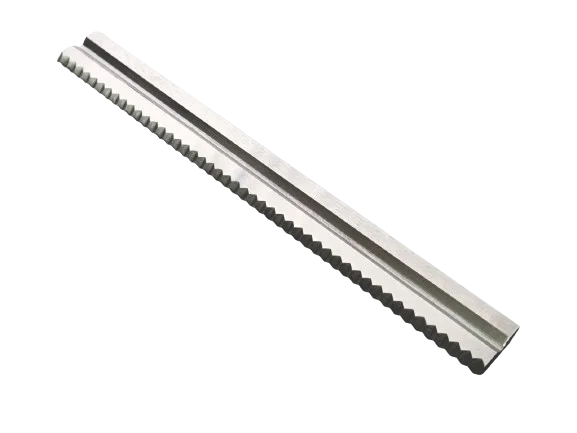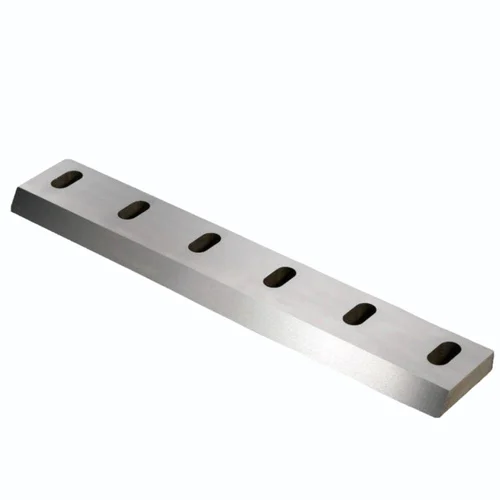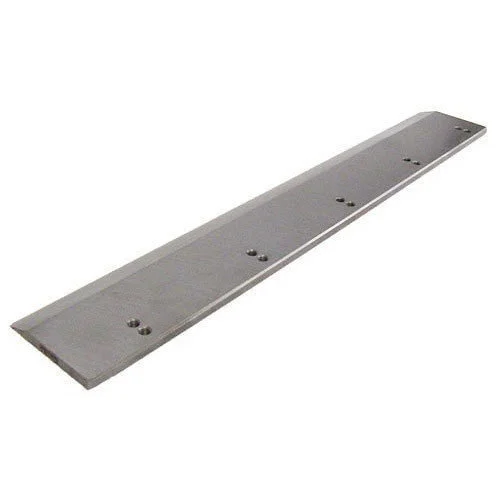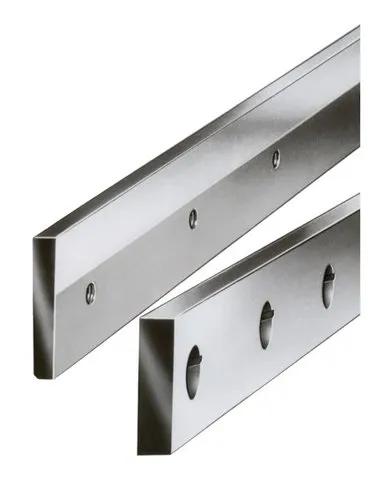







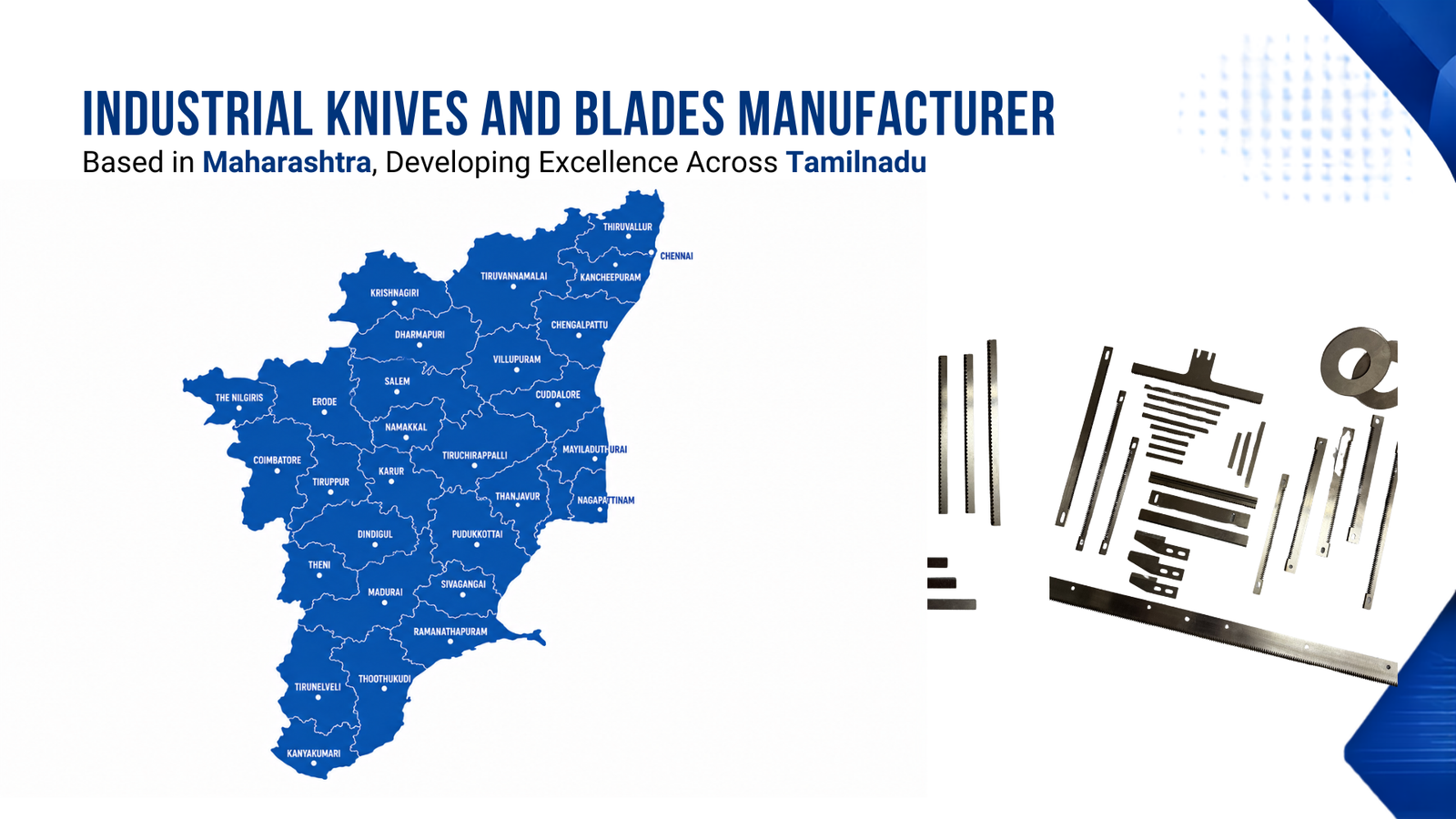
Tamil Nadu’s rubber, tyre manufacturing, auto component and plastics industries all depend on precision industrial blades somewhere in their production process – slitting rubber sheet for tyre building, trimming moulded auto components, or cutting plastic film in packaging lines. Finetech Engineering is an industrial blades manufacturer Tamil Nadu converters and manufacturers turn to because every blade we supply is matched to the material it will cut, the machine it runs in, and the tooth pattern the application demands – not a generic off-the-shelf blank.
As an industrial blades supplier Tamil Nadu plants have sourced from since 2023, the Circular Blades Tamil Nadu converters order most are used for continuous rotary slitting – rubber sheet ahead of tyre building, plastic film in packaging lines, and rewinding operations across the state’s converting plants. We also supply straight, serrated, perforating, packaging and guillotine blades, shear knives and paper cutting blades, each ground to the tolerances and steel grade the application demands.
Our factory in Thane dispatches across the industrial blades manufacturer Chennai-Oragadam-Coimbatore industrial belt, with regular scheduled delivery routes to Chennai, Oragadam, Sriperumbudur and Coimbatore. NABL traceable industrial blades Tamil Nadu certification – covering blade hardness and dimensional verification – is available on request, supporting quality-audit documentation requirements.
Tip: Blade performance depends on three things working together: the steel grade, the heat treatment, and the tooth or edge geometry. Tell us the material you are cutting and the cutting speed of your machine, and we will recommend the right combination – not just supply a generic replacement blade.
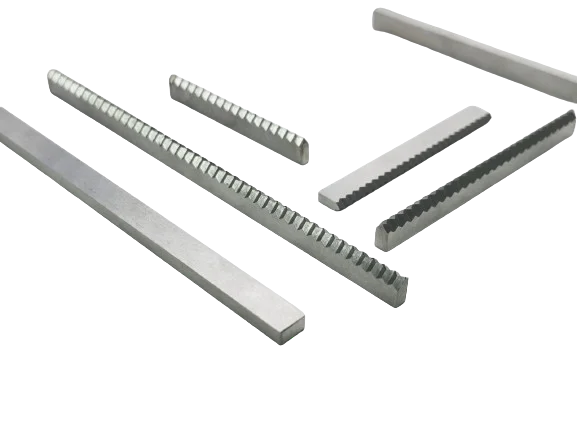
Single tooth vs multi tooth cutter blade which to use is a common question from Tamil Nadu converters choosing a serrated or toothed blade for the first time. The number and pitch of teeth on a blade edge significantly changes how it cuts, and the wrong choice leads to ragged cuts, excessive force, or premature wear:
Feature | Single Tooth (Coarse Pitch) | Multi Tooth (Fine Pitch) |
Cutting action | Fewer, larger teeth bite deeper per stroke, sawing through material with a tearing action | Many small teeth make many shallow cuts, producing a cleaner, smoother cut edge |
Best suited for | Thick, fibrous or slip-prone materials – rubber sheet, thick textiles, foam – where grip matters more than edge finish | Thin, precise materials – packaging film, paper, thin rubber – where a clean edge finish matters |
Cutting speed | Generally faster material removal per stroke, but rougher finish | Slower per stroke but a much finer, more consistent edge finish |
Wear pattern | Individual teeth wear and can chip under heavy loads, but are easier to re-sharpen | Fine teeth are more delicate and can dull or clog faster in sticky or fibrous materials |
Typical Tamil Nadu use | Rubber sheet cutting where grip on a slippery or thick material is the priority | Plastic film slitting and paper/board cutting where visual edge quality matters |
The single tooth vs multi tooth cutter blade which to use decision depends mainly on whether your priority is grip and material removal rate (favouring single/coarse tooth) or edge finish and precision (favouring multi/fine tooth). Some Tamil Nadu converters running mixed product lines keep both tooth patterns on hand and swap blades depending on the material batch.
Industrial knife hardness HRC explained – HRC stands for Rockwell Hardness Scale C, the most common hardness measurement used for industrial blade steel. Understanding what an HRC number means helps Tamil Nadu converters choose the right blade for their application rather than simply asking for “the hardest blade available”, which is not always the right choice.
Note: There is no single “correct” HRC number – the right hardness depends on the balance your application needs between edge retention and impact resistance. Continuous, steady-state slitting of abrasive material benefits from higher HRC; blades subject to shock loading, jams, or frequent impact benefit from a slightly lower HRC that resists chipping.
Tip: If you are seeing chipped or cracked blade edges rather than gradual dulling, the steel may be too hard (high HRC) for your application’s shock loading. If you are seeing rapid dulling with no chipping, the steel may be too soft (low HRC) for the material’s abrasiveness. Tell us which failure pattern you are seeing and we will recommend an HRC adjustment.
Custom blade manufacturing process – when a standard catalogue blade does not match your machine or material, Finetech Engineering builds a custom blade to your exact specification. Here is our process:
Step | What Happens |
1. Application review | We review the material you are cutting, your machine’s mounting dimensions, cutting speed, and any existing blade you are replacing, to define the required profile, steel grade and hardness. |
2. Steel grade selection | Based on the material and duty cycle, we select the appropriate steel grade (high carbon steel, D2 tool steel, stainless, or HSS) and target hardness range. |
3. Cutting & forming | The blade blank is cut and formed to the specified outline dimensions – straight, circular, or a custom profile – using precision cutting and forming equipment. |
4. Heat treatment | The formed blade is heat-treated (hardening and tempering) to achieve the target HRC hardness for the selected steel grade, balancing edge retention against toughness. |
5. Grinding & edge profiling | The cutting edge is precision-ground to the specified angle and, where required, a tooth pattern (single or multi-tooth, per the application) is cut into the edge. |
6. Hardness & dimensional verification | Each batch is hardness-tested (Rockwell C) and dimensionally checked against the agreed specification before dispatch. |
7. Finishing & dispatch | Blades are cleaned, protectively coated if required for transit, and dispatched with documentation covering the agreed specification. |
The custom blade manufacturing process typically takes longer than a catalogue blade order, since it involves specification review and dedicated tooling setup, but it ensures the blade is genuinely matched to your machine and material rather than a compromise fit. Tamil Nadu converters running older or imported machinery, where standard catalogue blades do not fit, are the most common customers for this service.
As an industrial blades supplier Tamil Nadu converters and manufacturers have used since 2023, Finetech Engineering manufactures the following blade range:
| Blade Type | Cutting Action | Typical Application |
| Circular Blades | Continuous rotary cutting edge | Roll-to-roll slitting of rubber sheet, plastic film and paper across tyre and packaging lines |
| Straight Blades | Linear shearing / slitting edge | General-purpose cutting of rubber sheet, film, board and auto-component trim |
| Serrated Blades | Toothed edge (single or multi-tooth) for sawing/gripping cut | Fibrous, thick or slip-prone materials – rubber sheet, foam, textiles |
| Perforating Blades | Intermittent tooth pattern creating a tear line | Tear-off packaging seals, ticket/coupon perforation |
| Packaging Blades | Precision slitting/trimming edge for packaging lines | Film slitting, carton trimming, flexible packaging converting |
| Guillotine Blades | Angled shear-stroke blade | Sheet and board shearing in packaging and plastics processing |
| Shear Knives | Heavy-duty shearing edge | Shearing thicker sheet and heavy-gauge material |
| Paper Cutting Blades | Precision straight or guillotine edge for paper/board | Paper and board converting and packaging finishing |
We dispatch from our Thane factory across Tamil Nadu’s converting and manufacturing belt: Chennai, Oragadam, Sriperumbudur and Coimbatore. As an industrial blades manufacturer Tamil Nadu plants have relied on, we also provide blade inspection, re-sharpening and replacement service.
Manufacturer, not a trader. Every blade is precision-ground, heat-treated and inspected at our Wagle Estate, Thane factory – not resold from another manufacturer.
ISO 9001 certified. ISO 9001 industrial blades Tamil Nadu standard is what we hold – our manufacturing is ISO 9001:2015 certified.
NABL-traceable hardness and dimensional certification. NABL traceable industrial blades Tamil Nadu – blade hardness and dimensions verified and certified, supporting quality-audit documentation needs.
Built for Tamil Nadu’s tyre and rubber converting belt. We dispatch across the industrial blades manufacturer Chennai-Oragadam-Coimbatore industrial belt, with scheduled delivery routes to Chennai, Oragadam, Sriperumbudur and Coimbatore.
Custom blade manufacturing. Where a catalogue blade does not fit your machine or material, we build to your exact specification – steel grade, hardness, and tooth pattern matched to the application.
Re-sharpening and replacement support. We offer blade re-sharpening and replacement to extend service life and maintain cut quality.














All Equipments & specimen preparation products can be customised as per requirements.
The single tooth vs multi tooth cutter blade which to use choice depends on your priority. Choose single/coarse tooth for thick, fibrous or slip-prone materials like rubber sheet or foam, where grip and cutting speed matter more than edge finish. Choose multi/fine tooth for thin, precise materials like packaging film or paper, where a clean, smooth edge finish is important. Some converters keep both and swap depending on the material being run.
Industrial knife hardness HRC explained: HRC (Rockwell Hardness Scale C) measures a blade steel's resistance to indentation, typically ranging from about 20 (soft) to 70 (very hard) for tool steels. Higher HRC means better edge retention and wear resistance, but also more brittleness and risk of chipping under shock loads. The right HRC balances edge retention against toughness for your specific cutting application - there is no single "best" number.
Custom blade manufacturing process: we review your application (material, machine, cutting speed), select the appropriate steel grade and target hardness, cut and form the blade to your specified profile, heat-treat it to the target HRC, precision-grind the edge and cut any required tooth pattern, verify hardness and dimensions against your specification, then finish and dispatch with documentation. This is used when a standard catalogue blade does not match your machine or material.
We are a manufacturer. As an industrial blades manufacturer Tamil Nadu plants have used since 2023, every blade is precision-ground, heat-treated and inspected in-house at our Wagle Estate, Thane facility - not purchased from another manufacturer and resold.
Yes. We hold ISO 9001 industrial blades Tamil Nadu certification - our manufacturing is ISO 9001:2015 certified. We also provide NABL traceable industrial blades Tamil Nadu hardness and dimensional certification on request, verifying blade specifications against the agreed standard.
We deliver and support across the industrial blades manufacturer Chennai-Oragadam-Coimbatore industrial belt: Chennai, Oragadam, Sriperumbudur and Coimbatore. Dispatch is from our Thane factory, with scheduled delivery routes covering these areas.