







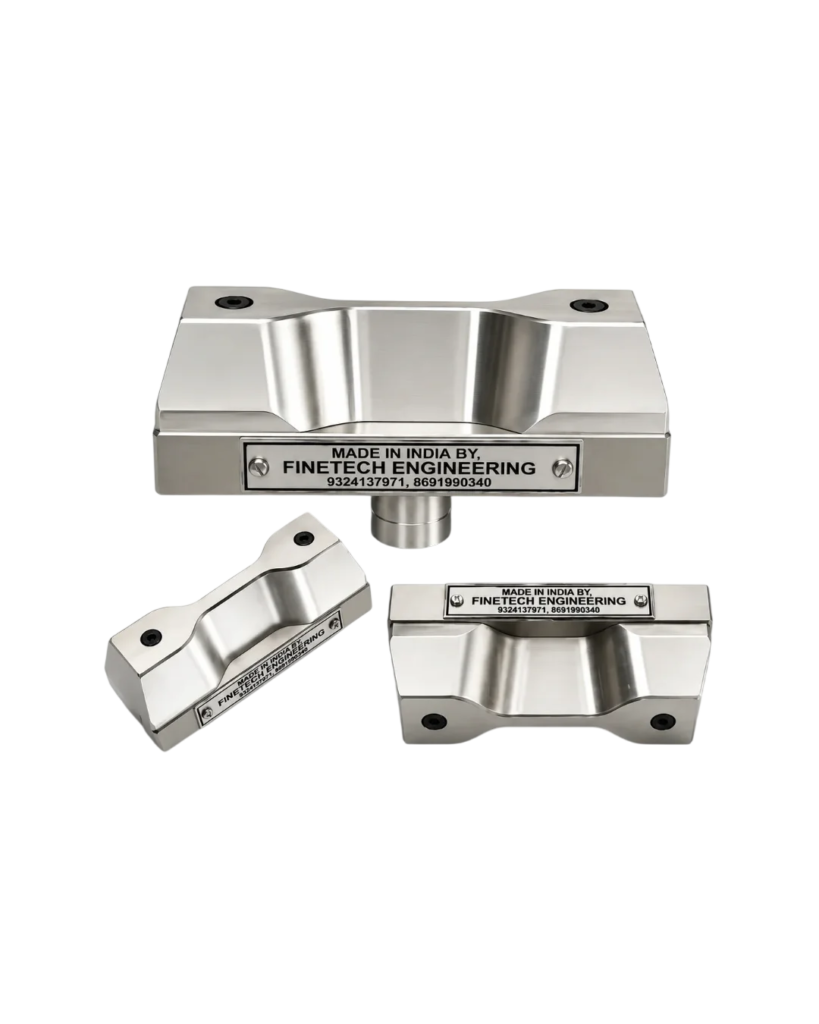
Finetech Engineering is a dumbbell cutter manufacturer Karnataka rubber and plastics testing labs rely on for accurate, repeatable tensile specimen preparation. Every dumbbell cutter we build is precision-ground and dimensionally verified against its governing ASTM or ISO specification before it leaves our Wagle Estate, Thane factory – manufacturer, not trader.
A dumbbell cutter rubber tensile test electronics auto begins with the specimen: a dumbbell-shaped, narrow-waisted strip punched from a rubber or plastic sheet using our dumbbell cutter, then pulled to failure on a universal testing machine to determine tensile strength, elongation at break and modulus. The cutter’s blade geometry directly determines specimen accuracy – a cutter that is even slightly out of tolerance produces specimens that will not give valid, comparable tensile results, regardless of how accurate the testing machine itself is.
As a dumbbell cutter supplier Bangalore and dumbbell cutter supplier Mysore testing labs have used since 2023, we supply cutters built to ASTM D412 (rubber, Dies A/B/C/D) and ISO 37 (rubber, Types 1/2/3), as well as ASTM D638 for plastics tensile specimens where required. For dumbbell cutter price Karnataka enquiries, contact us with your exact die or type requirement and we will confirm a quotation – every cutter is dispatched from our Thane factory with the exact blade geometry your governing standard specifies.
Tip: Karnataka’s electronics and auto-component labs testing both rubber grommets/seals and plastic housings should confirm whether their specification calls for ASTM D412 (rubber) or ASTM D638 (plastics) before ordering – these use different dumbbell dimensions and need separate dedicated cutters. Tell us both applications and we will supply the matching pair. Answering ‘ASTM D412 vs ASTM D638 which dumbbell cutter’ applies to your job directly: D412 for rubber grommets and seals, D638 for plastic housings and connectors – the two use different specimen dimensions and cannot share a single cutter.
Step | What to Do |
1. Prepare the sheet | Start from a moulded or calendared rubber sheet of uniform thickness within the tolerance ASTM D412 specifies (typically 2.0±0.2 mm). Uneven thickness introduces variability unrelated to the compound itself. |
2. Select the correct die | Choose Die A, B, C or D based on your customer or regulatory specification – each produces a different specimen width and gauge length, and results between dies are not directly comparable. |
3. Position the cutter | Place the dumbbell cutter on a clean, representative area of the sheet, away from edges, air bubbles or visible defects that would not represent the bulk compound. |
4. Apply a single firm press | Use a hydraulic or manual press for one clean, single-stroke cut – never a rocking or sawing motion, which distorts the cut edge and can introduce stress concentrations not part of the intended specimen geometry. |
5. Inspect and measure | Check the cut edge for nicks or roughness under magnification, and measure the actual specimen width and thickness at the narrow section – test calculations depend on the measured value, not the nominal sheet thickness. |
6. Condition before testing | Allow the specimen to condition at standard laboratory temperature and humidity for the period ASTM D412 specifies before running the tensile test. |
Note: A dull or nicked dumbbell cutter blade is one of the most common causes of unexplained scatter in tensile results – a rough cut edge acts as a stress concentrator and causes premature specimen failure away from the true material limit. Have your cutter blade inspected and re-sharpened or replaced periodically as part of routine lab maintenance. Answering ‘why does dull cutter blade cause scatter tensile results’ directly: a rough or nicked edge concentrates stress unevenly, so the specimen fails at a weak point in the cut itself rather than reflecting the material’s true tensile limit.
ISO 37 Type 1 vs Type 2 dumbbell cutter Bangalore export is a common question for Karnataka labs supplying electronics and auto-component OEM customers who specify ISO 37 rather than ASTM D412. ISO 37 defines three specimen types (Type 1, 2 and 3), each sized differently:
Feature | ISO 37 Type 1 | ISO 37 Type 2 |
Overall length | ~115 mm (larger specimen) | ~75 mm (smaller specimen) |
Narrow section width | 8.0 mm | 4.0 mm |
Typical use | Larger rubber sheet where more material is available; some legacy or thicker-gauge compounds | The most commonly specified ISO 37 type for general rubber tensile testing – smaller, faster to prepare and test |
Cutter needed | Dedicated Type 1 cutter | Dedicated Type 2 cutter – different blade geometry from Type 1 |
For most Karnataka rubber labs supplying ISO-specifying electronics and auto-component OEM customers, Type 2 is the more commonly requested size, but the ISO 37 Type 1 vs Type 2 dumbbell cutter decision should always be confirmed against the customer’s exact specification – Type 1 and Type 2 are not interchangeable, and a cutter built for one type cannot correctly produce specimens for the other.
Note: ISO 37 Type 3 (a smaller specimen still) exists for limited-material situations but is less commonly specified in standard industrial rubber testing. Confirm with your customer if Type 3 is genuinely required before ordering.
Whether your lab is in Peenya, Electronic City, KIADB Narsapura or Mysore, as a dumbbell cutter manufacturer Bangalore and laboratory equipment manufacturer Karnataka plants have sourced from since 2023, we dispatch dumbbell cutters directly from our Wagle Estate, Thane factory – including testing instruments Peenya Industrial Area labs receive on scheduled delivery routes covering that cluster. As a Peenya Electronic City dumbbell cutter supplier serving both electronics clusters directly, our scheduled routes also reach KIADB Narsapura and Mysore on the same delivery cycle.
Standard | Die / Type | Narrow Width | Gauge Length | Material |
ASTM D412 | Die A | 6.0 mm | 25 mm | Rubber |
ASTM D412 | Die B | 12.5 mm | 25 mm | Rubber |
ASTM D412 | Die C | 6.0 mm | 33 mm | Rubber |
ASTM D412 | Die D | 3.0 mm | 25 mm | Rubber |
ISO 37 | Type 1 | 8.0 mm | ~115 mm overall | Rubber |
ISO 37 | Type 2 | 4.0 mm | ~75 mm overall | Rubber |
ISO 37 | Type 3 | 2.0 mm | ~35 mm overall | Rubber, small specimens |
ASTM D638 | Type IV | 6.0 mm | 25 mm | Plastics |
Manufacturer, not a trader: Every dumbbell cutter is designed, precision-ground and dimensionally verified at our Wagle Estate, Thane factory – not resold from another manufacturer.
ISO 9001 certified: Our manufacturing is ISO 9001:2015 certified and our equipment is CE marked.
NABL-traceable dimensional certification: Cutter dimensions verified and certified against the governing ASTM/ISO specification, supporting NABL-accredited lab audits and electronics/auto OEM supplier requirements.
All ASTM D412 dies and ISO 37 types available: From Die A to Die D, and ISO 37 Type 1 through Type 3, we manufacture dedicated cutters matched to your exact specimen requirement – including the ISO-specified types Karnataka’s electronics and auto OEM customers frequently require.
Scheduled delivery across Karnataka: Regular routes covering Peenya, Electronic City, KIADB Narsapura and Mysore from our Thane factory.
Re-sharpening and replacement support: We offer blade re-sharpening and replacement service to keep your cutter producing clean, repeatable specimen edges.










Tell us which standard you test to (ASTM D412 and die type, ISO 37 and type, or ASTM D638 for plastics), and your location in Karnataka. For dumbbell cutter price Karnataka enquiries, we will confirm your exact specimen requirement first, then send a quotation – no invented figures, no generic pricing.
WhatsApp: +91 93241 37971 (click-to-chat)
Phone: +91 93241 37971 (click-to-call)
Factory & dispatch: C-1 New Kalwa Industrial Premises, Wagle Estate, Thane (W) 400604
All Equipments & specimen preparation products can be customised as per requirements.
A dumbbell cutter rubber tensile test electronics auto begins with the specimen: the cutter punches a dumbbell-shaped, narrow-waisted strip from a rubber sheet, which is then pulled to failure on a universal testing machine to measure tensile strength, elongation at break and modulus. The cutter's blade geometry must match the exact specimen dimensions your governing standard specifies - an inaccurate cutter invalidates the test result regardless of testing machine accuracy.
ASTM D412 specimen preparation step by step Karnataka: start from a uniform-thickness rubber sheet, select the correct die (A, B, C or D) per your specification, position the cutter on a clean representative area, apply a single firm press (not a rocking motion), inspect and measure the cut specimen, and condition it at standard temperature and humidity before testing. Each step affects result validity, and a poorly maintained cutter blade is one of the most common causes of unexplained tensile-test scatter.
ISO 37 Type 1 vs Type 2 dumbbell cutter Bangalore export: Type 1 produces a larger specimen (approximately 115 mm overall, 8.0 mm narrow width), while Type 2 produces a smaller specimen (approximately 75 mm overall, 4.0 mm narrow width) and is the more commonly specified size for general rubber tensile testing. Karnataka's electronics and auto-component OEM-supplying labs should confirm which type their customer specification names before ordering, since the two are not interchangeable.
We are a manufacturer. As a dumbbell cutter manufacturer Karnataka and dumbbell cutter manufacturer India testing labs have used since 2023, every cutter is designed, precision-ground and dimensionally verified in-house at our Wagle Estate, Thane facility - not purchased from another manufacturer and resold.
Yes. We are a dumbbell cutter supplier Bangalore and dumbbell cutter supplier Mysore labs have sourced from directly, alongside Electronic City and KIADB Narsapura. Dispatch is from our Wagle Estate, Thane factory, with scheduled delivery routes covering Karnataka's testing-lab corridor.