







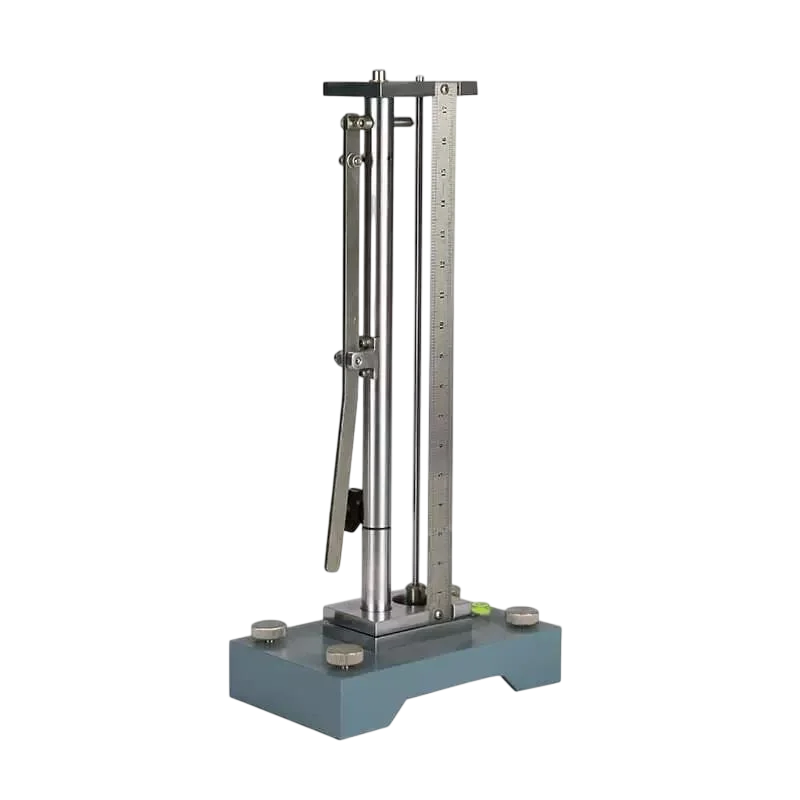
The Finetech Engineering vertical rebound tester manufacturer India is a precision ASTM D2632 rebound tester India that measures the rebound resilience of vulcanised rubber using the vertical plunger drop method. A cylindrical plunger is dropped from a fixed height through a vertical guide tube onto a flat rubber specimen. The plunger bounces off the rubber surface, and the rebound height is measured as a percentage of the original drop height.
To answer “what is rubber rebound resilience test”: this is the simplest and fastest method available. And “how is rubber resilience measured ASTM D2632”: no motors, no pendulums – just a precisely machined plunger, a guide tube, a calibrated scale, and a rubber specimen. Drop the plunger, read the rebound. The entire test takes less than 10 seconds per reading.
The vertical rebound method complements the pendulum rebound method (ISO 4662 / DIN 53512). Both measure resilience but by different impact geometries. ASTM D2632 specifies the vertical method. ISO 4662 covers both methods. Some specifications call for one or the other; some require both. Having both testers in your lab ensures you can meet any customer’s specification.
Note: Your vertical rebound resilience rubber tester India and the pendulum rebound tester measure the same property (resilience) by different methods. Results are correlated but not identical. Always specify which method was used when reporting rebound resilience values.
Parameter | Specification |
Product Name | Vertical Rebound Tester (Plunger Drop Rebound Resilience Tester) |
Test Method | Vertical free-fall plunger drop onto flat rubber specimen; rebound height measured |
Plunger | Cylindrical, specified mass and diameter per ASTM D2632 |
Drop Height | Fixed per standard |
Measurement | Rebound height as % of drop height (visual scale or digital measurement) |
Specimen | Flat rubber disc or button, ≥29 mm diameter, ≥12.5 mm thick (same as hardness buttons) |
Specimen Support | Rigid steel anvil, flat and horizontal |
Guide Tube | Precision-machined vertical tube with low-friction bore |
Standards | ASTM D2632, ISO 4662 |
Power Supply | None required (gravity-driven) |
Certification | ISO 9001:2015 certified manufacturing |
Simplest resilience test available – your Finetech vertical rebound tester manufacturer India choice. No motors, no power supply, no moving parts beyond the plunger. Drop it, read the bounce. Results in seconds.
Same specimen as hardness and pendulum rebound. Use one 29 mm rubber button for three tests: Shore hardness, pendulum resilience, and vertical resilience. Maximum data from minimum specimens.
Complements the pendulum rebound tester – understanding the vertical vs pendulum rebound rubber test difference means having both covers every spec. Some specs require vertical (ASTM D2632), others require pendulum (ISO 4662/DIN 53512). Having both covers all specifications.
Manufacturer, not trader – best vertical rebound tester price India direct from our Thane facility with calibration and support. Built at our Thane facility. Direct calibration and support.
| Product | Why Related |
Complementary resilience test by pendulum method |
|
Same specimen – hardness and resilience on one button |
|
Complementary viscoelastic property testing |
|
Complementary abrasion testing |
|
Complementary tensile testing |


















All Equipments & specimen preparation products can be customised as per requirements.
The answer to “what is rubber rebound resilience test”: it is the percentage of energy returned when a standard plunger is dropped onto a rubber specimen from a fixed height. The plunger bounces, and the ratio of rebound height to drop height is the resilience. Higher percentage = more elastic material.
On the vertical vs pendulum rebound rubber test difference: vertical rebound (ASTM D2632) drops a plunger vertically, and how is rubber resilience measured ASTM D2632 – by reading the rebound height as a percentage. Pendulum rebound (ISO 4662, DIN 53512) swings a pendulum horizontally. Both measure resilience but by different geometries. Results are correlated but not identical – always report which method was used.
A flat rubber disc or button, 29 mm or more diameter, at least 12.5 mm thick – the same as the specimens for Shore hardness and pendulum rebound testing. Note: does rebound resilience affect rolling resistance tyre? Yes – higher rebound resilience typically means lower rolling resistance, making this test valuable for tyre compound development.
No. The basic model is entirely gravity-driven. Just drop the plunger and read the scale. This makes it suitable for factory-floor use, field testing, or labs without power.
Yes. The Finetech ASTM D2632 rebound tester India meets requirements for NABL accreditation. We provide calibration certificates for plunger mass, drop height, and guide tube alignment.