







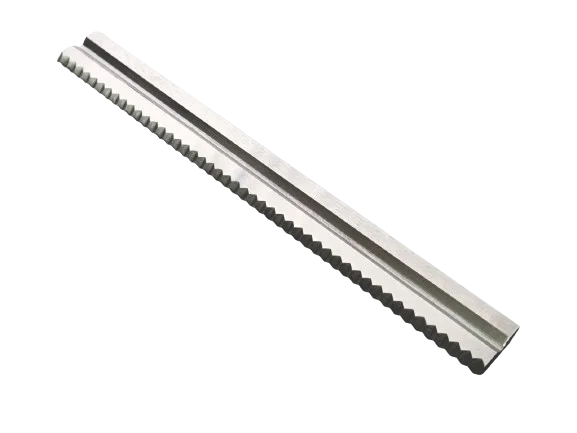
Understanding “what is a perforating blade packaging”: every time you tear open a biscuit packet, peel a ketchup sachet, or rip a paper towel from the roll, a perforating blade made it possible. These easy open packaging perforation blades India create a line of alternating cuts and uncut bridges (the cut-and-skip pattern) that weakens the material just enough to be torn by hand while keeping it intact during manufacturing, filling, transport, and shelf handling.
Understanding “what is cut-to-bridge ratio perforation blade” and “how to choose tooth pitch perforating blade”: both must be exactly right for the material. Too many cuts and the material tears during transport; too few and the consumer cannot open the pack. A 1 mm shift in tooth pitch across a 200 mm blade means inconsistent tear behaviour – a rejection risk for your packaging line.
Finetech Engineering, a trusted perforating blades manufacturer India and circular perforating blades manufacturer India, manufactures both rotary and straight configurations. Also a leading tissue paper perforation blades manufacturer India, we use D2 tool steel, HSS, and tungsten carbide with custom tooth pitch from 0.5 mm (micro-perforation for tissue) to 10 mm+ (coarse perforation for corrugated).
| Tooth Pitch | Cut-to-Bridge Ratio | Tear Difficulty | Best For |
| Fine (0.5–2 mm) | 3:1 or 4:1 | Very easy tear | Tissue paper, toilet rolls, paper towels, consumer sachets |
| Medium (2–4 mm) | 2:1 or 3:1 | Easy tear | BOPP pouches, flow-wrap packs, snack bags, labels |
| Standard (4–6 mm) | 1.5:1 or 2:1 | Moderate tear | Corrugated boxes, heavy paper, cardboard, industrial film |
| Coarse (6–10 mm+) | 1:1 or 1.5:1 | Firm tear | Heavy industrial packaging, transport packaging, pallet wrap |
Feature | Circular Perforating Blade | Straight Perforating Blade |
Shape | Disc with teeth around circumference | Flat blade with teeth along one edge |
Motion | Continuous rotation against anvil roller | Linear stroke (up-down or cross-cut action) |
Application | In-line (machine direction) perforation on web-fed machines | Cross-perforation (across the web) on converting machines |
Speed | High-speed continuous operation (200+ m/min) | Intermittent or lower speed |
Typical Use | Film slitting with tear lines, label web perforation, tissue converting | Pouch cross-perforation, bag-on-roll separation, sheet cross-perf |
Sizes | OD 20–300 mm, ID and thickness to spec | Length up to 1,000 mm |
Substrate | Recommended Blade Material | Why | Typical Life |
BOPP, CPP, PET film | D2 tool steel (HRC 58–60) | Oriented films are moderately abrasive; D2 provides good wear life at reasonable cost | 1–4 weeks |
LDPE, LLDPE film | D2 tool steel | Soft PE is easy on blades; D2 is cost-effective | 2–6 weeks |
Metallised film, aluminium foil | Tungsten carbide or carbide-tipped | Metal layer destroys D2 edges rapidly; only carbide survives | 4–12 weeks |
Paper, tissue, label stock | D2 or HSS (M2) | Recycled paper is abrasive; HSS for high-speed tissue lines | 1–4 weeks |
Corrugated board | D2 tool steel | Abrasive recycled fibres; D2 handles the abrasion | 1–3 weeks |
Cling film, stretch film | D2 or stainless steel | Low abrasion; stainless if food-contact is required | 3–8 weeks |
Parameter | Specification |
Product Name | Perforating Blades (Cut-and-Skip Perforation Knives) |
Blade Types | Circular (rotary) and Straight (flat) |
Circular OD Range | 20 mm to 300 mm |
Circular ID (bore) | To machine specification |
Straight Length Range | Up to 1,000 mm |
Tooth Pitch Range | 0.5 mm (micro) to 10 mm+ (coarse) |
Cut-to-Bridge Ratio | Customisable from 1:1 to 5:1 |
Tooth Profiles | V-tooth, U-tooth, alternating hi-low, custom profiles |
Steel Grades | D2, M2 (HSS), SS 420/440C, tungsten carbide |
Heat Treatment | In-house; HRC 58–65 depending on grade |
Tolerances | Tooth pitch ±0.02 mm; OD/ID ±0.01 mm; thickness ±0.02 mm |
Surface Finish | Ground, polished, chrome or TiN coating available |
Custom Capability | Any tooth pattern to drawing, sample, or specification |
Certification | ISO 9001:2015 |
Custom tooth pitch to ±0.02 mm accuracy – your trusted tear line blades packaging manufacturer India. Every tooth is CNC-ground to the specified pitch. No variation from tooth to tooth means a consistent perforation line across the entire blade – no sections that tear too easily or refuse to tear.
Cut-to-bridge ratio engineered for your material. We do not sell one standard perforation pattern. We specify the ratio based on your film type, film thickness, filling speed, and consumer opening requirement. Send us a sample of your desired tear behaviour and we will reverse-engineer the tooth pattern.
Both circular and straight in one order. Need in-line (machine-direction) and cross-direction perforation on the same line? We manufacture both from the same facility.
Material matched to your line speed and substrate. D2 for standard films. HSS for high-speed tissue lines. Carbide for metallised film and foil. We specify – you decide.
Manufacturer, not trader – trusted perforating blades manufacturer India at Thane facility. Ground, heat-treated, and inspected at our Thane facility. Custom perforation blades in 7–14 working days.
Product | Why Related |
Rotary slitting blades for packaging film | |
Cross-cut knives for packaging machines | |
For tearing-open applications with serrated profiles | |
Full range of blades for packaging and converting machines | |
Full range by geometry | |
Find blades matched to your specific industry |








All Equipments & specimen preparation products can be customised as per requirements.
Answering “what is a perforating blade packaging”: it is a cutting tool with a cut-and-skip tooth pattern that creates alternating cuts and uncut bridges in a material, allowing it to be torn by hand without tools. Used to create tear lines, easy-open features, and sheet separation in packaging, paper, tissue, labels, and corrugated products.
Answering “what is cut-to-bridge ratio perforation blade”: it is the proportion of cut length (where the tooth cuts) to bridge length (the uncut gap). A 3:1 ratio (3 mm cut, 1 mm bridge) tears easily; a 1:1 ratio (equal cut and bridge) tears firmly. The ratio is the primary specification for how easily the perforation tears.
Fine pitch (0.5–2 mm) for tissue and consumer sachets that must tear very easily. Medium pitch (2–4 mm) for BOPP pouches and snack bags. Standard pitch (4–6 mm) for corrugated and heavy paper. Coarse pitch (6–10 mm+) for transport packaging that must survive handling before being opened. Tell us your application and we will recommend.
Yes. Send us a drawing showing the desired tooth pitch, cut length, bridge length, and tooth profile (V, U, or custom). Or send us a sample of a perforation you like and we will reverse-engineer the pattern. Custom perforating blades are typically delivered in 7–14 working days.
D2 tool steel (HRC 58–60) is the standard for BOPP film perforation. For metallised BOPP or high-speed lines running 24/7, upgrade to HSS (M2) or tungsten-carbide-tipped blades for longer life.
It depends on the substrate and blade material. D2 blades on standard BOPP film: 1–4 weeks. Carbide blades on metallised film: 4–12 weeks. Tissue lines with HSS blades: 2–6 weeks. We can recommend a material that optimises your change frequency and total cost of ownership.
Yes. As a trusted tissue paper perforation blades manufacturer India, Finetech manufactures fine-pitch circular perforating knives for high-speed tissue lines – the blades that create the sheet-separation perforation on every paper towel and toilet tissue roll.