







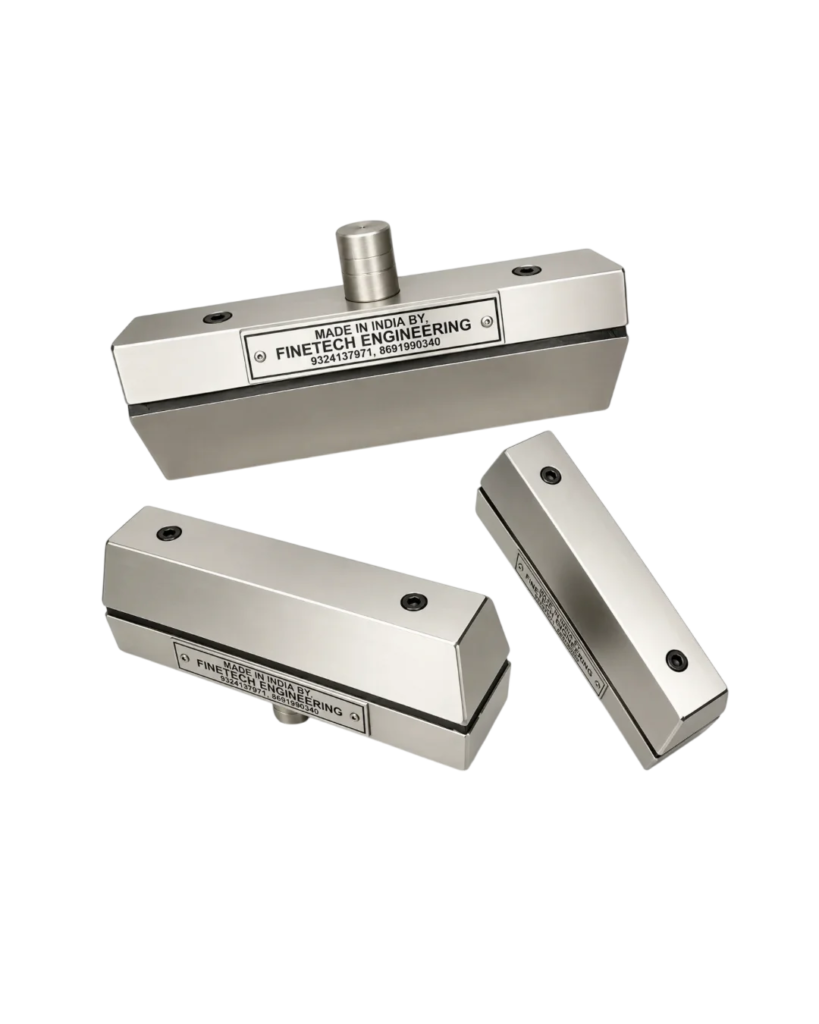
The Finetech Engineering Rectangle Specimen Cutter India is a precision parallel-blade die used to cut uniform rectangular test strips from flat sheets of rubber, plastic film, paper, paperboard, textile, and flexible packaging materials. As a specialist rectangular die cutter for rubber plastic and paper manufacturer, we produce this cutter in multiple widths to serve a broader range of testing standards than any other specimen geometry.
Unlike dumbbell cutters (which produce shaped specimens with a narrow gauge section), our rectangle specimen cutter India produces specimens with a constant width across their full length – a straight-sided strip. Rectangular strips are the most versatile specimen shape in material testing, specified across rubber tensile and fatigue testing (ASTM D412, D4482), plastic film testing (ASTM D882), paper tensile testing (ISO 1924, TAPPI T494), and textile testing (ASTM D5035, ISO 13934-1).
The key to reliable results is consistent strip width. Even a 0.5mm variation across the length of the strip introduces significant error in calculated stress values because the cross-sectional area changes. As a strip cutter for compression set testing India and general strip-cutting specialist, Finetech Engineering grinds every rectangular die cutter for rubber plastic to ±0.1mm parallelism – ensuring every strip is exactly the specified width from end to end.
Test / Application | Strip Width | Standard | Material |
Tensile testing of rubber (straight specimen) | 6 mm or as per die type | ASTM D412, ISO 37 Type 2 | Vulcanised rubber, TPE |
Extension cycling fatigue (FTFT) | Approx. 4 mm (narrow section) | ASTM D4482 | Vulcanised rubber |
Tensile testing of plastic films < 1 mm thick | 25 mm ± 0.5 mm | ASTM D882 | LDPE, HDPE, BOPP, stretch films |
Tensile testing of paper and paperboard | 15 mm or 25 mm | ISO 1924-2, ISO 1924-3, TAPPI T494 | Paper, paperboard, tissue |
Tear testing of paper (Elmendorf) | 63 mm × 76 mm (special shape) | TAPPI T414, ISO 1974 | Paper, paperboard |
Tensile testing of textiles (strip method) | 50 mm ± 0.5 mm | ASTM D5035, ISO 13934-1 | Woven and non-woven fabrics |
Peel testing of adhesive bonds | 25 mm standard | ASTM D1876, D903 | Adhesive laminates, tapes, films |
Compression set strip specimens | Various widths | ASTM D395 (if strip form) | Rubber |
General-purpose strip cutting | Custom width to order | Any | Any sheet material |
Standard | Specimen Description | Width (mm) | Length (mm) | Thickness (mm) |
ASTM D412 (straight specimen) | Straight uniform cross-section strip | 6 (or per grip width) | 150 typical | 2–3 |
ISO 37 Type 2 | Narrow rectangular strip | 4 | 75 | 2 |
ISO 37 Type 3 | Narrow rectangular strip | 4 | 50 | 2 |
ASTM D4482 (FTFT) | Fatigue strip with tabbed ends | ~4 (narrow section) | ~79 overall | 2 |
IS 3400 Part 1 | Straight strip for tension set | 6 or as specified | 150 typical | 2–3 |
Standard | Description | Width (mm) | Gauge Length (mm) | Thickness (mm) |
ASTM D882 | Thin sheeting and film tensile testing | 25 ± 0.5 | 50 (initial grip separation: 50–250) | < 1.0 |
ASTM D1938 | Tear propagation of thin films | 25.4 | 75 (notched) | < 0.25 |
Standard | Description | Width (mm) | Test Span (mm) | Notes |
ISO 1924-2 | Paper tensile (constant rate of elongation) | 15 ± 0.1 | 180 (grip separation) | Standard method |
ISO 1924-3 | Paper tensile (higher strain rate) | 15 ± 0.1 | 100 | Faster method for high-volume testing |
TAPPI T494 | Paper/paperboard tensile | 25 ± 0.5 | 180 (grip separation) | North American standard |
ASTM D828 | Paper/paperboard tensile | 25 | 180 | Similar to TAPPI T494 |
TAPPI T414 (Elmendorf tear) | Paper tear strength | 63 × 76 mm | Special Elmendorf template | Requires Elmendorf-specific die |
Standard | Description | Width (mm) | Gauge Length (mm) |
ASTM D5035 | Textile tensile (strip method) | 25 or 50 ± 0.5 | 75 |
ISO 13934-1 | Textile tensile (strip method) | 50 ± 0.5 | 200 |
ASTM D5587 | Textile tear (trapezoid method) | 75 × 150 mm | Trapezoid template |
Parameter | Specification |
Product Name | Rectangular Strip Specimen Cutter (Parallel Blade Die Cutter) |
Standard Widths Available | 6 mm, 10 mm, 15 mm, 25 mm, 50 mm |
Custom Widths | Any width manufactured to order (specify with enquiry) |
Cutting Length | Standard: 150 mm, 200 mm, 250 mm. Custom lengths available. |
Standards Supported | ASTM D412, D882, D4482, D1938, D5035ISO 37, ISO 1924, ISO 13934TAPPI T494, T414IS 3400ASTM D828, D1876, D903 |
Blade Material | Hardened tool steel (EN-31 / equivalent) |
Blade Hardness | 50–56 HRC |
Cutting Edge Finish | Precision ground, parallel edges. Polished min. 5 mm from cutting edge. |
Edge Parallelism | Parallel within ±0.1 mm across full cutting length |
Body Material | Mild steel (MS) body with machined handle |
Wall Thickness | Minimum 5 mm |
Operation | Used with Hydraulic Press / Manual Press / Pneumatic Press |
Certification | NABL-traceable dimensional certification available |
Precision parallelism. Every Finetech rectangle specimen cutter India is ground to ±0.1mm edge parallelism across the full cutting length – ensuring every strip is exactly the specified width and your tensile stress calculations are accurate.
One cutter covers multiple standards. A 25mm rectangular die cutter for rubber plastic covers ASTM D882 (plastic films), TAPPI T494 (paper), ASTM D5035 (textiles), and peel testing (ASTM D1876) – making it the most versatile die in your lab.
Complete width range. Standard widths from 6mm to 50mm, plus any custom width manufactured to order. Our strip cutter for compression set testing India range covers every strip width your standards require.
NABL certification available. NABL-traceable dimensional certification verifying parallelism and cutting width – essential for accredited labs using our rectangle specimen cutter India products.
Multi-strip cutters available. Need 5 or 10 identical strips in one press stroke? As your rectangular die cutter for rubber plastic manufacturer, Finetech makes multi-lane strip cutters for high-volume paper, film, and rubber testing labs.
| Product | Why Related |
For dumbbell/dogbone tensile specimens (ASTM D412, D638) |
|
For tear strength testing (ASTM D624, ISO 34-1) |
|
Labs testing paper tensile strips also test burst strength |
|
Uses rubber strips cut by the strip cutter for compression set testing |
|
The machine that runs tensile tests on cut strip specimens |
|
Drives the rectangular die cutter through sheet material |
|
For moulding rubber sheets from which strips are cut |










All Equipments & specimen preparation products can be customised as per requirements.
Yes. Finetech Engineering provides NABL-traceable dimensional certification verifying the cutting width and edge parallelism of each strip cutter.
Standard cutting lengths are 150 mm, 200 mm, and 250 mm. Custom lengths are available on request. The cutting length refers to the length of the cutter die itself — the specimen strip produced will be the same length as the cutter (minus a few mm at each end where the blade curves).
Yes. We manufacture multi-lane strip cutters (e.g., a cutter that produces 5 or 10 parallel strips in a single press stroke). This is commonly requested by paper mills and film testing labs that need to cut large numbers of identical strips for batch testing. Contact us with the number of strips and the width, and we will design a multi-strip cutter for your application.