


Which Dumbbell Cutter Do I Need for Rubber Tensile Testing? (ASTM D412 vs ISO 37)
If you manufacture rubber products – seals, gaskets, hoses, footwear soles, automotive components, or any vulcanised rubber compound – tensile testing is a non-negotiable part of your quality control process. And tensile testing starts with one thing: the dumbbell cutter.
But here is where it gets confusing. ASTM D412 gives you six die options: Die A through Die F. ISO 37 gives you four more: Type 1 through Type 4. Then there is IS 3400 Part 1 for Indian manufacturers. That is 11 possible die types for what seems like a simple test. Which one do you actually need?
This guide answers which dumbbell die to use for rubber tensile testing (ASTM and ISO). It walks you through every die type in ASTM D412 and ISO 37, explains when to use each one, shows you the dimensions in clear tables, and tells you which die is the right default choice for most rubber testing labs.
Why This Question Matters More Than You Think
I have seen labs in Thane, Pune, and Ahmedabad using the wrong dumbbell die for years without realising it. A factory in Thane was using ASTM D412 Die A for their routine QC testing. Die A is the largest die in the D412 series – it is designed for thick, soft rubber. Their rubber was a medium-hardness EPDM compound, 2 mm thick. The specimens were too wide for their UTM grips, and the gauge section was so long that the specimens stretched beyond the crosshead travel. They were getting inconsistent results and blaming the UTM.
The fix was simple: switch to Die C. Die C is the standard die for most rubber tensile testing worldwide. It cost them ₹2,500 for a new die. It would have saved them months of questionable test data if they had chosen correctly from the start.
The die you choose determines the specimen dimensions, which determines how the specimen behaves in the UTM, which determines whether your test results are valid and comparable to the rest of the industry.
How Rubber Tensile Testing Works (Quick Overview)
What is the rubber tensile test? Here is a simple explanation: rubber tensile testing measures how strong a rubber compound is when pulled apart and how much it stretches before breaking. Elongation at break is the percentage stretch at the point of failure. The test is simple:
- Cut a dumbbell-shaped specimen from a vulcanised rubber sheet using a dumbbell cutter and a hydraulic press
- Mount the specimen in a universal testing machine using roller grips (self-tightening grips that handle high elongation)
- Pull the specimen at a constant speed (typically 500 mm/min for rubber) until it breaks
- The UTM records the force and elongation, and calculates tensile strength (MPa) and elongation at break (%)
The dumbbell shape ensures that the specimen breaks in the narrow gauge section – not at the grips. The wider ends give the grips something to hold without damaging the test zone. If the specimen breaks at the grip, the test is invalid.
ASTM D412 Dumbbell Dies - Die A Through Die F Explained
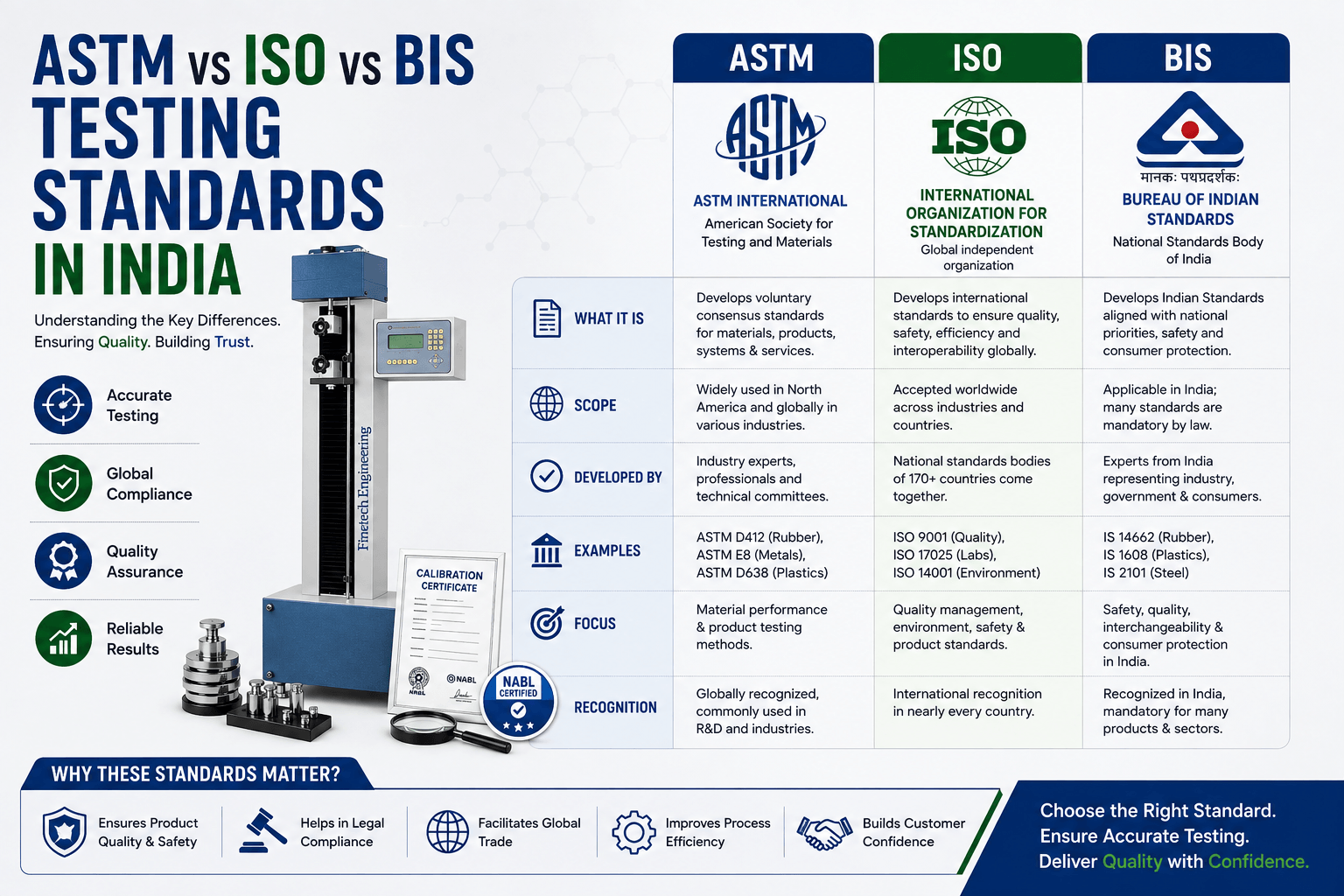
ASTM D412 is the American standard for tensile testing of vulcanised rubber and thermoplastic elastomers. It defines six die types, labelled A through F. As a leading rubber tensile specimen cutter ASTM D412 India manufacturer, Finetech supplies all six die types. Each has different dimensions:
Dimension Table – ASTM D412 Die A–F
Die | Overall Length (mm) | Gauge Length (mm) | Gauge Width (mm) | End Width (mm) | Best For |
Die A | 101.6 | 33.0 | 6.0 | 25.0 | Thick, soft rubber (≥3 mm thick) |
Die B | 101.6 | 33.0 | 3.0 | 25.0 | Thin rubber (<3 mm), same length as A |
Die C | 115.0 | 33.0 | 6.0 | 25.0 | THE STANDARD – most common die worldwide for rubber QC |
Die D | 115.0 | 33.0 | 3.0 | 25.0 | Thin rubber (<3 mm), same length as C |
Die E | 76.0 (approx) | 10.0 | Variable | Variable | Miniature die for small specimens or limited material |
Die F | 38.0 (approx) | 7.6 | Variable | Variable | Very small die for micro-specimens |
Which ASTM D412 Die Should You Use? (The Short Answer)
Use Die C from your trusted ASTM D412 Die C dumbbell cutter manufacturer India – available from Finetech, your specialist manufacturer in India. Unless your specification or customer explicitly calls for a different die, Die C is the default choice for rubber tensile testing per ASTM D412. It is the most widely used die in the global rubber industry. If you walk into any rubber testing lab in India – from a tyre factory in Chennai to a seal manufacturer in Pune – the die they use is almost certainly Die C.
Use Die D if your rubber sheet is thinner than 3 mm and the Die C gauge width of 6 mm would cause the specimen to curl or buckle during gripping.
Use Die A or Die B only if your standard or customer specification explicitly requires them. They were common in older specifications but have been largely replaced by Die C and Die D in current practice.
Dies E and F are specialised miniature dies used primarily in R&D applications where material availability is limited. Most QC labs will never need them.
ISO 37 Dumbbell Dies - Type 1 Through Type 4 Explained
ISO 37 is the international standard for tensile testing of vulcanised rubber. It defines four die types. Understanding ASTM D412 vs ISO 37 dumbbell specimen dimensions is essential before choosing your die:
Dimension Table – ISO 37 Type 1–4
Type | Overall Length (mm) | Gauge Length (mm) | Gauge Width (mm) | End Width (mm) | Best For |
Type 1 | 115 | 33 | 6 | 25 | Large specimen – equivalent to ASTM D412 Die C dimensions |
Type 2 | 75 | 25 | 4 | 12.5 | THE ISO DEFAULT – most common ISO 37 die, smaller than Type 1 |
Type 3 | 50 | 16 | 4 | 8.5 | Small die for limited material |
Type 4 | 35 | 12 | 2 | 6 | Miniature die for very thin or scarce material |
The default ISO 37 die is Type 2 – available from Finetech as your ISO 37 Type 2 dumbbell cutter manufacturer India. If your customer or standard says “ISO 37” without specifying a type, use Type 2. It is the most widely used ISO rubber tensile die.
Type 1 has the same gauge dimensions as ASTM D412 Die C (33 mm gauge length, 6 mm gauge width), making it directly comparable. If your lab tests to both ASTM D412 and ISO 37, using Die C and Type 1 gives you comparable specimen geometry.
ASTM D412 vs ISO 37 - Side-by-Side Comparison
If your lab serves both ASTM and ISO markets, you need to understand how the die types compare.
Feature | ASTM D412 Die C | ISO 37 Type 2 |
Overall Length | 115 mm | 75 mm |
Gauge Length | 33 mm | 25 mm |
Gauge Width | 6 mm | 4 mm |
End Width | 25 mm | 12.5 mm |
Specimen is… | Larger – needs more material | Smaller – uses less material |
Test Speed | 500 mm/min | 500 mm/min |
Grip Type | Roller grips | Roller grips |
Most Common In | India (domestic), USA, ASTM markets | Europe, Asia (export), ISO markets |
Key takeaway: a Die C specimen is significantly larger than a Type 2 specimen. On the ASTM D412 Die C vs ISO 37 Type 1 difference: both have the same gauge dimensions (33 mm length, 6 mm width) making them the closest ASTM/ISO equivalents. If you are testing the same rubber compound, tensile strength values should be comparable, but elongation at break may differ slightly due to gauge length differences between Die C and Type 2.
If you need to compare results from different labs – one using ASTM D412 Die C and the other using ISO 37 Type 2 – be aware that the results are not directly interchangeable without a correlation study.
What About IS 3400 Part 1? (For Indian Manufacturers)
IS 3400 is the Bureau of Indian Standards (BIS) master standard for methods of testing vulcanised rubber. Part 1 covers tensile stress-strain properties.
IS 3400 Part 1 references dumbbell specimens and specifies dimensions that align with the ISO 37 Type 2 die (75 mm overall, 25 mm gauge, 4 mm width). If your customer or the BIS specification says “test per IS 3400 Part 1,” the ISO 37 Type 2 die is what you need.
Many Indian government tenders specify IS 3400. Having the ISO 37 Type 2 die in your lab ensures you can meet both IS and ISO requirements with the same die. See our rubber industry testing equipment range for the complete IS 3400 setup.
Common Mistakes When Choosing a Rubber Dumbbell Cutter
- Using ASTM D638 dies for rubber – ASTM D638 is for rigid plastics. The specimen dimensions are completely different. Rubber must use ASTM D412 or ISO 37.
- Using Die A when Die C is correct – Die A is the legacy default. Die C is the current standard for most applications.
- Using a plastic dumbbell die and assuming it works for rubber – the gauge widths, lengths, and end shapes are different.
- Not checking whether the customer requires ASTM or ISO – the die dimensions are different, and results are not directly interchangeable.
- Buying the cheapest die without checking steel quality – soft steel dulls after 100–200 cuts on vulcanised rubber.
- Never verifying die dimensions against the standard – a worn die produces undersized specimens that give false high tensile results.
What to Look for in a Quality Dumbbell Cutting Die
- Hardened tool steel (HRC 56+) – resists edge deformation when cutting through tough vulcanised rubber
- Wire EDM or CNC machined – achieves the tight dimensional tolerances required by ASTM D412 and ISO 37
- Sharp, burr-free cutting edge – produces clean specimens without edge damage or stress whitening
- Dimensional inspection certificate – with measured gauge length, gauge width, and radius, traceable to the standard
- Manufacturer, not trader – a manufacturer can re-sharpen, customise, and certify the die. A trader can only resell.
How to Order the Right Die
When contacting Finetech Engineering (or any specimen cutter manufacturer), provide:
- Standard: ASTM D412 or ISO 37 (or IS 3400 Part 1)
- Die type: Die C, Die D, Type 1, Type 2, etc.
- Quantity: how many dies you need
- Press type: do you already have a pneumatic press, or do you need one? (Pneumatic, hydraulic, or manual)
- NABL certification: do you need a dimensional inspection certificate? See our calibration services for details
- Custom requirements: any non-standard dimensions?
Other Rubber Specimen Cutters You May Need
The dumbbell cutter is the starting point. But a complete rubber testing lab also needs:
- Tear specimen cutter (ASTM D624 Type C) – for tear strength testing
- Crescent specimen cutter (ASTM D624 Type A/B) – for tear propagation testing
- Round specimen cutter (29 mm for compression set, 16 mm for DIN abrasion) – for button and disc specimens
- Rectangular strip cutter – for fatigue testing and flex specimens
Finetech manufactures all of these in-house. Ask for a bundled quote that covers your complete specimen preparation needs.
Frequently Asked Questions
The answer to “which dumbbell die for rubber tensile testing ASTM ISO”: ASTM D412 Die C is the most common worldwide. If your specification says ASTM D412 without specifying a die type, use Die C. For ISO 37, the default is Type 2.
No. On dumbbell cutter ASTM D638 vs D412 rubber plastic: they have completely different specimen dimensions. You need separate dies for each standard.
The ASTM D412 Die C vs ISO 37 Type 1 difference: they have the same gauge length (33 mm) and gauge width (6 mm), making them the closest ASTM/ISO equivalents. Both are 115 mm overall. For practical purposes they produce comparable results.
If your lab is NABL accredited, yes – you need a dimensional inspection certificate for every die, verifying that the gauge length, gauge width, and radius meet the standard’s tolerances. Finetech provides this with every die.
With proper use (using a press, not a mallet) and on standard vulcanised rubber, a hardened tool steel die typically lasts 1,000–2,000 cuts before it needs re-sharpening or replacement. Hard rubber compounds or abrasive fillers reduce this lifespan.
For daily QC cutting (50+ specimens/day), use a pneumatic press. For occasional cutting or thick/hard rubber, use a hydraulic press. For low-volume labs, a manual press works. All Finetech presses accept all Finetech dies.
Final Thoughts
Choosing which dumbbell cutter for rubber tensile testing comes down to three decisions:
- Which standard? ASTM D412, ISO 37, or IS 3400 Part 1 – check your customer’s specification.
- Which die type? Die C for ASTM D412. Type 2 for ISO 37. These are the defaults for 90% of rubber QC labs.
- Which manufacturer? Choose one that machines their own dies in hardened tool steel, provides dimensional certificates, and can re-sharpen or customise when you need it.
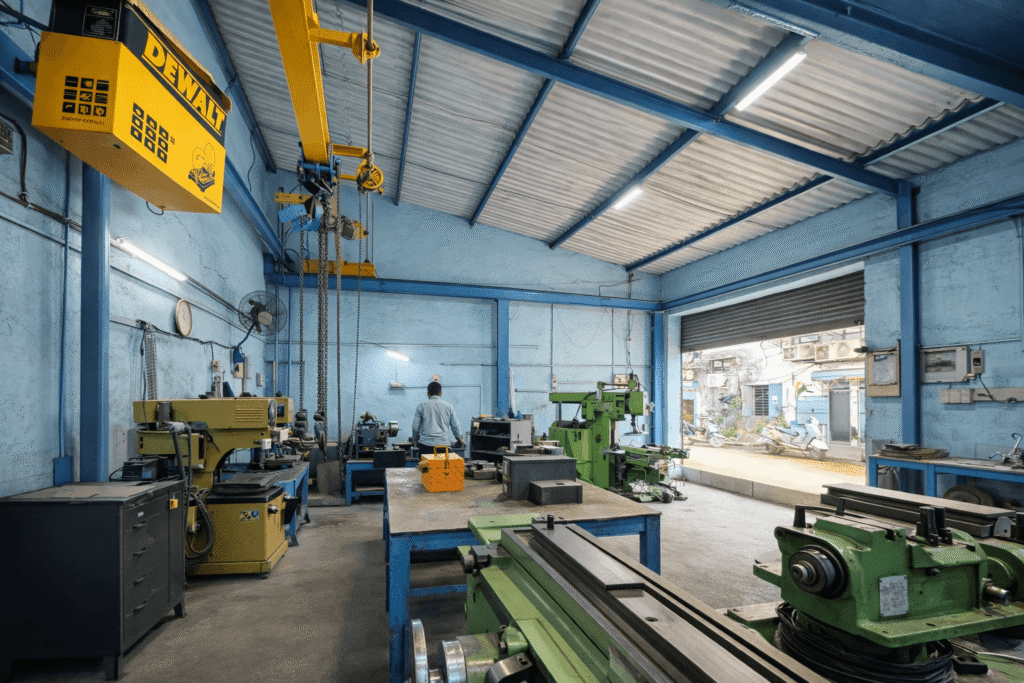
Finetech Engineering manufactures the complete range of rubber specimen cutters at our facility in Thane, Maharashtra. We build dies for ASTM D412 (Die A–F), ISO 37 (Type 1–4), and IS 3400 Part 1. Every die comes with a dimensional inspection certificate. And because we also manufacture the presses, grips, moulds, and testing machines, we can equip your entire rubber testing lab from one source.
Need a rubber dumbbell cutter? Tell us your standard (ASTM D412 or ISO 37) and die type. We’ll confirm dimensions and quote within 24 hours.
WhatsApp: +91 93241 37971 | Email: info@finetechengineer.com | Visit: /specimen-cutters-and-moulds/
– Santhosh Kumar VP, Founder & Managing Partner, Finetech Engineering