







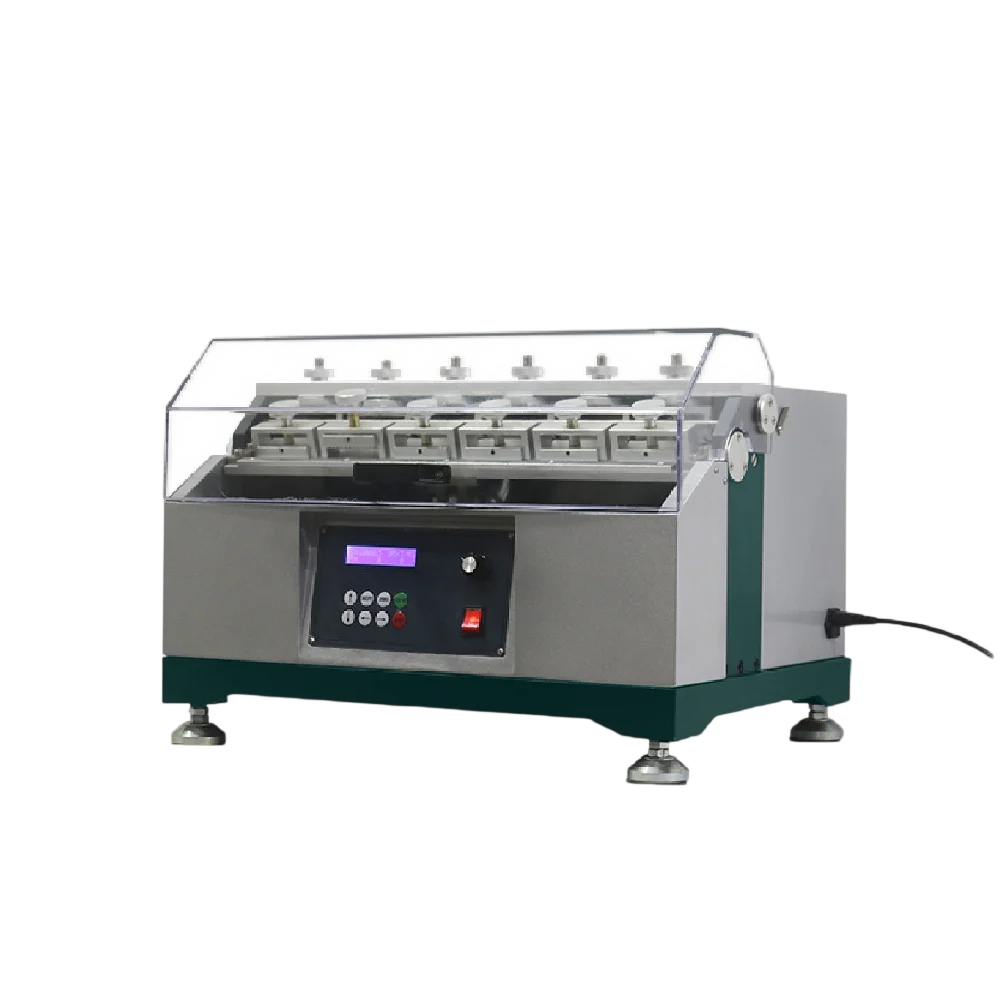
Understanding what is Ross flex test rubber cut growth: the Finetech Engineering rubber flex fatigue cut growth tester India measures how quickly a pre-existing cut in a rubber specimen grows when the material is subjected to repeated flexing. This test is critical for any rubber product that bends in service – shoe soles that develop cracks at the toe crease, conveyor belt covers that get nicked by sharp material, and hoses that develop surface cuts from abrasion.
Answering “how does Ross flex test work rubber”: a rectangular rubber specimen with a controlled pre-cut is clamped in the rubber cut growth resistance tester India and bent repeatedly. At regular intervals, the operator measures the length of the cut. The rate of cut growth (in mm per kilocycle) is the test result. A compound with low cut growth rate is more durable in applications where surface damage is inevitable.
The Ross vs Demattia flex tester rubber difference: Ross uses a pierced rectangular bar bent over a mandrel and measures cut growth rate; Demattia uses a grooved specimen bent between grips and measures crack initiation and growth. Many specifications require both tests for a complete flex fatigue characterisation.
Note: The ASTM D1052 cut growth tester rubber India requires pre-pierced specimens. Finetech manufactures the Ross flex mould for moulding specimens with the correct geometry and pre-cut – see our test specimen moulds range. Order the mould separately.
Parameter | Specification |
Product Name | Ross Flex Tester (Cut Growth Resistance Machine) |
Test Method | Repeated flexing of a pre-cut rubber specimen over a mandrel |
Specimen | Rectangular bar with central pre-cut (pierced), per ASTM D1052 |
Flexing Speed | Approximately 100 cycles/min (model-dependent) |
Flexing Angle | Per ASTM D1052 specification |
Specimen Stations | Multiple (model-dependent) |
Cycle Counter | Digital counter |
Drive | Electric motor with controlled-speed drive |
Standards | ASTM D1052, IS 3400 |
Power Supply | 230V AC, single phase, 50 Hz |
Certification | ISO 9001:2015 certified manufacturing |
ASTM D1052 and IS 3400 cut growth tester rubber India compliance – meets both international and Indian standards. Meets both international and Indian standards for cut growth testing.
Complements the Demattia flex tester – the Ross vs Demattia flex tester rubber difference means both together give a complete flex fatigue picture. Ross tests cut growth over a mandrel; Demattia tests flex cracking in a groove. Together they give a complete flex fatigue picture.
Ross flex mould available. We manufacture the mould for producing the pre-pierced specimens – complete specimen preparation from one supplier.
Manufacturer, not trader – best Ross flex tester price India direct from our Thane facility. Built at our Thane facility with direct calibration and AMC support.
| Product | Why Related |
Complementary flex crack initiation and growth testing |
|
Complementary abrasion resistance testing |
|
Complementary tensile and tear testing |
|
Ross flex mould and other specimen preparation tools |
|
Complementary viscoelastic property testing |


















All Equipments & specimen preparation products can be customised as per requirements.
To clarify “what is Ross flex test rubber cut growth”: it measures the rate at which a pre-existing cut in a rubber specimen grows when the specimen is repeatedly bent over a mandrel. The result is reported as cut growth in mm per kilocycle of flexing. Lower cut growth = better durability.
The Ross vs Demattia flex tester rubber difference: Ross bends a pre-pierced specimen over a mandrel and measures cut growth rate (mm/kilocycle); Demattia bends a grooved specimen between grips and measures both crack initiation (kilocycles to first crack) and crack growth rate. They test different aspects of flex fatigue. Many specifications require both.
As a dedicated footwear sole cut growth flex tester India, the Ross flex test is used most heavily by footwear sole manufacturers – it directly simulates the bending that occurs at the ball of the foot during walking. Conveyor belt and hose manufacturers also use it.
A rectangular rubber bar with a controlled pre-cut (pierce) at the centre, moulded in a Ross flex mould. The mould produces the correct specimen geometry per ASTM D1052.
Yes. As a certified Ross flex tester manufacturer India, Finetech provides calibration certificates for flexing speed and angle for NABL accreditation.