







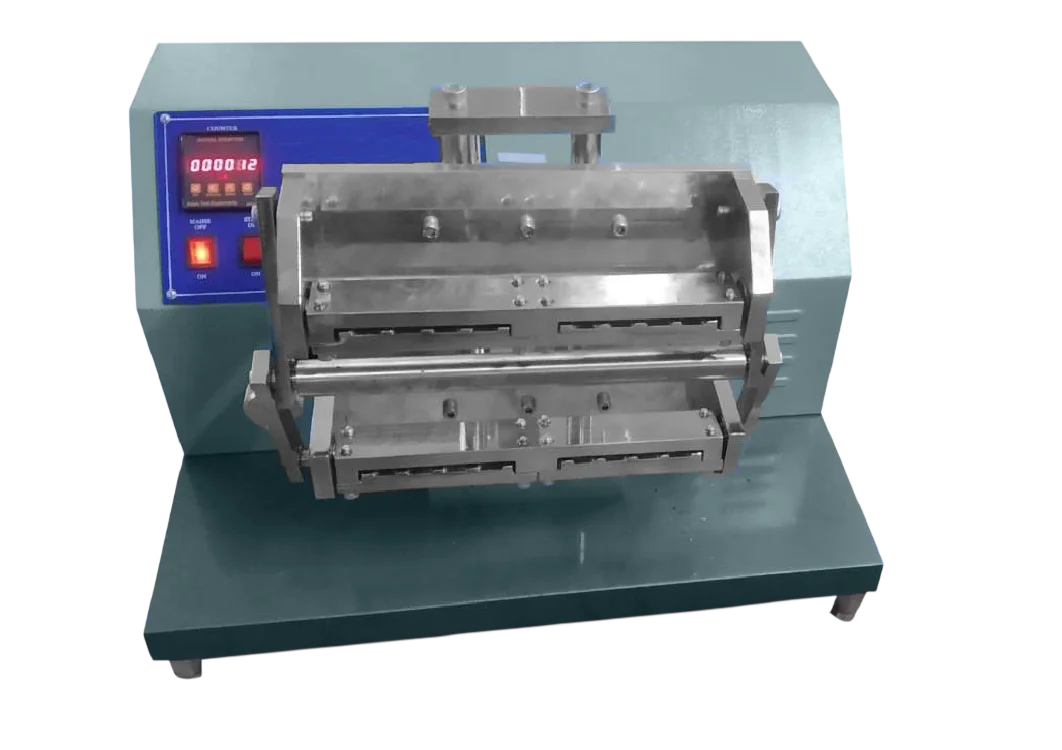
Finetech Engineering is a Bennewart flex tester manufacturer that sole-compound and footwear labs in Gujarat buy from directly: manufacturer, not a trader, built at Wagle Estate, Thane. For Gujarat labs working one step before the shoe, at the PVC, TPR or EVA compound stage, this flex endurance tester for footwear rubber and polymer soling is a recipe tool as much as a pass/fail check: a notched specimen bends through 90°, and the cut growth shows how the compound will behave at the sole’s flex line. As a Bennewart Flex Tester manufacturer that compounders in Gujarat can deal with without an agent, we set it up for the specimen your compound lab moulds.
What is the Bennewart flex test? A notched specimen of sole or sole compound is flexed repeatedly, and cut growth is read in millimetres at the end of the count. How many cycles does it run? 30,000 flexes in the ISO 17707 and EN ISO 20344 outsole tests; compound screening can use a different count if the buyer’s method sets one. The ISO 17707 outsole flex test checks a finished outsole, while the SATRA TM161 Bennewart flex test method adds a material cut-growth variant that suits sole compound flex cut growth testing on moulded sheet.
Parameter | Specification |
Product Name | Bennewart Flex Tester (Thin Rubber Flexing Endurance Machine) |
Test Method | Repeated flexing of thin rubber specimens to failure |
Specimen | Thin rectangular rubber strip, 2–4 mm thick, per IS 3400/DIN 53522 |
Specimen Stations | Multiple (model-dependent) |
Flexing Frequency | Controlled, per standard specification |
Cycle Counter | Digital counter with auto-stop |
Drive | Electric motor |
Standards | IS 3400, DIN 53522 |
Power Supply | 230V AC, single phase, 50 Hz |
Certification | ISO 9001:2015 certified manufacturing |
Bennewart fits outsole-type specimens and SATRA TM161 material cut growth. Thin rubber sheet and glove-rubber specifications more often call for Ross or De Mattia (ISO 132) flexing, and upper materials are flexed on different equipment – confirm which your buyer cites. How does compound formulation affect outsole flex resistance? Plasticiser level in PVC, filler loading, polymer blend ratio, cure or crosslink state, and foam density in EVA all change how fast a notch grows, so changing one formulation variable at a time gives the cleanest comparison.
| Standard | Method | Test parameter |
ISO 17707 |
Footwear outsole flex resistance (Bennewart) |
Pre-cut outsole flexed; notch growth in mm |
EN ISO 20344 / 20345 |
Safety footwear outsole flex |
30,000 flexes; notch growth in mm |
SATRA TM161 |
Bennewart flex test – cut growth on flexing |
90° flex; outsole cut growth, crack initiation, or material cut growth |
ASTM D1052 / IS 3400 Part 16 |
Ross flexing – a different machine |
Pierced strip bent 90° over a rod; cut growth tracked |
What is the difference between a Bennewart and a Ross flex tester? Both measure cut growth under 90° bending, but they are different machines with different specimens – Bennewart for outsoles and sole materials, Ross for a pierced rubber strip – so results are not interchangeable. Note that ASTM D1052 is the Ross method; Bennewart outsole testing follows ISO 17707 and SATRA TM161. PVC soling is flexed on the same Bennewart under SATRA TM161 or ISO 17707; the standard your buyer names decides the specimen.
Manufacturer, not a trader. A laboratory testing equipment manufacturer that labs in Gujarat deal with directly: built, calibrated and dispatched from Wagle Estate, Thane. Gujarat compounders deal with us at the factory, and we can also supply matching specimen cutters so every notch starts the same.
NABL traceable, ISO 9001:2015. Calibration certificates traceable to national standards; CE marked.
Direct factory supply. We quote your flex endurance tester for footwear rubber for the compounds you actually mould – PVC, TPR, EVA or rubber – with no reseller margin added.
Direct dispatch from Thane since 2023. Labs in Ahmedabad and Surat buy from us directly; we dispatch from Thane with installation, calibration and AMC. GIDC Vatva buyers reach the factory directly, with no dealer margin to pay.
See the full specifications on our main Bennewart flex tester page. We also supply and install Bennewart flex testers in other states: Bennewart flex tester in Andhra Pradesh · Bennewart flex tester in Karnataka · Bennewart flex tester in Maharashtra · Bennewart flex tester in Tamil Nadu · Bennewart flex tester in Telangana.
| Product | Why Related |
Complementary flex testing for standard-thickness specimens |
|
Complementary cut growth testing |
|
Complementary abrasion testing |
|
Complementary tensile testing |
|
Specimen preparation tools |
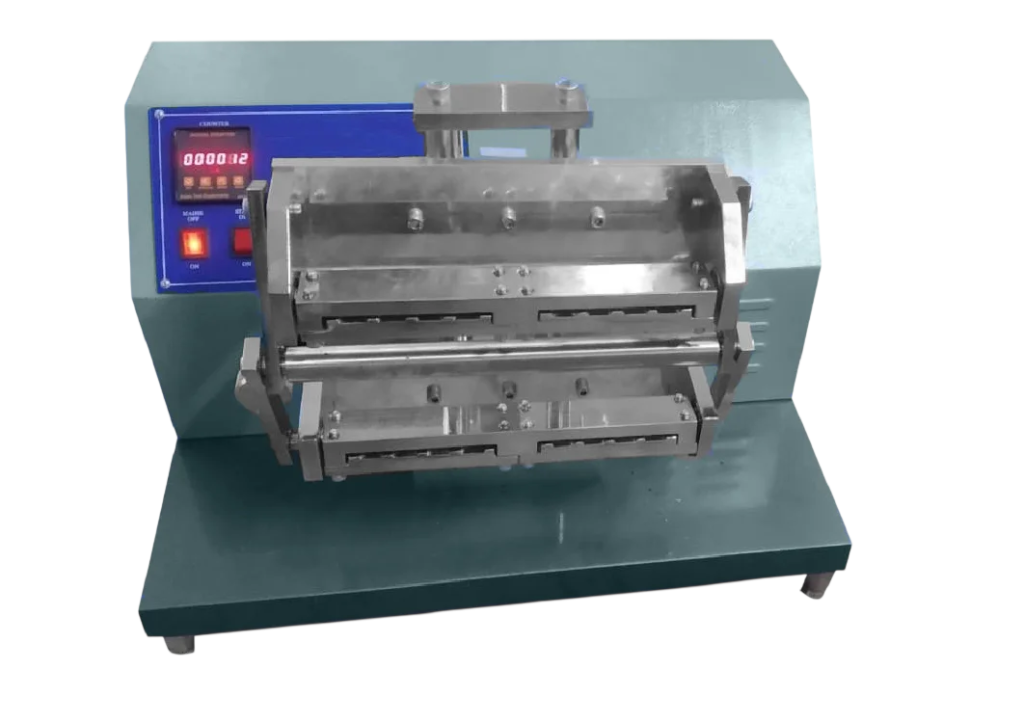


















All Equipments & specimen preparation products can be customised as per requirements.
Our Bennewart flex testers measure cut or crack growth in outsoles and sole compounds under repeated 90° flexing - that is the Bennewart flex test in practice. For compound labs, the result is most useful as sole compound flex cut growth testing that ranks recipes, not only as a single pass/fail.
ISO 17707, the outsole-flex clauses of EN ISO 20344/20345, and SATRA TM161; under EN ISO 20344 the test runs 30,000 flexes. Asked about an IS 3400 flex test procedure? The Indian rubber cut-growth method we can confirm is IS 3400 Part 16, the Ross method; tell us the standard your buyer cites and we will confirm the configuration. For sheet compounds, the SATRA TM161 Bennewart flex test method is the usual reference; for a finished sole, the ISO 17707 outsole flex test.
Change one ingredient per recipe, keep the sheet thickness, notch length, conditioning and flex count identical, flex all recipes in the same run, and record notch growth in mm for each. That is sole compound flex cut growth testing in practice, and it shows how formulation affects outsole flex resistance before you commit to a production batch. As the manufacturer, we help set up the first comparison run at installation.
Yes. We dispatch from Thane to Ahmedabad and Surat, and labs in Surat can order the same way. Send your standard and specimen type for a quotation. There is no dealer in between, so you get the factory's own quote.
For a Bennewart flex tester price in India, we quote against your standard and specimen type - no invented figures, no generic list price. Send your requirement through the form or WhatsApp.
Ross flexing (ASTM D1052, IS 3400 Part 16) bends a pierced rubber strip over a rod - see the comparison above; ASTM D1052 flex endurance testing of rubber is a Ross job. Bennewart tests outsoles and sole materials, not uppers. For comparing compound recipes, see the recipe FAQ above; Ross and De Mattia results should not be mixed into a Bennewart recipe comparison.