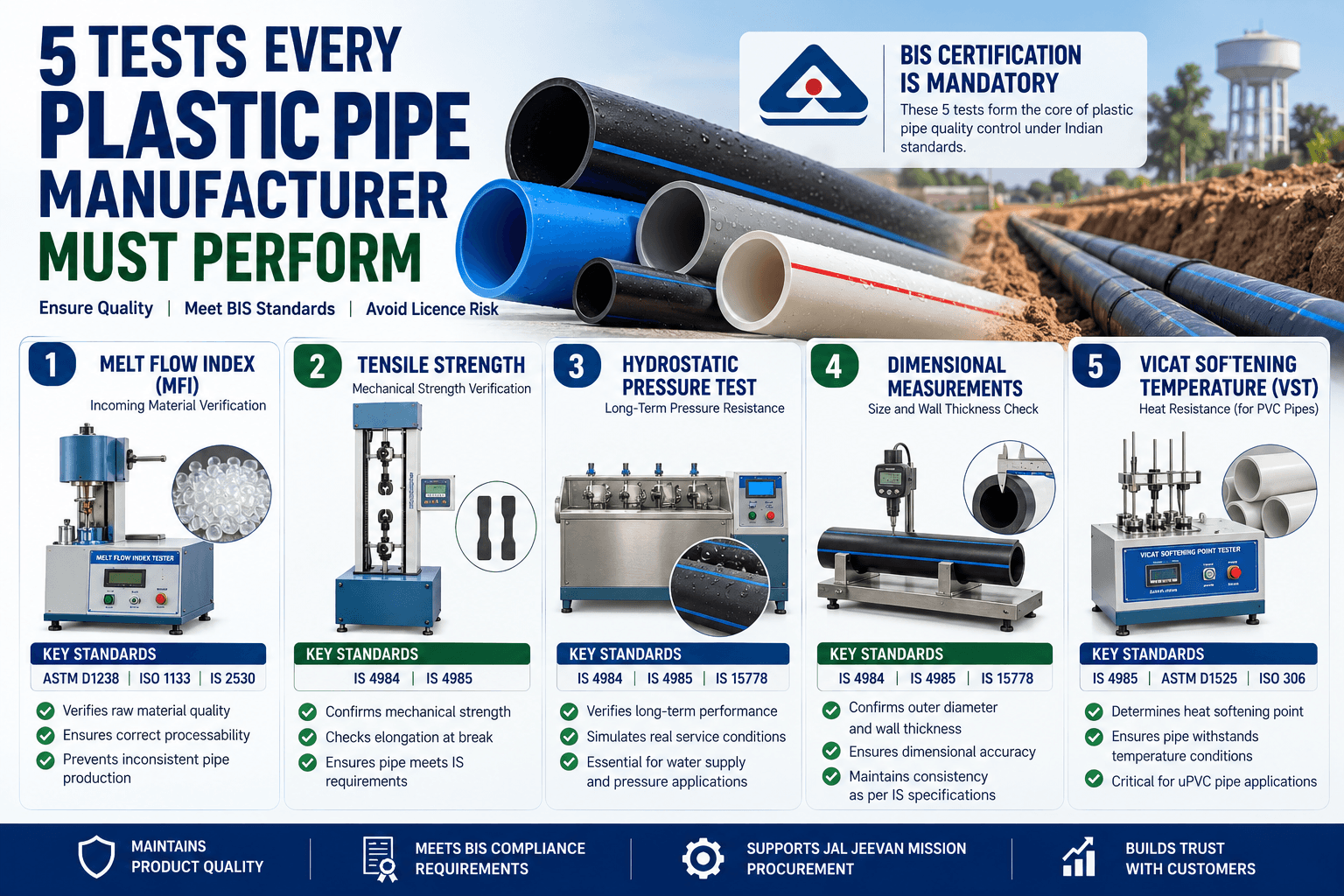



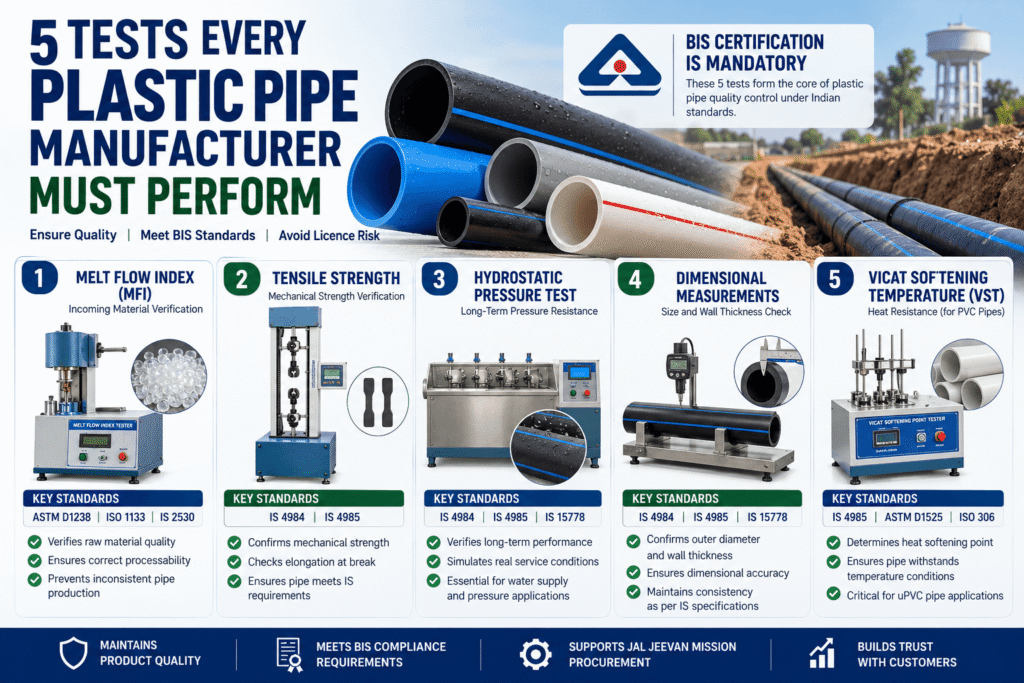
5 Tests Every Plastic Pipe Manufacturer Must Perform
BIS certification is now mandatory for most pipe categories. If you don’t have these 5 tests covered, you are risking your licence – not eventually, but at your very next surveillance audit.
I have been getting a noticeably higher volume of calls over the past year from small and mid-sized pipe manufacturers, many of them new to BIS compliance, asking essentially the same question: what do we actually need to test, and what equipment covers it? This blog answers that question directly, with the five tests that form the core of pipe quality control under Indian standards. If you are asking what tests are required for BIS pipe certification, the honest answer is exactly these five – not a longer list, and not a shorter one.
Why Pipe Standards Are Getting Stricter
Two forces are driving the increased scrutiny on plastic pipe quality in India right now. First, BIS has tightened enforcement and expanded mandatory certification (IS-mark requirement) across more pipe categories in recent years – HDPE, PVC, and PP-R pipes used in water supply, sewerage, and agriculture increasingly require demonstrable, audited compliance, not just a self-declared quality claim.
Second, and closely connected, is the scale of the Jal Jeevan Mission – the Government of India’s programme to provide piped water connections to every rural household. The volume of pipe procurement this programme has generated is substantial, and government procurement under Jal Jeevan Mission requires BIS-certified material. This has created urgent, genuine demand from smaller manufacturers – particularly in states like Rajasthan and Madhya Pradesh where rural water infrastructure expansion has been aggressive – who previously operated without in-house testing and now find themselves needing to demonstrate compliance quickly to participate in this procurement. Sourcing pipe testing equipment for Jal Jeevan Mission tenders quickly is exactly the pressure we see smaller manufacturers under right now, since the procurement window rarely allows time for a slow, phased lab build-out.
We have worked with several small manufacturers in this exact position over the past year – factories that had been supplying pipe to local markets for years without a formal QC lab, suddenly needing BIS compliance to bid on Jal Jeevan Mission tenders. In more than one case, we helped set up a fully BIS-compliant testing lab, covering all five tests in this blog, for under Rs 15 lakhs – often within a matter of weeks, because the tender timelines did not allow for a slow rollout.
If you manufacture plastic pipes and do not yet have in-house capability for the five tests below, this is worth treating as an immediate priority rather than a future project. Getting BIS compliant plastic pipe testing equipment in place before your next surveillance audit is the single most reliable way to avoid a licence suspension over a gap you already knew about.
Test 1: Melt Flow Index (MFI) - Incoming Material Verification
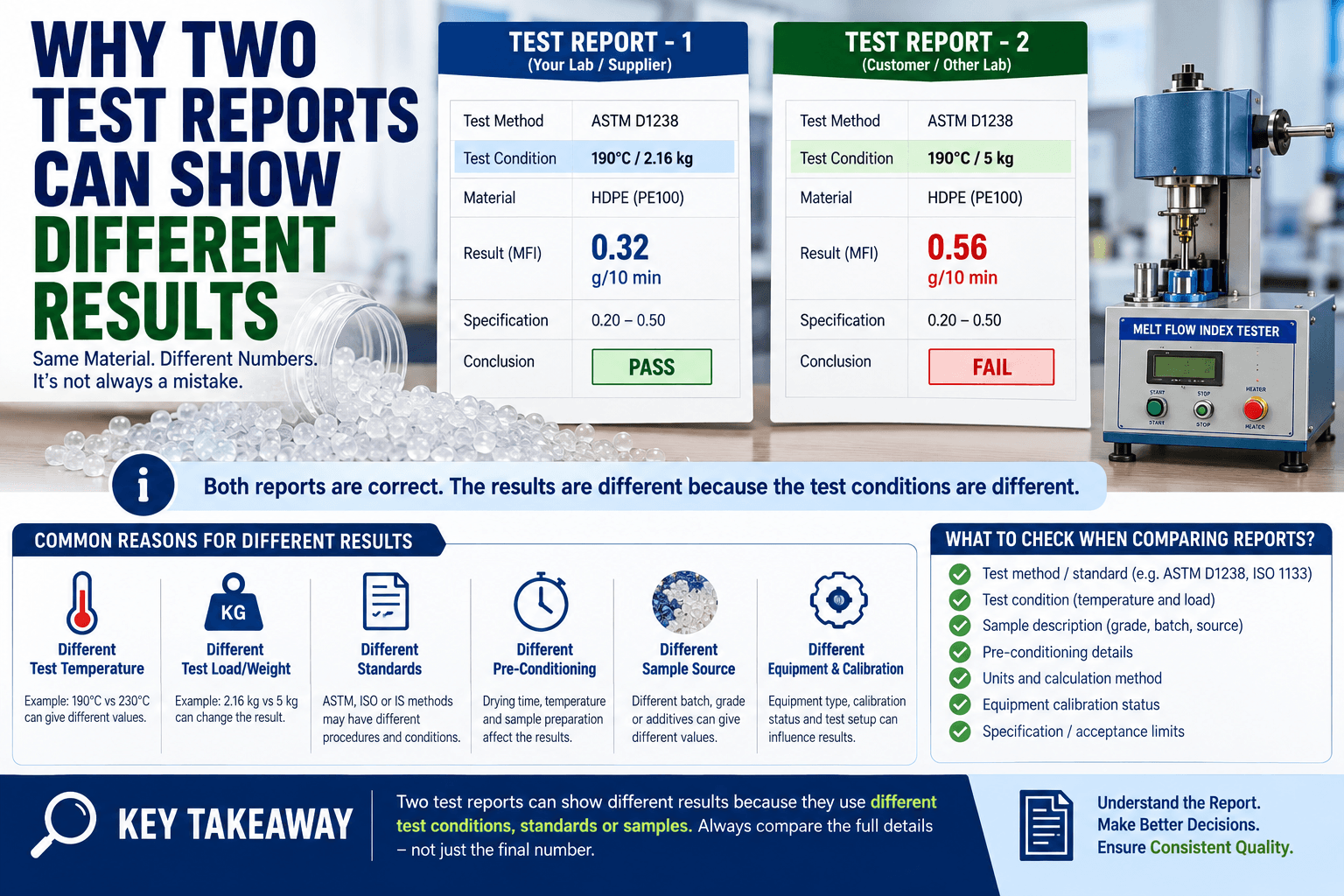
Before any pipe is extruded, the raw HDPE, PP, or PVC compound must be verified against its supplier’s Certificate of Analysis. Melt Flow Index is the fastest and most reliable way to confirm the material’s processability matches specification – a wrong MFI value means inconsistent wall thickness, weak weld joints in butt-fusion connections, and unpredictable extrusion behaviour.
Standard | Applies To | Typical Condition |
ASTM D1238 | General polymer MFI testing | 190°C/2.16 kg for HDPE (Condition 190/2.16) |
ISO 1133 | International MFI reference method | Similar conditions, more rigorous preheat protocol |
IS 2530 | Polyethylene for pipe manufacture | As specified for PE pipe grade material |
This is the same test we covered in detail in our MFI Tester blog – if you have not read it, it explains the step-by-step procedure and the most common causes of incorrect readings, including a real story about a Gujarat pipe manufacturer whose uncalibrated MFI Tester caused months of inconsistent pipe production.
Test 2: Tensile Strength
Tensile testing verifies that the finished pipe material – after extrusion, not just the raw compound – meets the mechanical strength requirements of the applicable IS standard. For HDPE and PVC pipes, this is typically performed on dumbbell specimens cut from the pipe wall, per IS 4984 (HDPE pipes) or IS 4985 (PVC pipes).
Standard | Pipe Type | Key Requirement |
IS 4984 | HDPE pipes for water supply | Minimum tensile strength and elongation at break specified per pipe grade (PE63, PE80, PE100) |
IS 4985 | Unplasticized PVC pipes | Tensile strength requirements specified per pipe class and application |
IS 15328 | PP-R pipes and fittings | Tensile strength and thermal stability requirements for PP-R material |
A Universal Testing Machine with appropriately sized grips and a specimen die matched to the standard’s dumbbell dimensions covers this test. We go into significant depth on UTM selection – including the exact mistake of buying too much load capacity – in our dedicated UTM blog.
Test 3: Hydrostatic Pressure
This is the test most specific to pipes – and arguably the one that most directly simulates real-world service conditions. A pipe sample is sealed at both ends, filled with water, and pressurised to a specified level for a specified duration (short-term tests run for a set number of hours; long-term tests can run for 1,000 hours or more) at a controlled temperature. The pipe must survive without bursting, leaking, or showing visible deformation. Answering ‘how long does a long-term hydrostatic pressure test take’ directly: 1,000 hours or more is common, which is exactly why this test is planned for and budgeted early rather than treated as a quick add-on.
Short-term hydrostatic strength: Verifies immediate pressure resistance – typically tested for a defined number of hours at higher pressure and elevated temperature to accelerate the test
Long-term hydrostatic strength (creep rupture): Predicts the pipe’s service life under sustained pressure – extrapolated from extended test durations to project decades of service life, per ISO 9080 methodology adapted into Indian standards
This test requires dedicated pressure testing apparatus with a controlled water bath – it is not something a Universal Testing Machine or MFI Tester covers. If you are setting up a new pipe QC lab, this is typically the single largest capital item after your Tier 1 equipment, and it is worth budgeting for early since BIS auditors specifically check for this capability on-site. What is the difference between short-term and long-term hydrostatic testing in practice? Short-term tests run at higher pressure over hours to confirm immediate burst resistance, while long-term tests run at lower pressure over hundreds or thousands of hours to project service life. A hydrostatic pressure test apparatus price India buyers should budget for typically runs Rs 3.5 to 6 lakhs, confirming what most first-time lab builders discover the hard way. A hydrostatic pressure test apparatus for HDPE pipe manufacturers specifically needs a water bath with tight temperature control, since even small temperature drift skews the burst-pressure result.
Test 4: Environmental Stress Cracking Resistance (ESCR)
ESCR testing is specific to HDPE pipe grades and is one of the more overlooked tests among smaller manufacturers – largely because it takes longer to run and its importance is less immediately obvious than tensile or pressure testing. Environmental stress cracking is a failure mode where HDPE develops brittle cracks under the combined effect of mechanical stress and exposure to certain chemicals or surfactants – a failure mode that would not show up in a standard short-duration tensile or pressure test. Why is ESCR testing important for HDPE pipes specifically? Because it catches a failure mode – brittle cracking under combined stress and chemical exposure – that a standard tensile or short-term pressure test will not reveal at all.
The test – per ASTM D1693 or the adapted IS 7328 – involves bending a notched HDPE specimen into a controlled strain condition, immersing it in a surfactant solution at elevated temperature, and monitoring for crack initiation over an extended period, often hundreds of hours.
Warning: ESCR is one of the tests most commonly missing from smaller manufacturers’ lab setups – not because it is technically difficult, but because the extended test duration makes it tempting to skip. BIS and IS 4984 compliance for pressure pipe grades specifically require ESCR data. Do not treat this as optional.
Test 5: Heat Deflection Temperature / Vicat Softening Point (HDT/VSP)
This test matters most for PVC and PP-R pipes intended for hot water or elevated-temperature applications, and for pipes that may be exposed to high ambient temperatures during installation or service (common in many parts of India). HDT measures the temperature at which a loaded specimen deflects by a specified amount. Vicat Softening Point measures the temperature at which a needle penetrates the material under a specified load – both are indicators of the material’s thermal performance limits.
Standard | Test | Relevant Pipe Type |
ASTM D648 / ISO 75 | Heat Deflection Temperature (HDT) | PVC, PP-R pipes and fittings – thermal performance under load |
ASTM D1525 / ISO 306 | Vicat Softening Point (VSP) | PVC pipes especially – softening behaviour under heat |
IS 15328 | PP-R pipes – thermal stability requirements | Hot and cold water plumbing PP-R systems |
A single HDT / VSP Apparatus typically covers both tests, since the oil bath heating principle and loading mechanism are shared between the two methods, with different specimen loading configurations.
Minimum Lab Setup and Budget
Here is a realistic budget for a BIS-compliant pipe testing lab covering all five tests, based on what we have helped manufacturers set up over the past year – including the Rajasthan and Madhya Pradesh factories preparing for Jal Jeevan Mission tenders. Answering how much does a pipe testing lab cost in India directly: a complete five-test, BIS-compliant setup typically lands between Rs 7.9 and Rs 14.7 lakhs, well inside the budget most tender timelines require.
Equipment | Covers Which Test(s) | Approximate Price (INR) |
Melt Flow Index (MFI) Tester | Test 1 – Incoming material verification | Rs 60,000 – Rs 1,20,000 |
Universal Testing Machine (10 kN, with pipe-specimen grips) | Test 2 – Tensile strength | Rs 1,50,000 – Rs 2,80,000 |
Hydrostatic Pressure Test Apparatus (with water bath) | Test 3 – Short-term and long-term hydrostatic strength | Rs 3,50,000 – Rs 6,00,000 |
ESCR Apparatus | Test 4 – Environmental stress cracking resistance | Rs 40,000 – Rs 80,000 |
HDT / VSP Apparatus | Test 5 – Heat deflection temperature / Vicat softening point | Rs 80,000 – Rs 1,40,000 |
Specimen cutters and dies (dumbbell, pipe ring) | Specimen preparation for Tests 2 and 3 | Rs 30,000 – Rs 70,000 |
Lab setup (benches, power, water supply for hydrostatic bath) | Infrastructure | Rs 50,000 – Rs 1,20,000 |
NABL-traceable calibration (initial, all instruments) | Compliance – audit readiness from day one | Rs 30,000 – Rs 60,000 |
Configuration | Total Estimated Cost (INR) |
Complete 5-test BIS-compliant lab (as above) | Rs 7,90,000 – Rs 14,70,000 |
Annual calibration + AMC (ongoing) | Rs 50,000 – Rs 1,00,000 per year |
Tip: This range comfortably fits the ‘under Rs 15 lakhs’ benchmark we have delivered for several small pipe manufacturers preparing for Jal Jeevan Mission tenders. The hydrostatic pressure apparatus is typically the single largest line item – plan your budget around that first, then fill in the remaining four tests.
Final Thoughts
BIS certification for plastic pipes is not getting easier, and the volume of tender opportunity created by programmes like Jal Jeevan Mission means the manufacturers who get their testing capability in place quickly are the ones positioned to bid – while those without it are locked out regardless of their production capacity or pricing.
The five tests in this blog – MFI, tensile strength, hydrostatic pressure, ESCR, and HDT/VSP – cover the core compliance requirements under IS 4984, IS 4985, and IS 15328 for HDPE, PVC, and PP-R pipe categories respectively. None of these tests are exotic or difficult to run once the equipment is in place and your operator is trained. The barrier is almost always simply getting the right equipment specified and installed quickly.
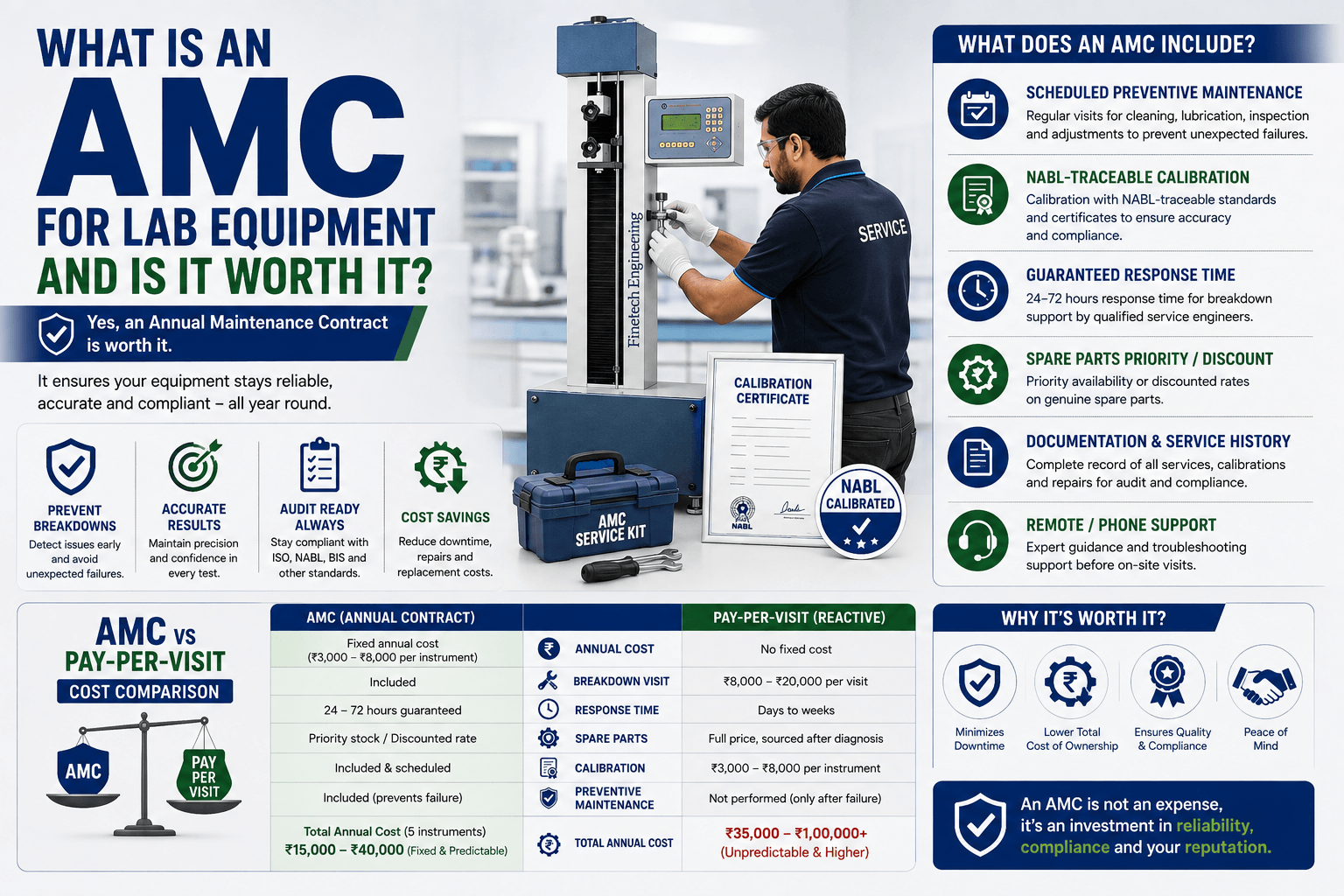
At Finetech Engineering, we manufacture the laboratory testing equipment covering all five of these tests at our Thane facility, and we have specifically helped smaller manufacturers move from zero in-house testing capability to a fully BIS-compliant lab within weeks, not months – because we understand that tender timelines do not wait. We provide NABL-traceable calibration with every instrument and structured AMC support so your lab stays audit-ready year-round. As a plastic pipe testing lab equipment manufacturer India factories turn to when a tender deadline will not wait, we cover all five instruments from one supplier – which is consistently faster than sourcing them separately and trying to coordinate five different calibration schedules.
If you are preparing a BIS certification application or bidding on a Jal Jeevan Mission tender and need your testing lab in place quickly, talk to us. We will tell you exactly what you need, what it will cost, and how fast we can get it installed.
Setting Up or Upgrading a Pipe Testing Lab?
Call or WhatsApp: +91 93241 37971
Email: info@finetechengineer.com
Tell us your pipe category (HDPE, PP-R, PVC) and applicable IS standard. We will recommend the exact 5-test lab configuration and give you a straight budget.
If you’d like to talk it through first, contact us and we’ll map your standards together.
– Santhosh Kumar VP, Founder & Managing Partner, Finetech Engineering