


What Is a Humidity Chamber and Why Do Manufacturers Use It?
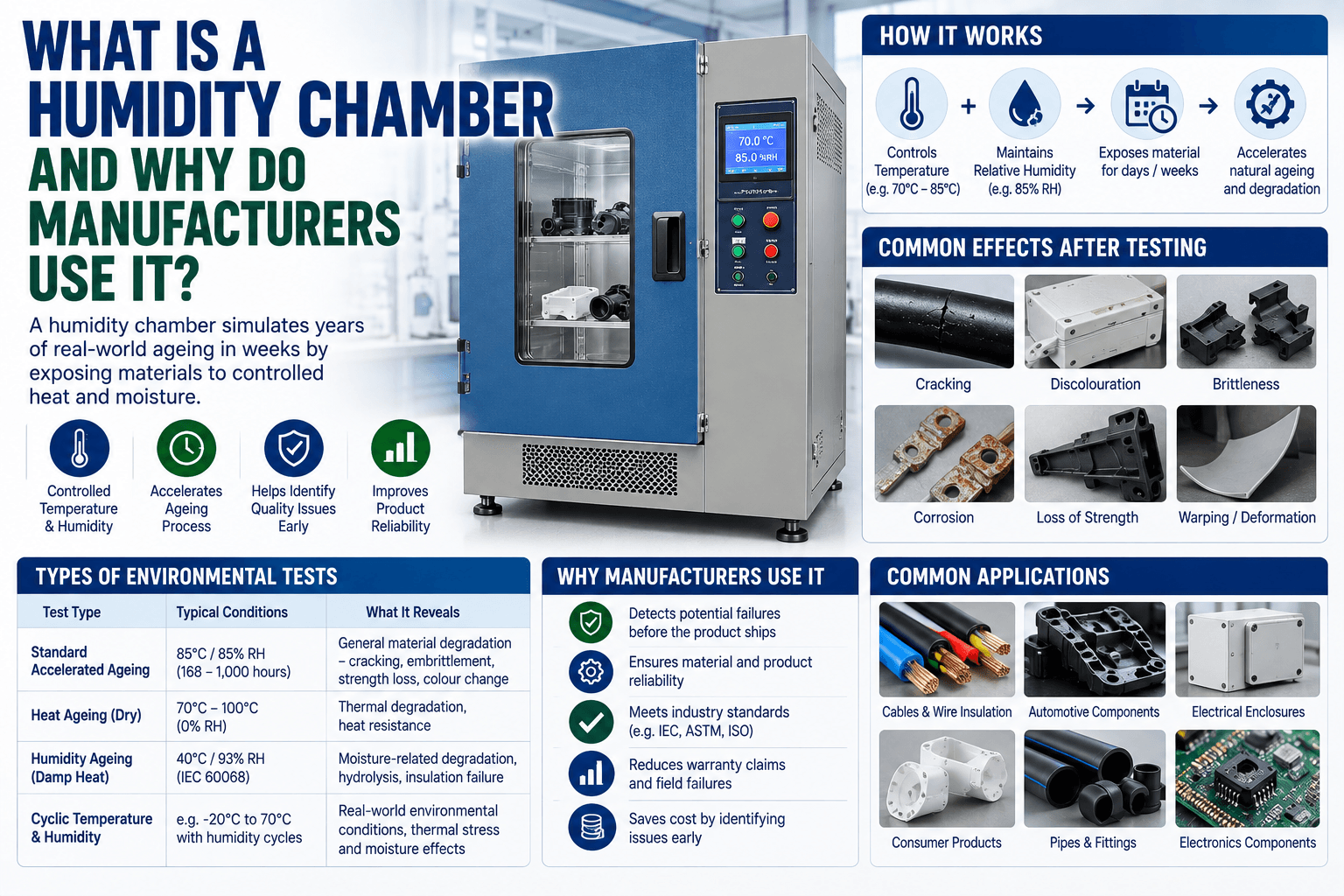
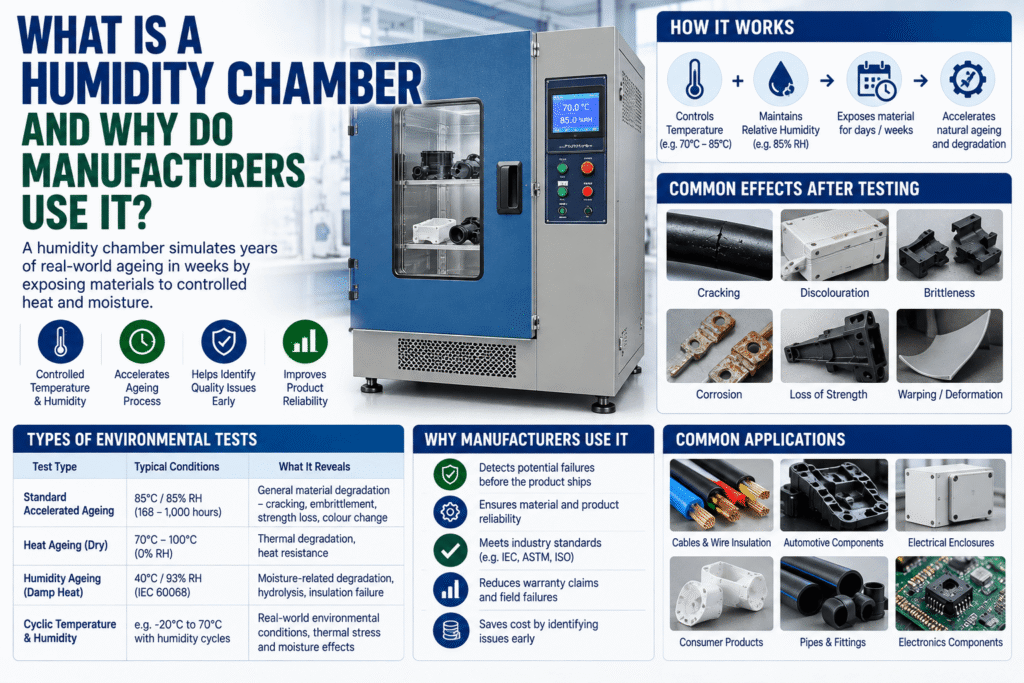
Products that work perfectly in a lab can fail within months in the real world. A humidity chamber simulates years of ageing in weeks – exposing your material to controlled heat and moisture that accelerates the same degradation processes that would otherwise take years to show up in the field. Answering how does a humidity chamber simulate years of ageing in weeks directly: by running the same degradation chemistry at elevated temperature and humidity, which speeds up reactions that would otherwise take years to accumulate at ambient conditions.
I want to tell you about a cable insulation manufacturer near Nasik who learned this the hard way – and then, to their credit, built accelerated ageing testing into their QC process permanently as a result. A humidity chamber for cable insulation testing is exactly the equipment that would have surfaced this problem within days rather than years, which is precisely the point of this story.
Real situation, name withheld: The Nasik manufacturer began receiving field complaints about insulation cracking on cable installed roughly two years earlier. The cracking pattern suggested premature material degradation, not physical damage. When we ran an accelerated ageing test on current production material – 70°C at 85% relative humidity – visible surface cracking appeared within 168 hours, just 7 days. That result told the story clearly: the material in current production would not have survived two years in the field either. Investigation traced the cause to an undisclosed formulation change by their compound supplier – a change in the plasticiser system that reduced the compound’s resistance to heat and humidity ageing, made without notifying the cable manufacturer. Had they been running accelerated ageing tests on every incoming batch, the formulation change would have been caught within a week of the new material arriving – not two years later, after cable was already installed in the field and customer complaints had started.
This is exactly what a humidity chamber is for: catching a problem in a week that would otherwise take years to surface – and by then, the product is already installed, shipped, or in a customer’s hands.
What Does a Humidity Chamber Do?
A humidity chamber is an enclosed test environment that maintains precisely controlled temperature and relative humidity over an extended period, allowing materials and products to be exposed to conditions that accelerate the natural ageing processes they would experience over months or years of real-world service. A damp heat testing chamber for electronics IEC 60068 compliance calls for is really the same base instrument, configured to that standard’s specific 40°C / 93% RH profile rather than the general-purpose 85/85 condition.
The science behind accelerated ageing rests on a well-established principle: most degradation reactions in polymers – oxidation, hydrolysis, plasticiser migration, UV-independent thermal breakdown – proceed faster at elevated temperature and humidity. By exposing a material to controlled elevated conditions (commonly 70°C to 85°C, at 85% relative humidity, though exact conditions vary by standard and material), you compress years of gradual real-world degradation into days or weeks of accelerated testing. What is the difference between heat ageing and humidity ageing in practice? Heat ageing isolates thermal degradation alone, with no moisture present, while humidity ageing adds moisture-driven mechanisms like hydrolysis on top of the same thermal effect – which is why the two tests reveal different failure modes and neither substitutes for the other. Can accelerated ageing testing predict real world product failure with certainty? Not with certainty, but it correlates closely enough with real-world behaviour for well-characterised material families that it remains the industry-standard screening method – it identifies risk before shipment, rather than guaranteeing an exact field lifespan.
This lets you answer a critical question before a product ships, not after: will this material still perform adequately after 2, 5, or 10 years of real-world service? A humidity chamber is how you get that answer in a QC-relevant timeframe rather than waiting for actual field data to accumulate – which, as the Nasik story shows, is often how manufacturers learn about a material problem the hard way. A humidity chamber for automotive under-bonnet component testing answers exactly this question for OEM suppliers, since under-bonnet parts routinely face the combined heat-and-humidity cycling this test is built to simulate.
Types of Environmental Tests
Test Type | Typical Conditions | What It Reveals |
Standard accelerated ageing | 85°C / 85% RH, duration per material and standard (often 168-1,000 hours) | General material degradation – cracking, embrittlement, strength loss, colour change |
Heat ageing (dry) | 70°C – 100°C, no humidity control, extended duration | Thermal-only degradation – isolates heat effect without moisture contribution |
Cyclic humidity/temperature | Alternating high and low temperature/humidity cycles | Simulates seasonal or day-night environmental cycling – relevant for outdoor products |
Damp heat testing (electronics) | 40°C / 93% RH or similar, per IEC 60068-2-78 | Electronic component and enclosure resistance to humid environments |
Condensation/dew cycling | Controlled temperature swing causing condensation on specimen surface | Corrosion and moisture ingress testing for metal and coated components |
The 85°C / 85% RH condition – often just referred to as ’85/85 testing’ in industry shorthand – is one of the most widely referenced accelerated ageing benchmarks across plastics, rubber, cable, and electronic component testing, largely because it represents a reasonably aggressive but not unrealistic combined stress condition, and because decades of industry data exist correlating 85/85 exposure duration to real-world service life for many material families. Answering what does 85/85 testing mean in industry shorthand directly: it is a shorthand reference to the 85°C, 85% relative humidity condition itself, not a fixed duration. Asking how many hours should an accelerated ageing test run has no single answer either – durations from 168 to 1,000 hours are all common, depending on the material and the standard your customer or specification references.
Industries That Need This
Industry | What Gets Tested | Why It Matters |
Cable and wire manufacturing | Insulation and jacket compounds | Field failures from insulation cracking cause safety hazards and expensive replacement – the Nasik story |
Automotive components | Under-bonnet and exterior plastic/rubber parts | Components face genuine heat-humidity cycling in real vehicle service; OEM specs commonly require ageing data |
Packaging materials | Films, laminates, adhesive seals | Shelf-life and seal integrity claims must be substantiated with accelerated ageing data |
Electrical enclosures and connectors | Housing materials, gaskets, seals | Outdoor or humid-environment installations require demonstrated resistance to moisture ingress and material degradation |
Rubber seals and gaskets | O-rings, gaskets, weatherstripping | Seal performance depends on the material retaining elasticity and not cracking after extended heat/humidity exposure |
Consumer appliances | Housings, seals, internal plastic components | Products marketed with multi-year warranties need data supporting that the material will actually last that long |
Construction materials | PVC profiles, roofing membranes, waterproofing compounds | Outdoor exposure over building lifetimes (often 15-25 years) requires accelerated data since real-time testing is impractical |
Choosing the Right Chamber
If you are setting up humidity chamber testing capability for the first time, here is what actually matters when specifying the equipment:
Specification | What to Look For | Why It Matters |
Temperature range | Minimum -10°C to 100°C for general use; wider range for specialised testing | Covers standard accelerated ageing plus cyclic and cold-chamber testing needs |
Humidity range and accuracy | 10% to 98% RH, controlled to within ±3% RH | Poor humidity control gives inconsistent, non-repeatable ageing results between test runs |
Chamber volume | Match to your specimen batch size – typically 100 to 500 litres for standard QC labs | Undersized chambers limit batch testing capacity; oversized chambers waste energy and floor space |
Uniformity across chamber | Temperature and humidity uniformity within ±1°C / ±3% RH across the chamber volume | Specimens in different chamber positions must experience genuinely equivalent conditions |
Recovery time after door opening | Fast recovery (under 5-10 minutes) to setpoint after specimen loading | Frequent specimen checks should not significantly disrupt the overall test conditions |
Programmable cycling | Ability to program temperature/humidity ramps and cycles, not just fixed setpoints | Required for cyclic and condensation-type tests beyond simple static ageing |
Data logging | Continuous temperature/humidity logging with exportable records | Provides documented evidence of actual test conditions maintained – important for audit and customer reporting |
Tip: Do not undersize your chamber to save on upfront cost if you expect to test multiple product lines or larger specimen batches. A chamber that is too small forces you to run sequential batches, effectively doubling or tripling your test turnaround time – often costing more in delayed decisions than the price difference between chamber sizes.
Maintenance Tips
A humidity chamber is a more maintenance-sensitive instrument than most QC lab equipment, because it relies on precise control of two interacting variables – temperature and humidity – over extended, sometimes continuous, operating periods. A few practical maintenance points:
Clean the water reservoir regularly: Standing water in the humidity generation system is prone to scale buildup and microbial growth, both of which affect humidity control accuracy over time. Clean per the manufacturer’s recommended schedule, typically monthly for continuous-use chambers.
Check door seals: A degraded door gasket allows moisture and temperature loss, directly undermining chamber uniformity and control accuracy. Inspect and replace seals as part of routine preventive maintenance.
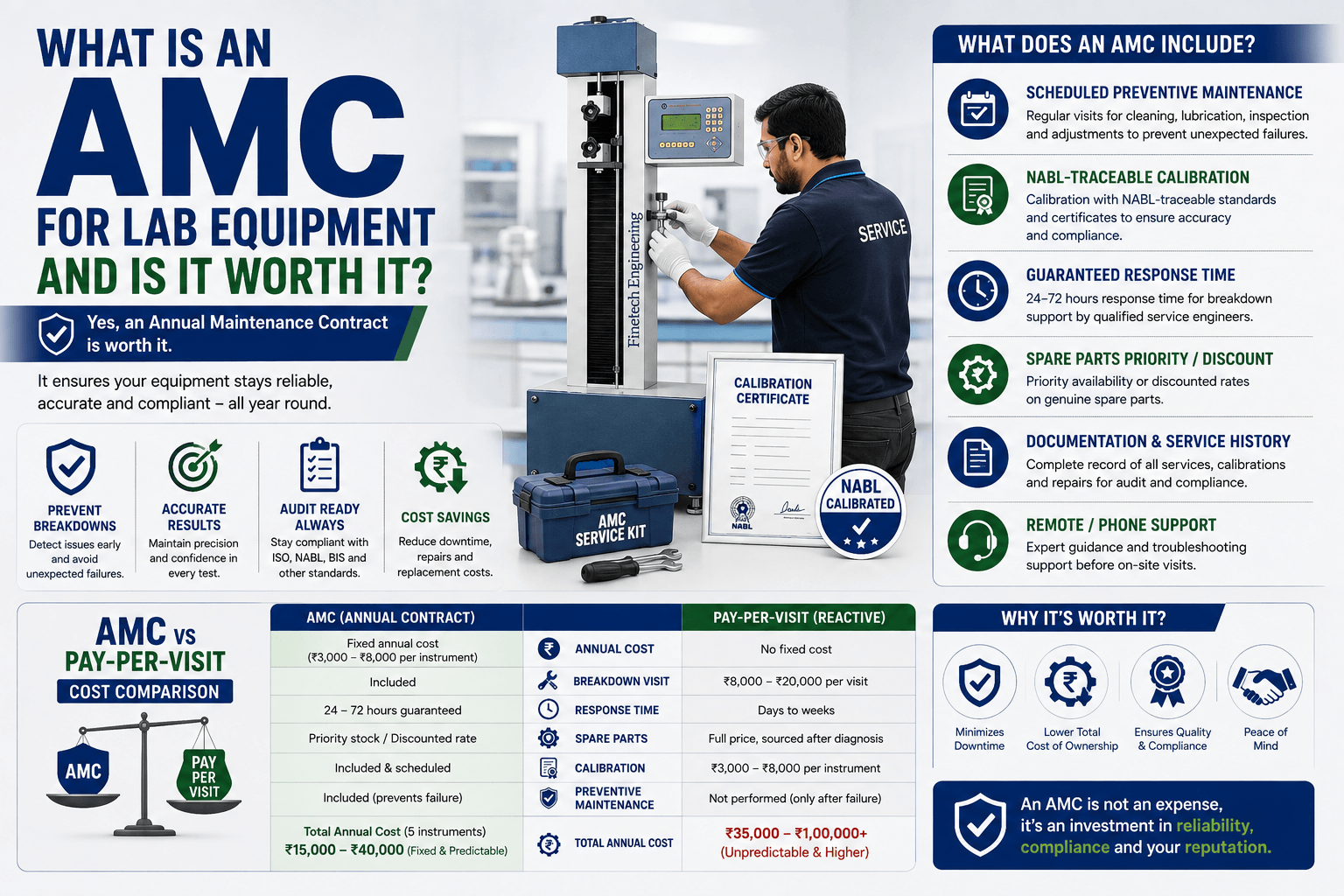
Calibrate temperature and humidity sensors annually: Sensor drift in humidity chambers compounds over time due to continuous exposure to moisture – arguably more prone to drift than dry-environment instruments. NABL-traceable calibration should be part of your annual schedule without exception.
Monitor for condensation in the control cabinet: Electronic control components are vulnerable to the same humidity the chamber is designed to generate. Proper cabinet sealing and occasional inspection prevents control system failures.
Keep a maintenance and calibration log per chamber: Given how central this equipment often is to product qualification and customer-facing test reports, documented service history is essential for audit purposes.
Final Thoughts
The Nasik cable manufacturer’s story illustrates something worth internalising: a material problem that would eventually surface in the field – after two years, after cable was installed, after customer complaints started – was fully visible within 168 hours of accelerated ageing testing. That is the entire value proposition of a humidity chamber. It converts a multi-year unknown into a one-week answer.
If your product will spend years in real-world service – exposed to heat, humidity, or both – and you are not currently running accelerated ageing tests on incoming material or finished product, you are relying on hope rather than data. The equipment cost is modest relative to the cost of a field failure, a recall, or a lost customer relationship over a material problem that testing would have caught early. On accelerated ageing chamber cost India manufacturers typically budget, most buyers are surprised how quickly the equipment pays for itself the first time it catches a problem before it ships.
At Finetech Engineering, we manufacture Humidity Chambers at our Thane facility, sized and specified to your batch volume and test protocol requirements. We provide NABL-traceable calibration and AMC support, because – as this blog’s maintenance section makes clear – a humidity chamber’s accuracy depends on consistent upkeep more than most other lab instruments. As an environmental ageing test equipment supplier India manufacturers turn to when they need chamber sizing and protocol advice, not just a machine, we specify the right chamber for your product rather than selling you a generic size.
Need to Simulate Years of Ageing Before It Happens to Your Customer?
Call or WhatsApp: +91 93241 37971
Email: info@finetechengineer.com
Tell us your product, its expected service environment, and how long it needs to last. We will recommend the right chamber size and test protocol.
If you’d like to talk it through first, contact us and we’ll map it out together.
– Santhosh Kumar VP, Founder & Managing Partner, Finetech Engineering