


What Is an AMC for Lab Equipment and Is It Worth It?
Yes, an annual maintenance contract is worth it. I will say that plainly at the start rather than making you read to the end for the answer. But the more useful question is not whether an AMC is worth it in general – it is what a good AMC should actually include, and how to tell a genuinely useful contract from a paperwork formality that does not protect you when it matters.
Lab equipment does not fail dramatically. It fails slowly, silently, and expensively. A heater element degrades gradually. A sensor drifts a fraction of a degree at a time. A seal wears down over hundreds of cycles. None of this shows up as a warning light – until the day the equipment simply stops mid-test, usually at the least convenient possible moment.
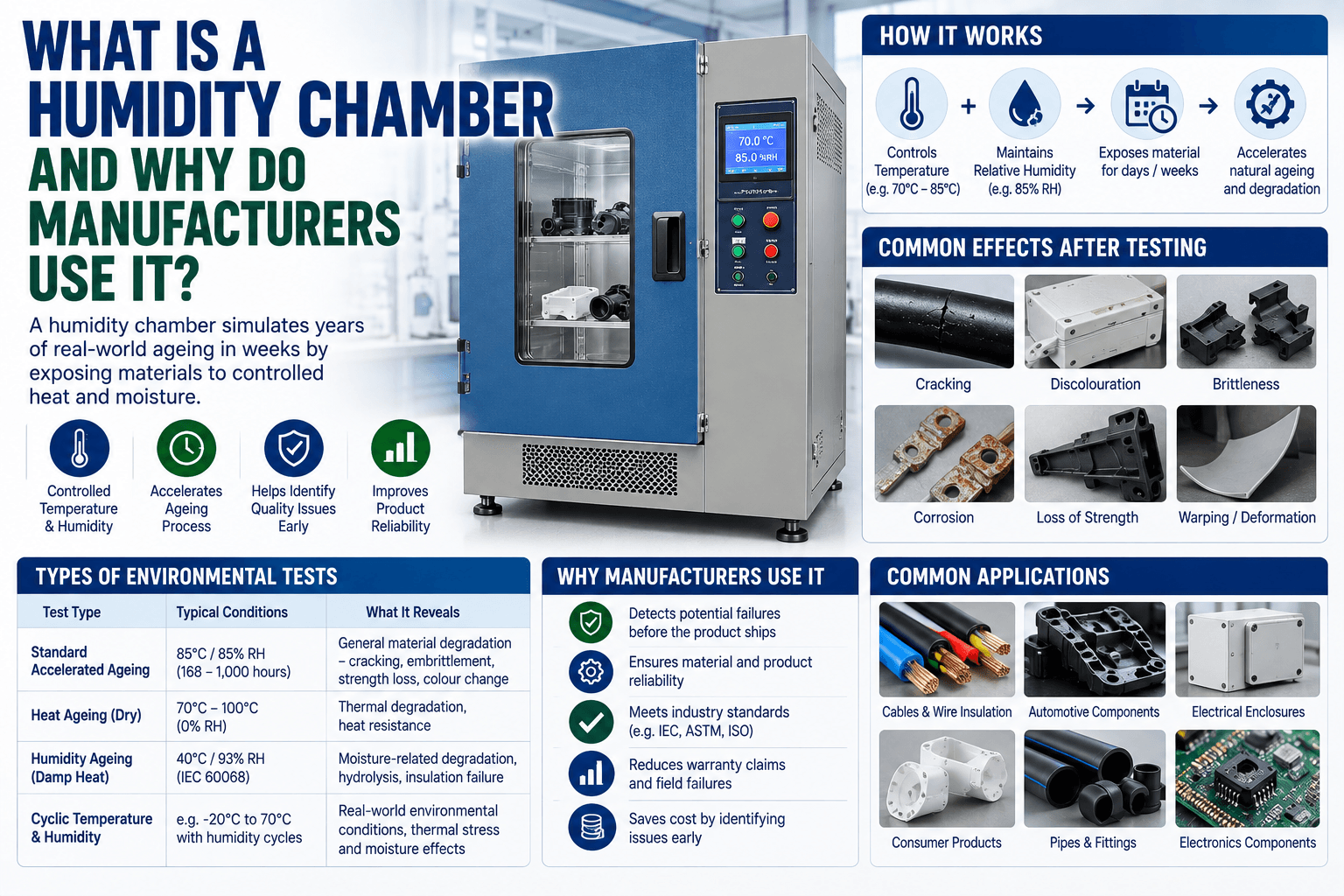
Real situation, name withheld: A packaging materials company in Daman was running a 1,000-hour accelerated ageing test in a Humidity Chamber, part of a customer qualification programme. At the 700-hour mark, the chamber’s heating element failed completely. They had no AMC – the chamber had been purchased from a trader who was, by that point, out of business. There was no service contact, no spare parts source, and no calibration history to reference for a replacement unit’s specification. The 700 hours of test data were lost because the interruption invalidated the continuity requirement of the ageing protocol. They had to source an emergency repair from a third-party technician unfamiliar with that specific chamber model, wait 12 days for a compatible heating element, and then restart the entire 1,000-hour test from zero. The customer qualification deadline was missed by three weeks.
An AMC with guaranteed response time would very likely have caught the early signs of that heating element’s degradation during a scheduled preventive maintenance visit – long before it failed mid-test. This blog explains what a proper AMC includes, what it costs against the alternative, and how to evaluate whether an offer in front of you is actually worth signing.
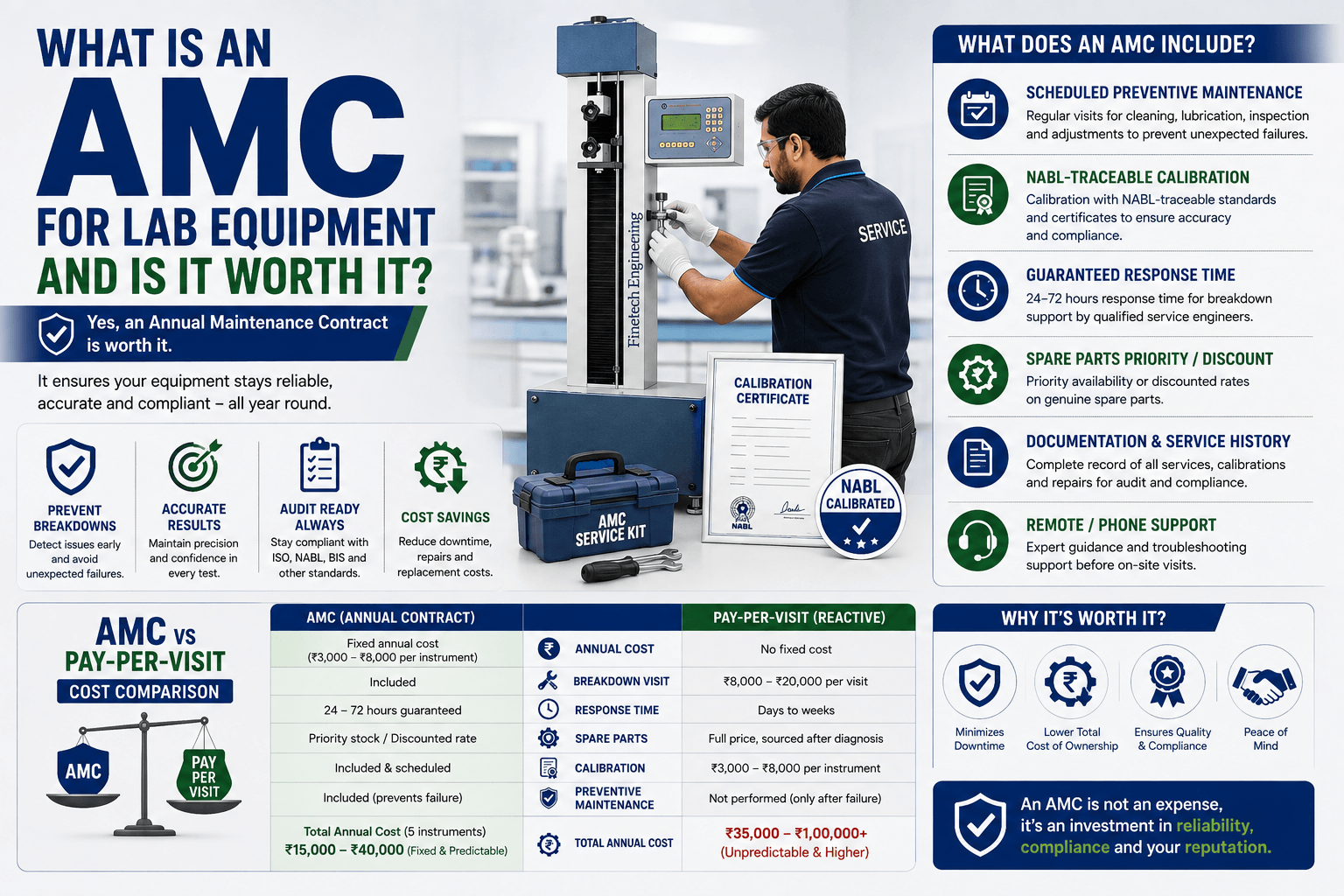
What Does an AMC Include?
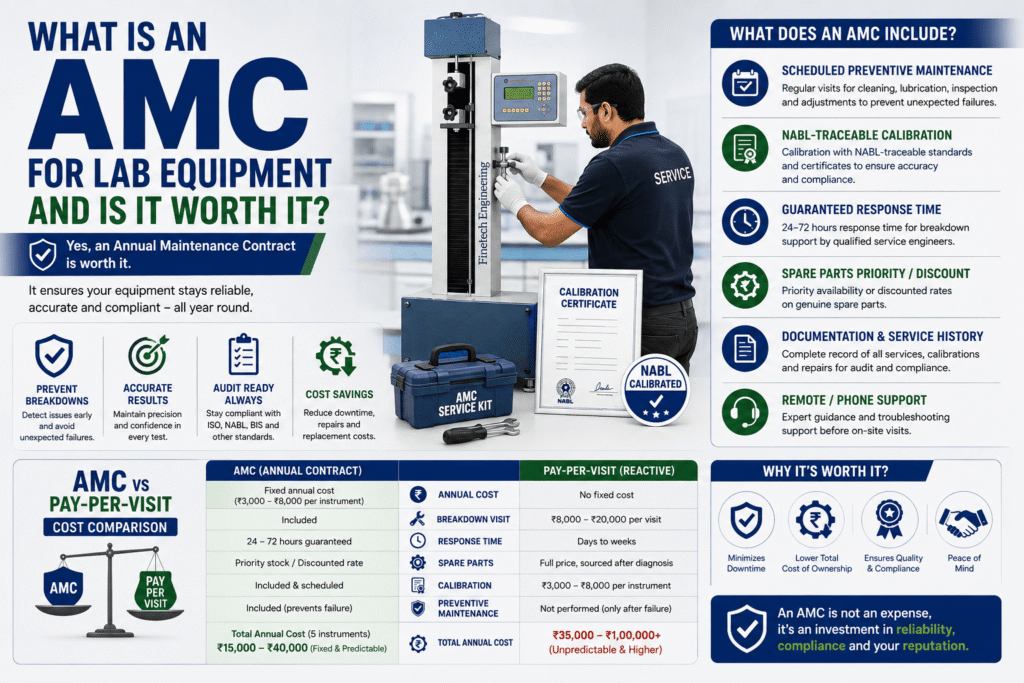
Not all AMCs are the same – this is exactly the what does AMC include testing equipment checklist question I get asked constantly. A genuinely useful annual maintenance contract for laboratory testing equipment should include the following components:
Component | What It Means | Why It Matters |
Scheduled preventive maintenance visits | Typically 1-2 visits per year – cleaning, lubrication, wear-part inspection, adjustment | Catches degradation (worn seals, loose connections, early sensor drift) before it causes failure |
NABL-traceable calibration | Calibration performed during scheduled visits, with certificates issued for each instrument | Keeps you continuously audit-ready instead of scrambling before an inspection |
Guaranteed breakdown response time | A defined window – typically 24 to 72 hours – for a technician to respond to an unscheduled failure | Limits downtime; you know what to expect instead of an open-ended wait |
Spare parts priority or discount | Either stocked common parts or a discounted rate on parts sourced for your equipment | Avoids the multi-week delay of sourcing parts from scratch during a breakdown |
Documentation and service history | A maintained record of every visit, calibration, and repair for each piece of equipment | Single reference point for audits; demonstrates ongoing compliance to ISO, BIS, or customer auditors |
Remote or phone support | Access to a technician for troubleshooting guidance before an on-site visit is scheduled | Sometimes resolves minor issues immediately, avoiding an unnecessary visit |
AMC vs Pay-Per-Visit: Cost Comparison
The most common objection I hear is: “We will just call someone when something breaks.” Here is the AMC vs pay per visit cost comparison lab equipment owners actually need, based on what we typically see across our customer base for a mid-sized lab with 4 to 6 instruments:
Cost Factor | AMC (Annual Contract) | Pay-Per-Visit (Reactive) |
Annual cost (typical, per instrument) | Rs 3,000 – Rs 8,000 | Not applicable – no fixed cost |
Emergency breakdown visit cost | Included in contract | Rs 8,000 – Rs 20,000 per visit (urgency premium, travel, diagnosis) |
Response time | 24-72 hours guaranteed | Days to weeks – depends entirely on technician availability |
Spare parts | Priority stock or discounted rate | Full price, and often sourced only after diagnosis – adds delay |
Calibration | Included and scheduled automatically | Separate cost, easy to forget or postpone – Rs 3,000-8,000 per instrument when remembered |
Preventive maintenance | Included – catches problems before failure | Not performed – only reactive repair after failure |
Typical annual total (5-instrument lab) | Rs 15,000 – Rs 40,000 (fixed, predictable) | Rs 35,000 – Rs 1,00,000+ (variable – depends on how many breakdowns occur, unpredictable) |
Downtime cost (not included above) | Minimal – hours to 1-2 days per incident | Significant – days to weeks per incident, production and testing halted |
Even in a quiet year with few breakdowns, the AMC customer gets calibration, preventive maintenance, and audit-ready documentation bundled into that fixed cost. The pay-per-visit customer gets nothing until something actually fails – and then pays an urgency premium for the privilege of an unplanned, unscheduled fix. This is exactly the emergency repair cost testing equipment vs AMC comparison I walk every customer through before they sign anything.
Tip: for budgeting purposes, a reasonable rule of thumb – AMC typically costs around Rs 15,000 per year for a small lab, against Rs 35,000 or more for a single emergency Service and Repair visit without a contract. Even a single prevented breakdown often pays for two to three years of AMC coverage.
What Happens When You Skip Maintenance
I get asked what happens if you skip lab equipment maintenance more than almost any other question on this topic. Beyond the Daman story, here is the pattern I see repeatedly across factories that skip scheduled maintenance and calibration:
- Silent calibration drift – equipment continues producing readings that look normal but are gradually inaccurate. This is often only caught during a customer or certification audit, at which point non-conforming product may already have shipped.
- Mid-test failures – long-duration tests – ageing, endurance, environmental cycling – are especially vulnerable. A failure partway through invalidates the entire test, and depending on the protocol, may require a complete restart.
- Compounding repair cost – a worn part left unaddressed often damages adjacent components. A degraded heater element, for example, can eventually damage the temperature sensor or controller board it works alongside – turning a small part replacement into a larger, more expensive repair.
- Audit non-conformance – ISO 9001, BIS, and NABL audits all check calibration currency. Lapsed calibration is one of the most common non-conformances found in supplier quality audits – and it is entirely preventable. This is the NABL audit compliance AMC calibration continuous gap that surfaces almost every time.
- Vendor dependency risk – if your equipment was purchased from a trader who later becomes unreachable, you have no fallback service option – exactly what happened in the Daman chamber failure.
Warning: the most expensive maintenance failures are rarely the ones that happen quickly. They are the ones that accumulate quietly for months or years and then surface all at once – during an audit, a customer complaint, or a critical test run – at the worst possible time.
How to Evaluate an AMC Offer
Not every AMC on the market is worth signing, which is exactly why I put together this how to evaluate AMC offer lab equipment checklist. Use it before committing to any contract:
- Number of scheduled visits per year clearly stated (not vague – “1 visit” or “2 visits”, in writing)
- NABL-traceable calibration explicitly included, not offered as a separate paid add-on
- Guaranteed response time for breakdowns stated in the contract (e.g. “48 hours”) – not just “as soon as possible”
- Spare parts pricing or priority stock commitment specified, not left ambiguous
- Technician qualification – ask whether the technician assigned actually knows your specific equipment model
- Documentation delivery – confirm you receive calibration certificates and service reports after every visit, not just a verbal confirmation
- Contract provider stability – is this a manufacturer with a fixed facility, or a service agent who could disappear like the Daman chamber’s original trader?
That last point matters more than people initially think. An AMC is only as reliable as the company behind it. A manufacturer with a fixed factory address, an ongoing customer base, and a reputation to protect has every incentive to honour the contract terms. A service agent operating independently, with no accountability beyond the contract itself, carries more risk – especially years into the contract when your specific equipment may need specialised parts or knowledge only the original manufacturer has.
Final Thoughts
An AMC is not a luxury add-on. For any factory relying on testing equipment for quality decisions – which is almost every factory with a QC lab – it is closer to insurance against the kind of silent, compounding failure that the Daman humidity chamber story illustrates. 700 hours of test data, a missed customer qualification deadline, and an emergency repair costing far more than years of AMC coverage – all traceable back to the absence of a Rs 15,000-per-year contract.
At Finetech Engineering, our AMCs bundle scheduled preventive maintenance, NABL-traceable calibration services, guaranteed breakdown response, and full documentation into one predictable annual cost. Because we manufacture the equipment ourselves, our service team already knows your machine’s configuration – no guesswork, no waiting for a manual, no dependency on a trader who might not be reachable next year.
If you already have an AMC with another provider, run the checklist in this blog against it. If you do not have one at all, send us your equipment list and we will give you a straightforward quote – including an honest assessment of which of your instruments genuinely need one now, and which can reasonably wait.
Want an AMC Quote for Your Lab?
Call or WhatsApp: +91 93241 37971
Email: info@finetechengineer.com
Send us your equipment list – make, model, and age. We will give you a straight AMC quote and tell you honestly if your equipment does not need one yet.
Contact us to get started.
– Santhosh Kumar VP, Founder and Managing Partner, Finetech Engineering