







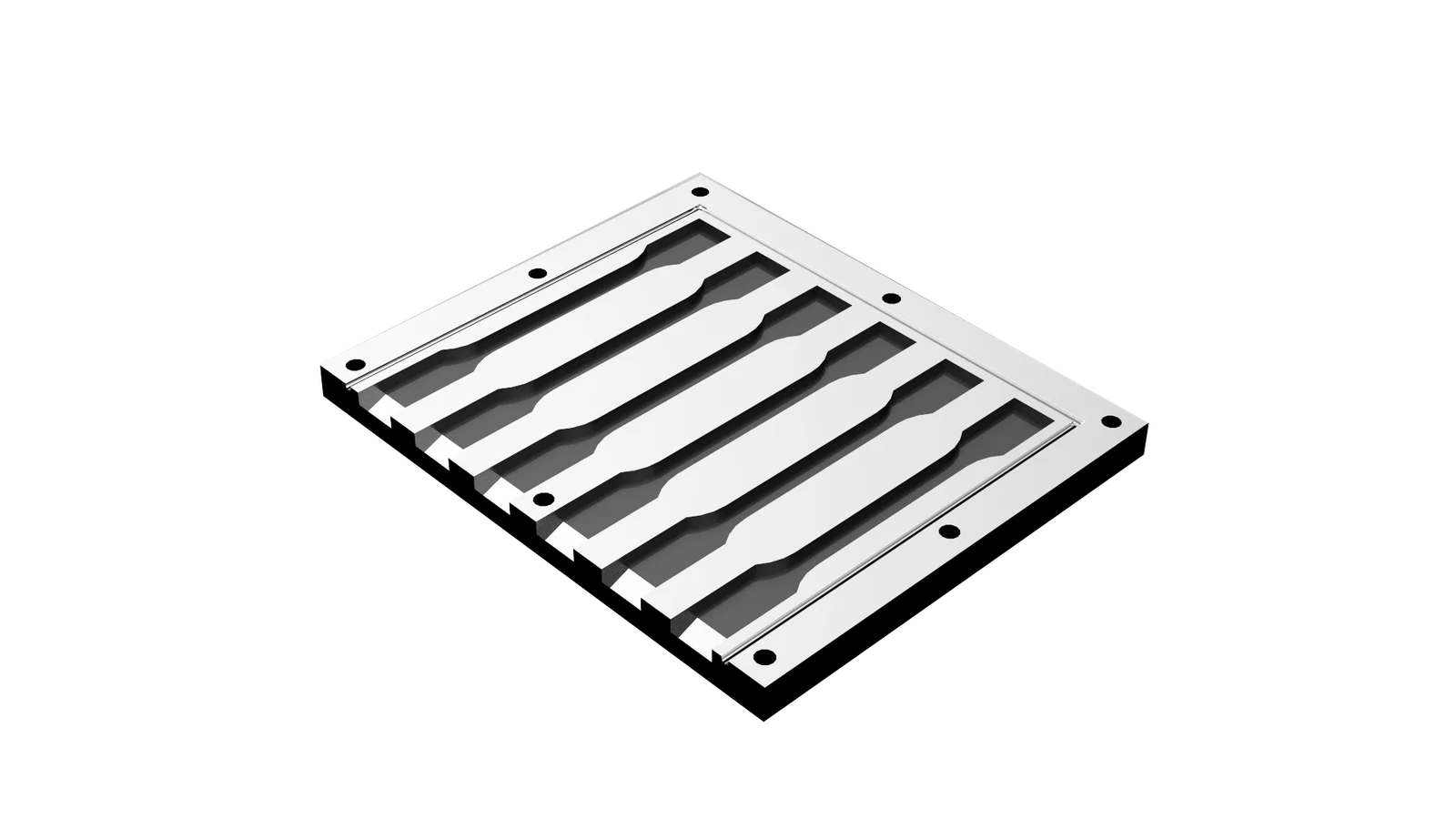
Before you can test rubber, you need rubber test specimens. And before you can cut specimens, you need vulcanised rubber sheets and buttons of the correct thickness, surface quality, and cure state. That is what test specimen moulds do – they create the standardised shapes from which specimens are cut or which are tested directly. As a dedicated rubber test specimen mould manufacturer India, Finetech Engineering manufactures every mould from SS 304 stainless steel with diamond-polished cavities for consistent, standard-compliant specimens.
The mould defines the specimen’s thickness, diameter, surface finish, and dimensional uniformity. A poorly made mould with rough cavities, uneven platen surfaces, or imprecise dimensions produces specimens that fail dimensional checks, give inconsistent test results, and waste compound. A well-made mould – precision-machined from stainless steel with diamond-polished cavities – produces specimens that meet every tolerance specified by the standard, test after test, year after year.
Finetech Engineering, your trusted test specimen mould manufacturer India and rubber testing mould manufacturer India, manufactures the complete range of rubber test specimen moulds. Every mould is made from SS 304 stainless steel, precision-ground to dimensional tolerance, and diamond-polished for a surface finish that releases specimens cleanly without sticking. Because we also manufacture the hydraulic press with heated platens, the specimen cutters, and the testing machines, we supply the entire workflow from raw compound to test result – from one manufacturer.
Mould Type | Specimen Produced | Standard | Cavity Dimensions | Used With (Test Equipment) |
Flat Sheet Mould | Vulcanised rubber test sheet (2 mm thick standard) | ASTM D3182, ISO 2393 | 150 × 150 × 2 mm (or 200 × 200 mm; 1, 2, 4, 6 mm thicknesses) | All tests – sheets are cut into dumbbell, tear, crescent, strip, and other specimens |
Compression Set Mould (Type 1) | Cylindrical button, 29 mm dia × 12.5 mm | ASTM D395 Type 1, ISO 815 | 29.0 ±0.5 mm dia × 12.5 ±0.5 mm | Compression Set Apparatus |
Compression Set Mould (Type 2) | Cylindrical button, 13 mm dia × 6.3 mm | ASTM D395 Type 2 | 13.0 ±0.5 mm dia × 6.3 ±0.3 mm | Compression Set Apparatus |
Hardness Button Mould | Flat cylindrical button, ≥29 mm dia × ≥6 mm | ASTM D2240, ISO 868 | 29+ mm dia × 6+ mm thick (stackable for 12 mm) | Shore A / Shore D Hardness Tester |
DIN Abrasion Mould | Cylindrical disc, 16 mm dia × 6–16 mm | DIN 53516, ISO 4649, ASTM D5963 | 16.0 ±0.2 mm dia × variable thickness | DIN Abrasion Tester |
Demattia Flex Mould | Grooved rectangular specimen | ASTM D430, ASTM D813, ISO 132 | Per standard geometry with central groove | Demattia Flex Tester |
Ross Flex Mould | Rectangular bar with pre-cut (pierced) | ASTM D1052 | Per standard geometry | Ross Flex Tester |
Tensile Dumbbell Mould | Dumbbell-shaped specimen (Die C or ISO Type 2) | ASTM D412, ISO 37 | Die C: 115 mm overall, 6 mm gauge width | UTM (alternative to die-cutting from sheets) |
Custom Moulds | Any geometry per customer drawing | Customer specification | As specified | Any test equipment |
Parameter | Details |
Standard | ASTM D3182, ISO 2393 |
Cavity Size | 150 × 150 mm (standard); 200 × 200 mm (larger option) |
Sheet Thickness Options | 1.0, 2.0, 4.0, 6.0 mm (2.0 mm is the standard for most rubber tests) |
Cavities per Mould | 1 or 2 (single-cavity or dual-cavity) |
Construction | SS 304 stainless steel |
Cavity Finish | Diamond-polished for clean specimen release |
Frame | Hinged frame with alignment dowel pins |
Flash Grooves | Overflow channels for excess compound |
Parameter | Type 1 (Large) | Type 2 (Small) |
Standard | ASTM D395 Type 1, ISO 815 | ASTM D395 Type 2 |
Button Diameter | 29.0 ±0.5 mm | 13.0 ±0.5 mm |
Button Height | 12.5 ±0.5 mm | 6.3 ±0.3 mm |
Cavities per Mould | 3 or 6 (model-dependent) | 6 or 12 |
Construction | SS 304 stainless steel | SS 304 stainless steel |
When to Use | Standard specimen – use when material is available | Small specimen – when material is limited |
Parameter | Details |
Standard | ASTM D2240, ISO 868 |
Button Diameter | ≥29 mm |
Button Thickness | 6 mm (single) or 12.5 mm (standard) |
Cavities | 3 or 6 per mould |
Construction | SS 304 |
Surface | Diamond-polished – flat, parallel surfaces essential for accurate hardness readings |
Parameter | Details |
Standard | DIN 53516, ISO 4649, ASTM D5963 |
Cylinder Diameter | 16.0 ±0.2 mm |
Cylinder Height | 6–16 mm (minimum 6 mm for test) |
Cavities | 3 or 6 per mould |
Construction | SS 304 |
Parameter | Details |
Standard | ASTM D430, ASTM D813, ISO 132, IS 3400 Part 7 & 8 |
Specimen Shape | Rectangular bar with central transverse groove |
Construction | SS 304, precision-machined groove geometry |
Cavities | 2 or 4 per mould |
Parameter | Details |
Standard | ASTM D1052, IS 3400 |
Specimen Shape | Rectangular bar with central piercing |
Construction | SS 304 |
Step 1: Weigh and Load
Step 2: Close and Press
Step 3: Cure
Step 4: Demould
Feature | Finetech Standard | Why It Matters |
Material | SS 304 stainless steel | Resists corrosion from repeated exposure to high temperature, moisture, and rubber chemicals. Carbon steel moulds corrode within months. |
Cavity Surface | Diamond-polished | Smooth surface enables clean specimen release without sticking. Rough surfaces trap rubber, damage specimen surface, and produce inaccurate test results. |
Dimensional Tolerance | Per applicable ASTM/ISO standard | ±0.1–0.2 mm cavity dimensions ensure specimens meet the standard’s thickness and diameter requirements. |
Alignment | Precision dowel pins | Ensures top and bottom plates close perfectly aligned. Misalignment produces specimens with uneven thickness across the cross-section. |
Flash Grooves | Machined overflow channels | Controls where excess compound escapes. Without flash grooves, excess compound forces the mould open and produces oversized specimens. |
Finish | Powder-coated exterior | Professional appearance, corrosion protection on non-contact surfaces. |
Parameter | Specification |
Construction Material | Stainless Steel 304 (SS 304) |
Cavity Finish | Diamond-polished (mirror finish for specimen contact surfaces) |
Alignment System | Precision dowel pins (2 or 4 per mould) |
Frame Type | Hinged frame with handles (flat sheet moulds) or bolted plate assembly (button moulds) |
Temperature Rating | Up to 200°C continuous (suitable for all standard rubber curing temperatures) |
Compatible Press | Finetech Hydraulic Press with heated platens |
Available Mould Types | Flat sheet, compression set (Type 1 & 2), hardness button, DIN abrasion, Demattia flex, Ross flex, tensile dumbbell, custom |
Standards Supported | ASTM D3182, D395, D2240, D430, D813, D1052, ISO 2393, ISO 815, ISO 868, ISO 132, DIN 53516, IS 3400 |
NABL Certification | Dimensional inspection certificate available for all moulds |
Certification | ISO 9001:2015 certified manufacturing |
SS 304 stainless steel as standard – rubber test specimen mould manufacturer India quality. Every Finetech mould is manufactured from SS 304 stainless steel – not carbon steel. This matters because specimen moulds operate at 140–180°C in a rubber curing environment with chemical accelerators and sulphur. Carbon steel corrodes, pits, and stains specimens within months. SS 304 lasts for years.
Diamond-polished cavities. The cavity surface is diamond-polished to a mirror finish. Rubber releases cleanly from polished stainless steel without sticking, tearing, or surface damage. This is especially important for hardness buttons where surface flatness directly affects test accuracy.
Moulds + press + cutters + testers from one manufacturer. Finetech manufactures the mould, the hydraulic press with heated platens, the specimen cutting dies, and the testing machines. One supplier for the entire workflow from raw compound to test result. One purchase order. One point of contact.
NABL-traceable dimensional certificates. We provide dimensional inspection certificates verifying cavity dimensions against the applicable standard. This documentation supports NABL accreditation for your rubber testing lab.
Custom moulds within 2–3 weeks. Need a non-standard mould? Send us a drawing or dimensions. We will review, quote, and manufacture within 10–21 working days, depending on complexity.
| Product | Why Related |
Essential – the press provides the clamping force and curing temperature for moulding |
|
Cuts tensile specimens from the flat sheets this mould produces |
|
Cuts tear specimens from flat sheets |
|
Alternative to moulds for cutting buttons from thick sheets |
|
Uses the buttons produced by the compression set mould |
|
Uses the cylinders produced by the DIN abrasion mould |
|
Uses the buttons produced by the hardness button mould |
|
Uses the specimens produced by the Demattia flex mould |
|
Browse the complete range of cutters and moulds |
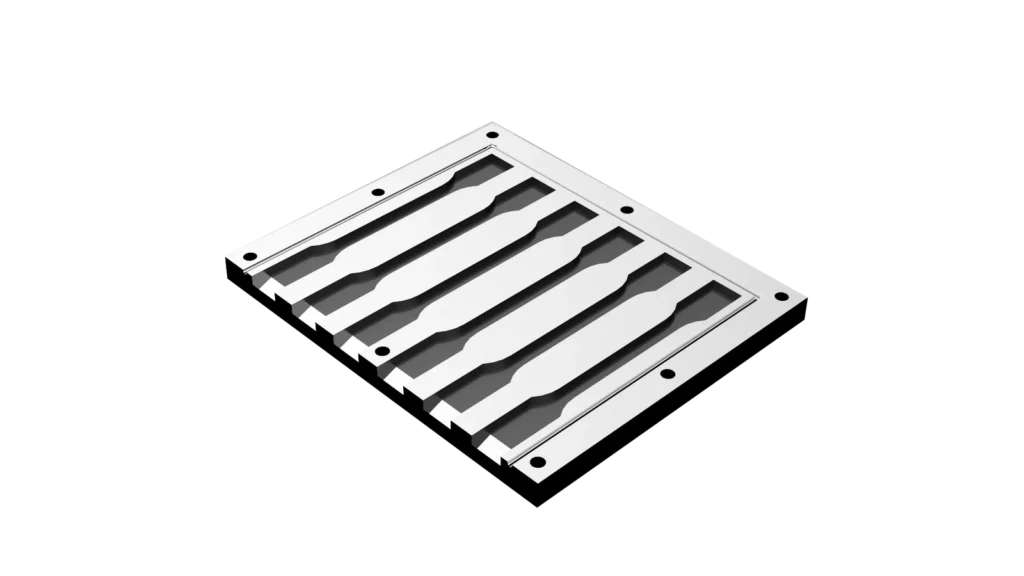


















All Equipments & specimen preparation products can be customised as per requirements.