







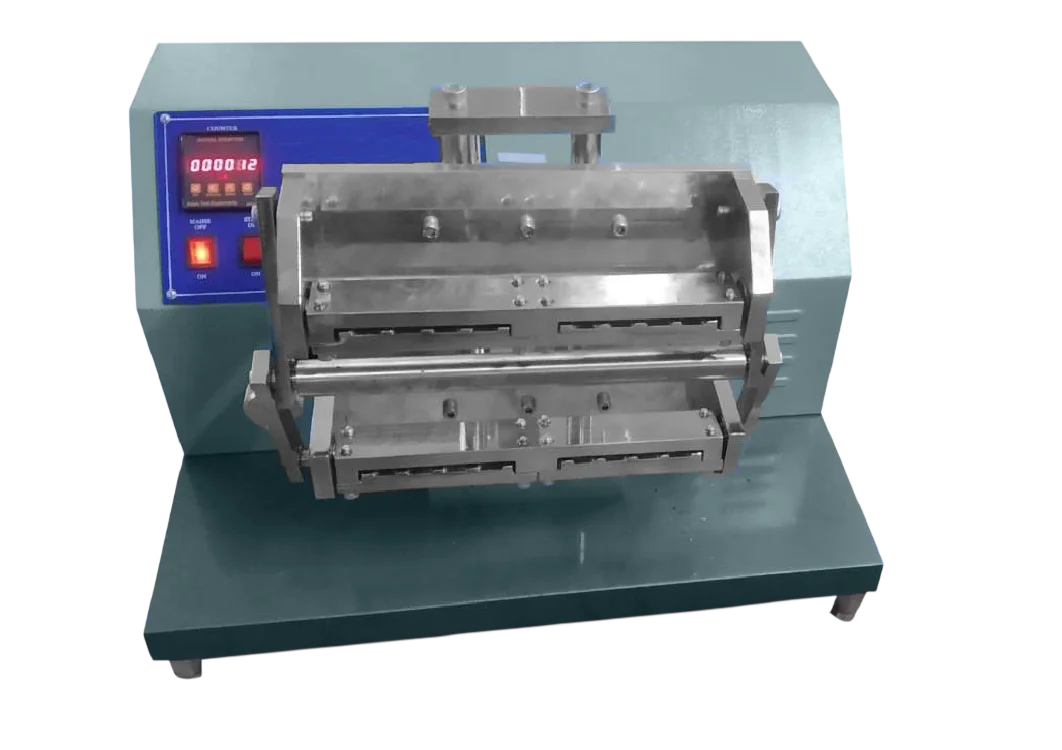
Finetech Engineering is a Bennewart flex tester manufacturer that shoe and soling plants in Tamil Nadu buy from directly: manufacturer, not a trader, with every unit built at Wagle Estate, Thane. In a state whose footwear runs from Ambur leather soles to Chennai safety boots, it works as a flex endurance tester for footwear rubber and other soling: the specimen bends through 90° and the growth of a cut or crack is recorded. As a Bennewart Flex Tester manufacturer that labs in Tamil Nadu can deal with without a middleman, we specify the machine to your method rather than from a catalogue.
What is the Bennewart flex test? A notched sole specimen is flexed over a mandrel and the notch is measured once the set count is reached, giving growth in millimetres. How many cycles does it run? 30,000 flexes in the ISO 17707 and EN ISO 20344 outsole tests; other methods set their own count. The ISO 17707 outsole flex test works on outsole test pieces, while the SATRA TM161 Bennewart flex test method has three variants: outsole cut growth, crack initiation and material cut growth.
Parameter | Specification |
Product Name | Bennewart Flex Tester (Thin Rubber Flexing Endurance Machine) |
Test Method | Repeated flexing of thin rubber specimens to failure |
Specimen | Thin rectangular rubber strip, 2–4 mm thick, per IS 3400/DIN 53522 |
Specimen Stations | Multiple (model-dependent) |
Flexing Frequency | Controlled, per standard specification |
Cycle Counter | Digital counter with auto-stop |
Drive | Electric motor |
Standards | IS 3400, DIN 53522 |
Power Supply | 230V AC, single phase, 50 Hz |
Certification | ISO 9001:2015 certified manufacturing |
Tamil Nadu is a major footwear and leather hub. Bennewart supplies outsole and sole-compound flex data; upper materials are flexed on different equipment. Ambur and Ranipet buyers often ask how leather and rubber soles differ in flex resistance: leather and rubber soling respond differently to repeated bending, so a result on one is never used to approve the other.
| Standard | Method | Test parameter |
ISO 17707 |
Footwear outsole flex resistance (Bennewart) |
Pre-cut outsole flexed; notch growth in mm |
EN ISO 20344 / 20345 |
Safety and protective footwear outsole flex |
30,000 flexes; notch growth in mm |
SATRA TM161 |
Bennewart flex test – cut growth on flexing |
90° flex; outsole cut growth, crack initiation, or material cut growth |
ASTM D1052 / IS 3400 Part 16 |
Ross flexing – a different machine |
Pierced strip bent 90° over a rod; cut growth tracked |
What is the difference between a Bennewart and a Ross flex tester? Both measure cut growth under 90° bending, but they are different machines with different specimens – Bennewart for outsoles and sole materials, Ross for a pierced rubber strip – so results are not interchangeable. Note that ASTM D1052 is the Ross method; Bennewart outsole testing follows ISO 17707 and SATRA TM161. How does a soled footwear flex test differ from a sole material flex test? The first uses a test piece cut from a finished, soled shoe, as EN ISO 20344 does; the second flexes a sheet of soling compound before moulding, as in SATRA TM161’s material cut-growth method. Vellore and Ambur sole suppliers usually need the second, Chennai safety-boot makers the first.
Manufacturer, not a trader. A laboratory testing equipment manufacturer that labs in Tamil Nadu deal with directly: built, calibrated and dispatched from Wagle Estate, Thane. There is no dealer in between – you buy from the factory that builds the machine.
NABL traceable, ISO 9001:2015. Calibration certificates traceable to national standards; CE marked.
Direct factory supply. No reseller margin. We quote your flex endurance tester for footwear rubber with the clamps and mandrel your method needs, whether the specimen is leather soling from Ambur or a PU-rubber safety sole from Ambattur.
Direct dispatch from Thane since 2023. Labs in Chennai and Coimbatore buy from us directly; we dispatch from Thane with installation, calibration and AMC. Ambur and Coimbatore labs that buy from us directly also get scheduled recalibration visits.
See the full specifications on our main Bennewart flex tester page. We also supply and install Bennewart flex testers in other states: Bennewart flex tester in Andhra Pradesh · Bennewart flex tester in Gujarat · Bennewart flex tester in Karnataka · Bennewart flex tester in Maharashtra · Bennewart flex tester in Telangana.
| Product | Why Related |
Complementary flex testing for standard-thickness specimens |
|
Complementary cut growth testing |
|
Complementary abrasion testing |
|
Complementary tensile testing |
|
Specimen preparation tools |
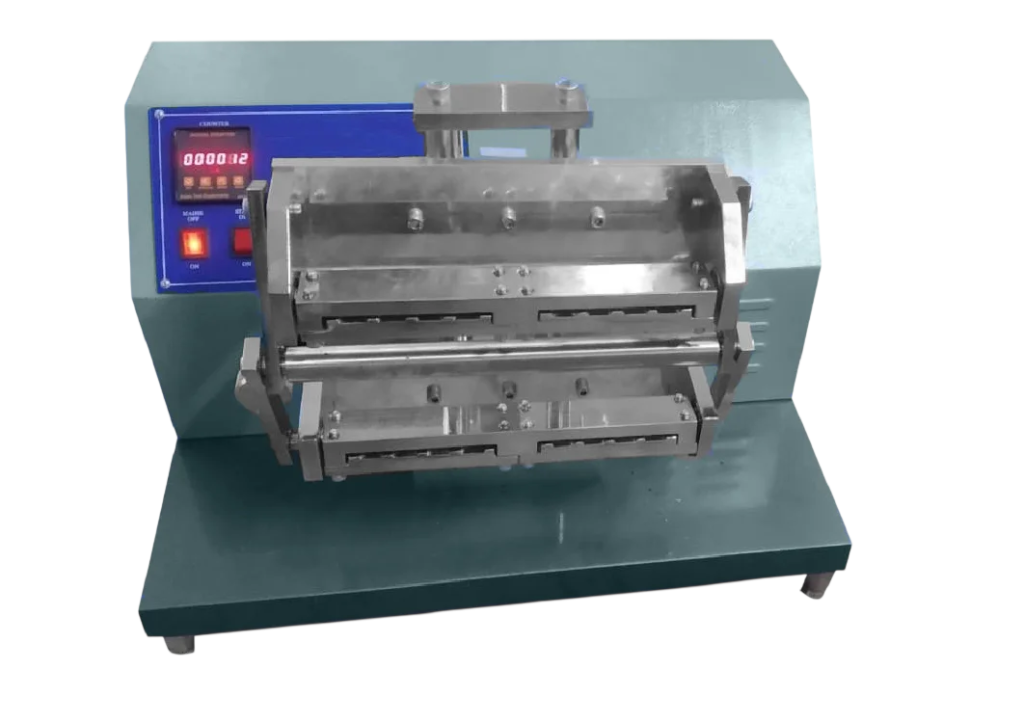


















All Equipments & specimen preparation products can be customised as per requirements.
It measures how a cut or crack grows in a sole specimen under repeated 90° flexing. Our Bennewart flex testers run this test for Chennai safety-footwear and Ambur soling labs; for safety footwear outsole flex testing, Chennai exporters usually run the EN ISO 20344 30,000-flex check.
ISO 17707, the outsole-flex clauses of EN ISO 20344/20345, and SATRA TM161; under EN ISO 20344 the test runs 30,000 flexes. Asked about an IS 3400 flex test procedure? The Indian rubber cut-growth method we can confirm is IS 3400 Part 16, which is the Ross method; tell us the standard your buyer cites and we will confirm the configuration. In short, the ISO 17707 outsole flex test and the SATRA TM161 Bennewart flex test method both run on one Bennewart frame; your buyer's specification decides which report you issue.
Yes, a leather soling specimen can be notched and flexed, but leather and rubber soles differ in flex resistance, so the two results are not interchangeable. Confirm the method scope with your buyer; for Ambur and Vellore exporters we set the machine up for the method they name.
Yes. We dispatch from Thane to Chennai and Coimbatore, and labs in Coimbatore can order the same way. Send your standard and specimen type for a quotation. There is no dealer in between, so you get the factory's own quote.
For a Bennewart flex tester price in India, we quote against your standard and specimen type - no invented figures, no generic list price. Send your requirement through the form or WhatsApp.
Ross flexing (ASTM D1052, IS 3400 Part 16) bends a pierced rubber strip over a rod - see the comparison above; ASTM D1052 flex endurance testing of rubber is a Ross job. Bennewart tests outsoles and sole materials; upper materials are flexed on different equipment. For soled footwear versus sole material flex tests, see the Standards section: a shoe test piece versus a compound sheet.