







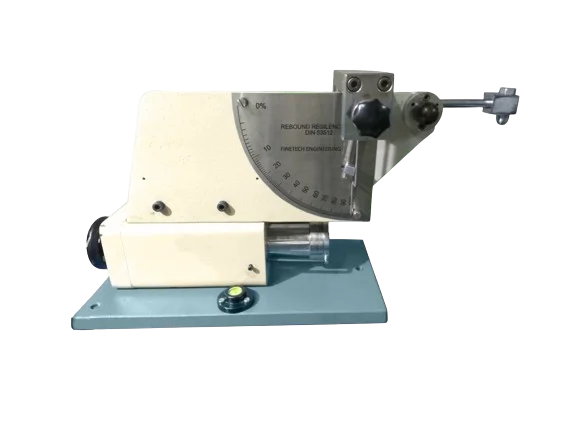
The Finetech Engineering Pendulum Rebound Resilience Tester measures the elastic resilience of vulcanised rubber by striking a rubber specimen with a pendulum and measuring how high the pendulum rebounds. Resilience is the ability of rubber to return stored elastic energy after deformation – think of it as the material’s “bounce.” A tyre tread compound needs low resilience (high hysteresis) for grip. A ball needs high resilience for bounce. A vibration mount needs tuned resilience for damping.
To answer “what is rebound resilience rubber Schob pendulum” and “how is rebound resilience measured rubber pendulum”: a pendulum is released from a known angle, strikes the flat surface of a rubber specimen, and rebounds to a lower angle. The ratio of rebound height to drop height, expressed as a percentage, is the rebound resilience. A perfect elastic material would rebound to 100%. Real rubber compounds typically show 20–80% resilience depending on polymer type, filler loading, and temperature.
The ISO 4662 pendulum rebound tester India (also called the Schob pendulum or Lupke pendulum) is the most widely used rubber elasticity tester pendulum India in the rubber industry. It correlates well with dynamic mechanical properties and is used for compound development, batch QC, and material specification compliance.
Note: Rebound resilience is temperature-sensitive. Always test your rebound resilience tester rubber India specimens at the standard temperature (23°C ±2°C) unless your specification requires otherwise. A compound tested at 40°C will show higher resilience than the same compound at 23°C.
Parameter | Specification |
Product Name | Pendulum Rebound Resilience Tester (Schob Pendulum) |
Test Method | Pendulum impact rebound – measures rebound angle after striking rubber specimen |
Measurement | Rebound resilience (%) = (rebound height / drop height) × 100 |
Pendulum Type | Schob-type (Lupke) pendulum per ISO 4662 / DIN 53512 |
Drop Angle | Fixed per standard (typically 45° or 90° depending on method) |
Measurement System | Digital angle encoder or graduated scale with pointer capture |
Specimen | Flat rubber disc or button, ≥29 mm diameter, ≥12.5 mm thick |
Specimen Support | Rigid steel anvil, flat and horizontal |
Standards | ASTM D1054, ASTM D2632, ISO 4662, DIN 53512, IS 3400 Part 14 |
Power Supply | Manual release mechanism (no electrical power required for basic model) |
Certification | ISO 9001:2015 certified manufacturing |
Quick and simple test – your Finetech pendulum rebound resilience tester manufacturer India choice. Results in seconds. No specimen preparation beyond a standard rubber button. Ideal for rapid incoming QC and compound screening.
IS 3400 Part 14 compliance. Meets Indian BIS standards alongside ASTM, ISO, and DIN.
Same specimen as hardness testing. Use the same 29 mm rubber button for both Shore A hardness and rebound resilience – two tests, one specimen.
Digital angle measurement. Eliminates parallax error from analogue pointer reading. More repeatable results.
Manufacturer, not trader – best pendulum rebound tester price India direct from our Thane facility with calibration and AMC support. Built at our Thane facility. Direct calibration and AMC support.
| Product | Why Related |
Same specimen type – hardness and resilience tested on the same rubber button |
|
Complementary viscoelastic property testing |
|
Complementary abrasion resistance testing |
|
Complementary flex fatigue testing |
|
Complementary tensile testing |


















All Equipments & specimen preparation products can be customised as per requirements.
To answer “what is rebound resilience rubber Schob pendulum”: rebound resilience is the percentage of energy returned by a rubber specimen when struck by a pendulum. Higher resilience means the rubber is more elastic and returns more energy. Lower resilience means more energy is absorbed as heat. Typical values range from 20% (high-damping compounds like butyl rubber) to 80% (highly elastic compounds like natural rubber).
The pendulum vs vertical rebound rubber test difference: the pendulum rebound test uses a swinging pendulum that strikes a flat specimen horizontally; the vertical rebound test (ASTM D2632) drops a plunger vertically and measures the bounce height. Both measure resilience but by different methods. The pendulum method is preferred in ISO and DIN standards. The vertical method is a simpler ASTM option. Finetech manufactures both.
A flat rubber disc or button, minimum 29 mm diameter and 12.5 mm thick. This is the same specimen used for Shore A/D hardness testing. You can use the same hardness buttons from the Finetech hardness button mould.
ASTM D2632 recommends at least 3 impacts per specimen at different locations, and at least 3 specimens per sample. Report the median or mean.
On the question “is rebound resilience same as hardness rubber” – no. They are related but different. Hardness measures resistance to static indentation; resilience measures energy return under dynamic impact. A compound can be soft (low hardness) but highly resilient, or hard but poorly resilient.
Yes. The Finetech ISO 4662 pendulum rebound tester India meets NABL requirements. We provide calibration certificates for pendulum angle and release mechanism.