







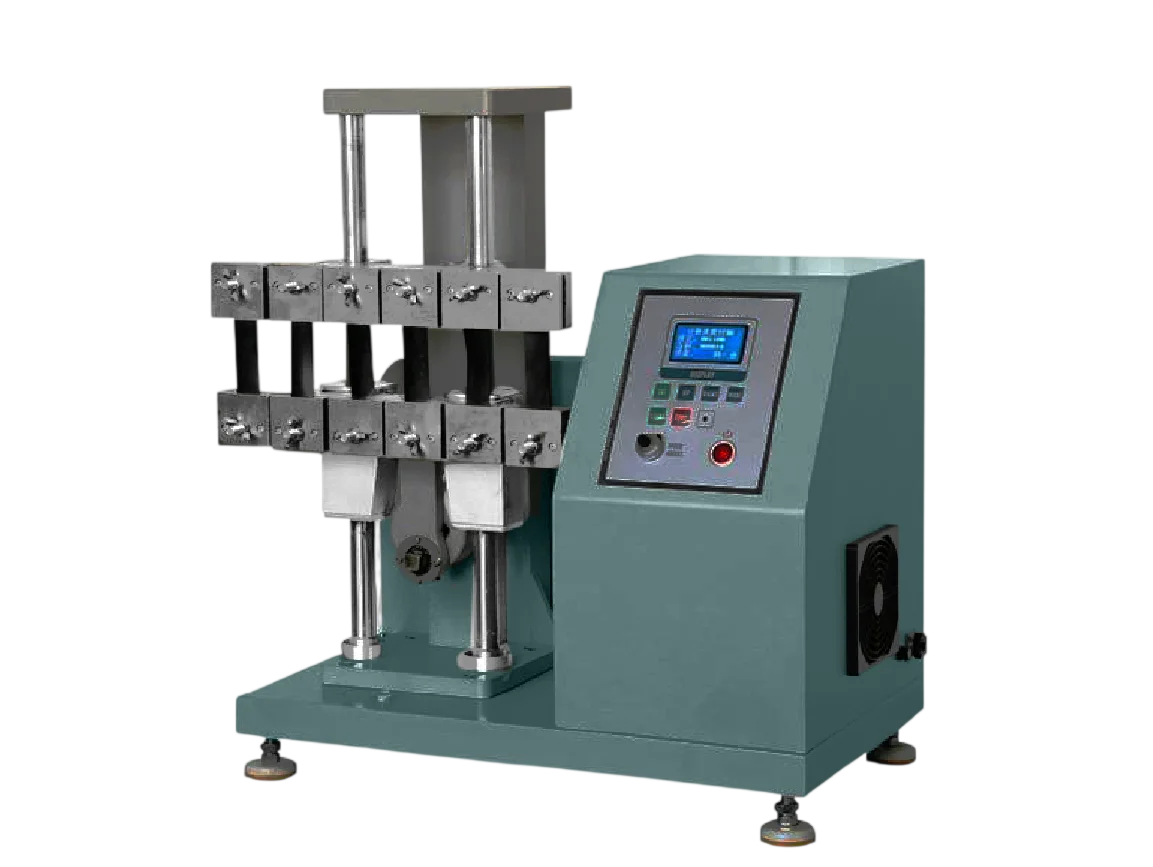
Understanding what is Demattia flex test rubber: the Finetech Engineering rubber fatigue crack tester vulcanised India evaluates how well vulcanised rubber resists cracking when subjected to repeated bending and flexing. In real-world applications, rubber components like shoe soles, bellows, hoses, engine mounts, and conveyor belt covers are subjected to millions of flex cycles over their service life. Each cycle generates a small stress at the surface, and over time, tiny cracks initiate and grow until the part fails.
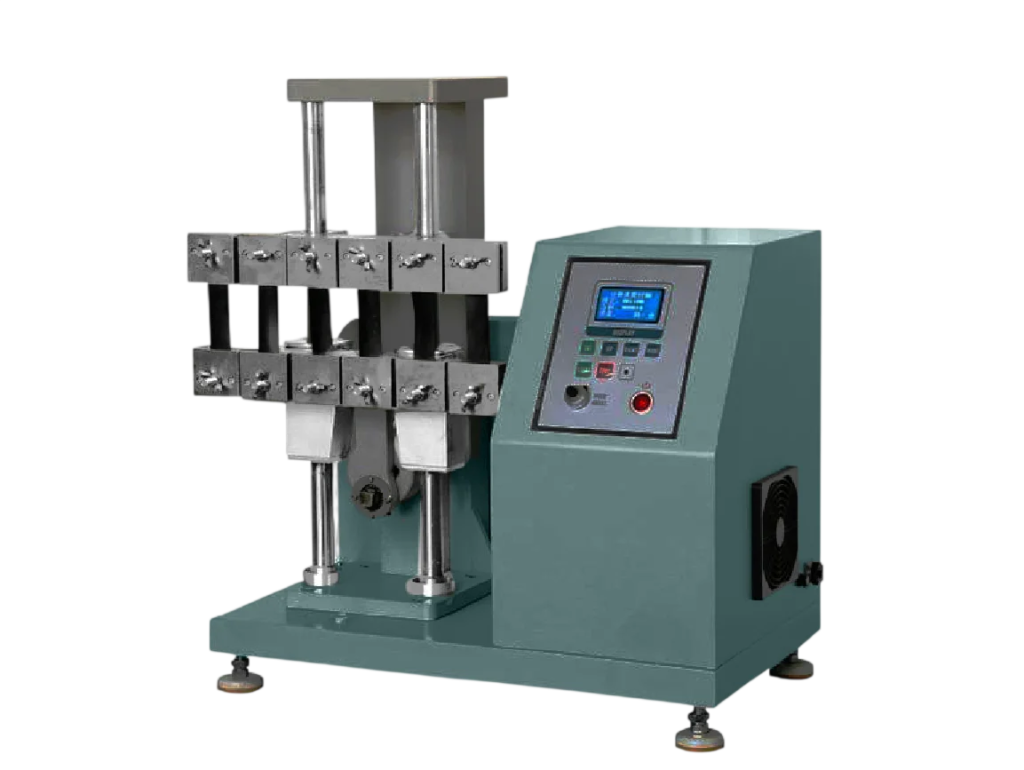
This rubber flex fatigue testing machine India replicates the fatigue mechanism in the laboratory. A grooved rectangular rubber specimen is clamped between two grips – one stationary, one moving. The moving grip cycles at approximately 300 cycles per minute, repeatedly bending the specimen at the groove. As a rubber flex crack initiation tester India, it records both the number of cycles to first visible crack initiation (per ASTM D430 Method B) and the rate of crack growth in millimetres per kilocycle (per ASTM D813).
Two tests are performed on this one machine: ASTM D430 Method B (crack initiation – uncut specimen) and ASTM D813 (crack growth – specimen with a controlled 2 mm puncture at the groove base). The first measures the compound’s resistance to starting a crack. The second measures how fast an existing crack grows once started. Both are critical for predicting field performance.
Note: The Demattia flex mould (for producing the grooved specimens) and the piercing tool (for creating the 2 mm puncture for ASTM D813) are available separately from Finetech – see our test specimen moulds range. As your dedicated footwear sole flex crack tester India partner, Finetech recommends ordering the mould and piercing tool together with the tester.
Parameter | Specification |
Product Name | Demattia Flex Tester (Flex Cracking & Crack Growth Machine) |
Test Methods | Flex crack initiation (ASTM D430 Method B) + Flex crack growth (ASTM D813) |
Specimen Stations | 6 pairs (standard) or 12 pairs (high-capacity model) |
Flexing Speed | Approximately 300 cycles/min (5 Hz) ±10 cycles |
Stroke Length | ~57 mm (per ASTM D430/D813 specification) |
Drive | Electric motor with constant-velocity eccentric drive |
Cycle Counter | Digital counter – kilocycle resolution |
Specimen Type | Grooved rectangular bar moulded in Demattia flex mould per ASTM D430/ISO 132 |
Puncture for D813 | 2 mm controlled puncture at groove base using piercing tool |
Safety | Safety guard, motor overload protection |
Power Supply | 230V AC, single phase, 50 Hz |
Standards | ASTM D813, ASTM D430 Method B, ISO 132, ISO 6943, IS 3400 Part 7 & 8, DIN 53522, JIS K6260 |
Certification | ISO 9001:2015 certified manufacturing |
Two tests, one machine – your Finetech Demattia flex tester manufacturer India choice. Flex crack initiation (D430) and crack growth (D813) on the same tester. No need for separate equipment.
6 or 12 stations for batch testing on your rubber flex fatigue testing machine India. Run multiple compounds or formulations simultaneously for direct comparison.
IS 3400 Part 7 & 8 compliance. Meets Indian BIS standards alongside ASTM, ISO, and DIN – important for government tenders.
Moulds and piercing tool available. Finetech manufactures the Demattia flex mould and piercing tool, so your specimen preparation is covered.
Manufacturer, not trader – best Demattia flex tester price India direct from our Thane facility with factory support, calibration, and AMC.
| Product | Why Related |
Complementary tensile and tear testing of rubber |
|
Complementary abrasion resistance testing |
|
Complementary compression set testing for seals |
|
Alternative flex test for cut growth (ASTM D1052) |
|
Demattia flex mould and all other specimen preparation tools |


















All Equipments & specimen preparation products can be customised as per requirements.
It measures two properties: (1) flex crack initiation resistance – the number of flex cycles before a crack first appears at the groove in an uncut specimen (ASTM D430 Method B), and (2) flex crack growth rate – how fast an existing 2 mm cut grows per kilocycle of flexing (ASTM D813). Together they characterise the rubber’s resistance to dynamic fatigue cracking.
The ASTM D813 D430 difference rubber flex test: ASTM D430 Method B tests crack initiation on an uncut specimen – how many cycles until the first crack appears. ASTM D813 tests crack growth on a pre-cut specimen – how fast the cut extends per kilocycle. A compound may resist initiation well but grow cracks rapidly once started (or vice versa). Testing both gives a complete picture.
Specimens are moulded in a Demattia flex mould using a hydraulic press with heated platens. The mould produces a grooved rectangular bar with the groove at the centre. For ASTM D813, a 2 mm puncture is made at the groove base using a piercing tool. The Finetech IS 3400 Part 7 flex tester rubber India also requires the same specimen geometry, making the same mould and tool set compatible.
ASTM D430 and D813 recommend at least 3 specimens per compound, but 6 is preferred for statistical confidence. The 6-station tester allows you to test an entire set simultaneously.
Footwear sole manufacturers (the #1 user), rubber hose manufacturers, conveyor belt companies, and automotive rubber component producers. Any application where the rubber part is subjected to repeated bending in service.
Yes. The Finetech ASTM D813 flex crack growth tester India meets ASTM D813, D430, and ISO 132 requirements for NABL accreditation. We provide calibration certificates for cycle speed and stroke length.