


ASTM vs ISO vs BIS: Which Testing Standard Should Indian Manufacturers Follow?
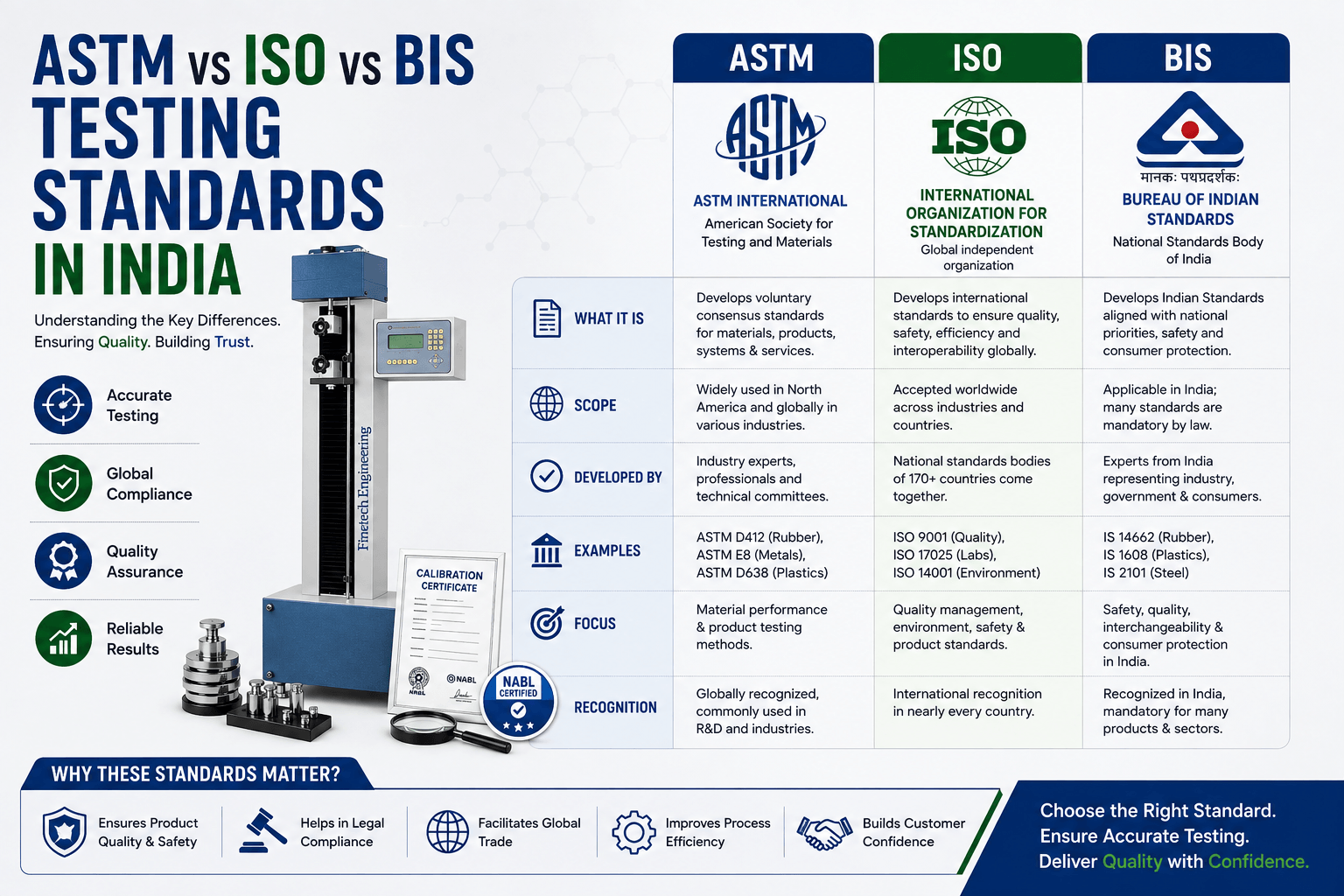
Three acronyms, three bodies, sometimes three different methods for the same property. Let me simplify this, because I get asked about it in almost every second conversation with a new customer. If you are trying to make sense of ASTM vs ISO vs BIS testing standards India customers keep referencing on their spec sheets, you are in exactly the right place.
A factory owner will call and say, ‘Santhosh, we need a tensile testing machine.’ Fair enough. But then the real question follows: tensile testing to which standard? ASTM D638? ISO 527? IS 2530? The specimen dimensions are different. The test speed is different. In some cases, the reported units are different. Buying the wrong configuration means retesting, re-fixturing, or in the worst case, buying additional equipment you did not budget for.
This blog is the reference I wish every new customer had before their first laboratory testing equipment purchase.
What Are ASTM, ISO, and BIS?
Body | Full Name | Origin | What It Governs |
ASTM | American Society for Testing and Materials (now ASTM International) | United States | Voluntary consensus standards widely adopted globally, especially by US-linked OEMs and multinational companies operating in India |
ISO | International Organization for Standardization | Switzerland (international) | Globally harmonised standards, dominant reference for European markets and increasingly for global supply chains |
BIS | Bureau of Indian Standards | India (Government of India) | India’s national standards body; issues IS (Indian Standard) numbers; mandatory for IS-marked product categories |
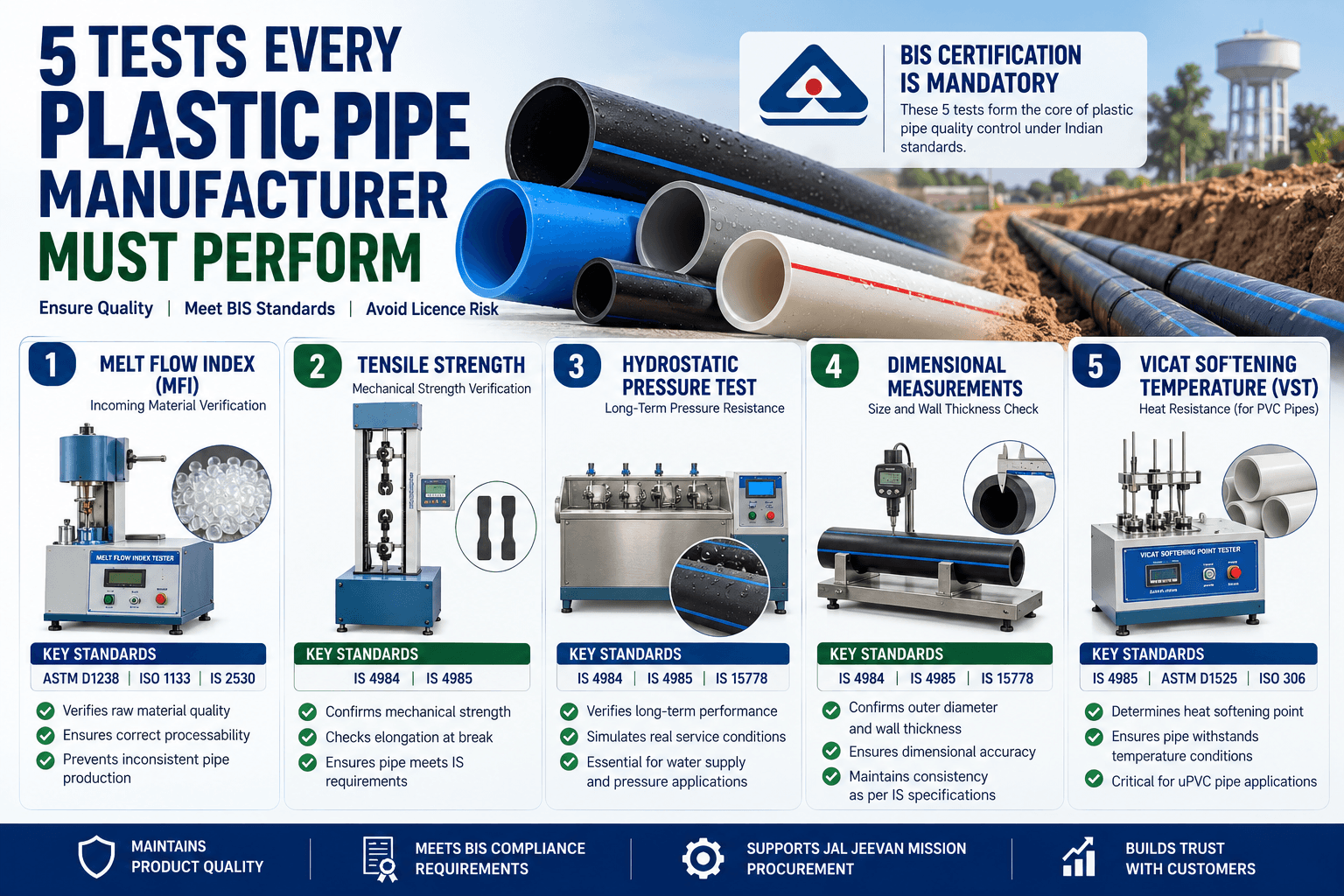
Here is the important nuance: BIS does not always write standards from scratch. Many IS standards are direct adoptions or close adaptations of ISO methodology, sometimes with India-specific modifications for local material grades or climatic conditions. For example, IS 2530 for polyethylene pipe testing draws heavily on ISO test principles while specifying India-relevant parameters. This is why ‘ASTM vs ISO vs BIS’ is not always a three-way fork – often BIS and ISO align closely, while ASTM takes a genuinely different approach to specimen geometry or test speed. The difference between ASTM and ISO testing standard methodology, in most cases, comes down to specimen geometry and test speed rather than the property being measured. Knowing the IS standard equivalent to ASTM ISO testing you already run saves you from buying duplicate equipment when a new customer’s spec sheet references a body you have not worked with before.
None of these bodies are mutually exclusive, and none is universally ‘better.’ They exist because different markets, historically, built their own testing infrastructure and specification culture. As a manufacturer selling into multiple markets, your job is not to pick a favourite – it is to know which standard each customer expects, and to have equipment capable of delivering it.
Which Standard for Which Market?
Your Customer / Market | Standard Body You Will Likely Need | Typical Reason |
US-based OEM or their India subsidiary | ASTM | American engineering specifications default to ASTM test methods |
European OEM or their India subsidiary | ISO | European engineering specifications default to ISO test methods |
Domestic Indian government / PSU procurement | BIS (IS-marked) | Government tenders and PSU procurement typically mandate BIS/IS certification |
Domestic Indian private sector (large conglomerates) | Often ISO, sometimes BIS | Large Indian conglomerates with international quality systems (e.g. Aditya Birla Group, Pidilite) frequently reference ISO in their internal QMS |
Export to Middle East / GCC | Often ISO, occasionally BIS-equivalent Gulf standards (GSO) | GCC countries widely reference ISO; some product categories require GSO conformity |
Export to USA / North America | ASTM (mandatory for many product categories) | US import regulations and OEM specs are predominantly ASTM-based |
Export to EU | ISO / EN standards | CE marking and EU market access typically reference ISO/EN harmonised standards |
Automotive component supply (India, any OEM) | Check OEM engineering spec – varies by OEM origin | Indian automotive OEMs with foreign parentage (Japanese, Korean, German, American) often carry over the parent standard |
If you supply to a mix of these customer types – which is increasingly the norm for growing Indian manufacturers – you will likely need testing capability across at least two of the three bodies. This is completely normal, and it is exactly why we built our own equipment to be reconfigurable across standards rather than locked to one. Working out which testing standard for export market India customers will actually specify is really the starting point for this whole decision, since your customer mix determines which standards you need to cover, not the other way around.
Key Standards Every Manufacturer Should Know
This is the table I tell customers to bookmark. It maps the most common test properties in plastic and rubber testing across ASTM, ISO, and BIS/IS, so you can identify at a glance which standard your customer’s spec sheet is referencing. Think of this as the testing standards mapping table plastic rubber India QC managers keep bookmarked, since it covers the properties that come up in almost every spec sheet you will see.
Property Tested | ASTM Standard | ISO Standard | BIS / IS Standard | Equipment Needed |
Tensile properties – rigid plastics | ASTM D638 | ISO 527-1/2 | IS 13360 (Part 5) | |
Tensile properties – thin film | ASTM D882 | ISO 527-3 | IS 2508 | UTM with film/pneumatic grips |
Tensile properties – rubber | ASTM D412 | ISO 37 | IS 3400 (Part 1) | UTM with rubber dumbbell grips |
Melt flow rate | ASTM D1238 | ISO 1133 | IS 2530 | |
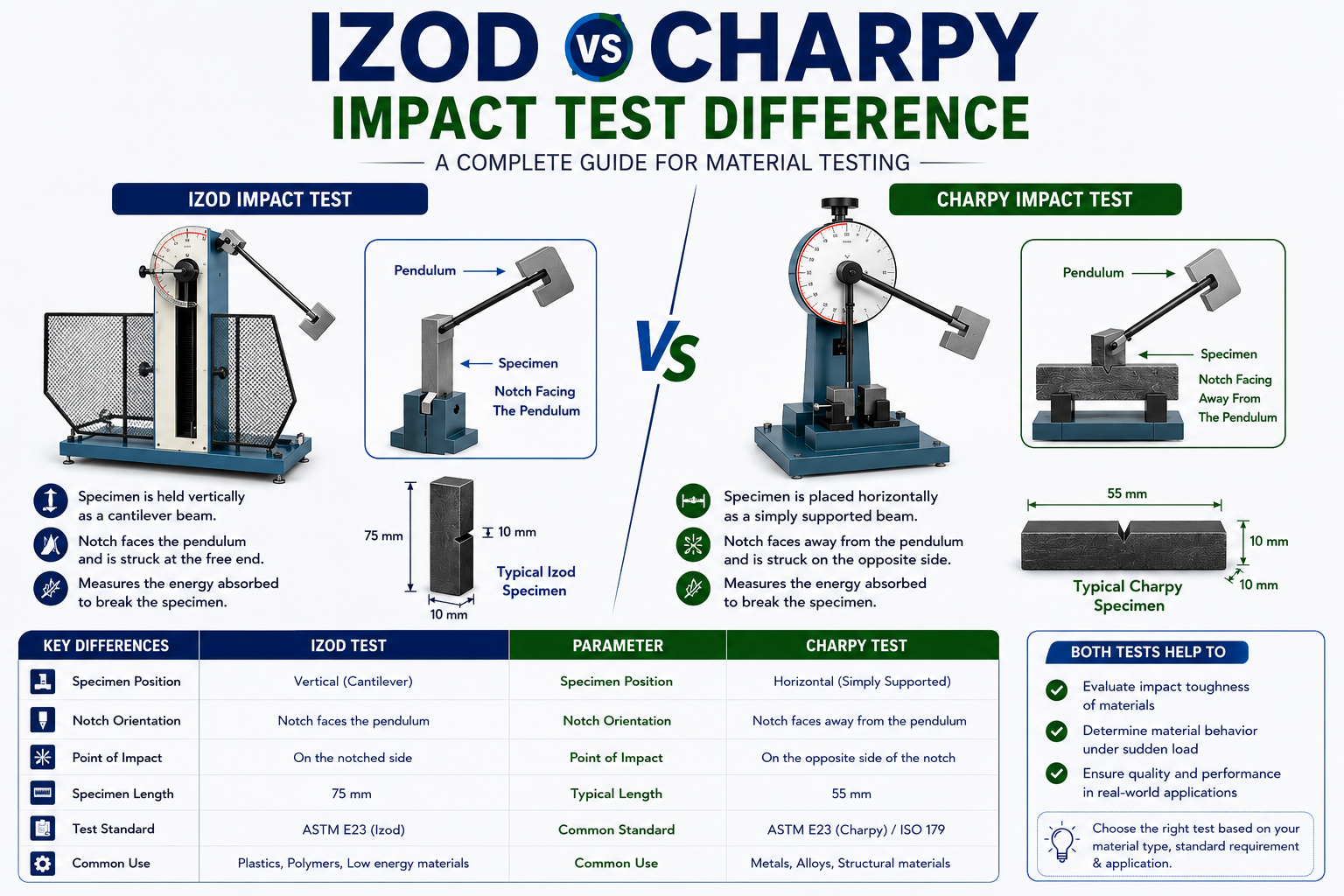
Izod impact strength | ASTM D256 | ISO 180 | IS 13360 (Part 5) | |
Charpy impact strength | ASTM D6110 | ISO 179 | IS 13360 (Part 5) | |
Flexural properties | ASTM D790 | ISO 178 | IS 13360 (Part 5) | Universal Testing Machine with flexural fixture |
Compressive properties | ASTM D695 | ISO 604 | IS 13360 (Part 5) | Universal Testing Machine with compression platens |
Shore hardness (A/D) | ASTM D2240 | ISO 868 | IS 13360 (Part 5) | |
Heat deflection temperature | ASTM D648 | ISO 75 | IS 13360 (Part 6) | |
Vicat softening point | ASTM D1525 | ISO 306 | IS 13360 (Part 6) | HDT / VSP Apparatus |
Environmental stress cracking | ASTM D1693 | ISO 4599 / ISO 22088 | IS 7328 | ESCR Apparatus |
Dart impact (film) | ASTM D1709 | ISO 7765-1 | – | Dart Impact Tester |
Flammability (electrical/electronic) | ASTM D635 / UL 94 | IEC 60695 | IS 11731 | Flammability Tester |
Tip: Save this table. When a customer sends a spec sheet referencing a standard number you do not recognise, search this table first – most common plastic and rubber test properties are covered here, and you can quickly identify the equivalent standard from another body if you already own equipment configured for it.
Note that the equivalence between standards is close but rarely exact. ASTM D638 and ISO 527 both measure tensile properties, but the specimen dimensions, test speeds, and sometimes the calculated values (particularly modulus) differ. Treat this table as a map to the right test category and equipment, not as a claim that results are numerically interchangeable across standards. This ASTM D638 vs ISO 527 tensile testing difference is the single most common equivalence question we field, precisely because the two are so close in what they measure yet different enough in method to trip up a buyer who assumes they are interchangeable.
Can One Machine Test for Multiple Standards?
In most cases, yes – with the right fixtures and specimen preparation, not necessarily a different machine. This is the single most cost-effective insight I can give a factory owner evaluating multi-standard testing needs. Answering ‘can one machine test multiple standards ASTM ISO’ directly: yes, in the great majority of cases. A multi-standard testing equipment manufacturer India factories work with should be able to specify exactly which fixtures and dies turn one base machine into coverage for two or three standard bodies.
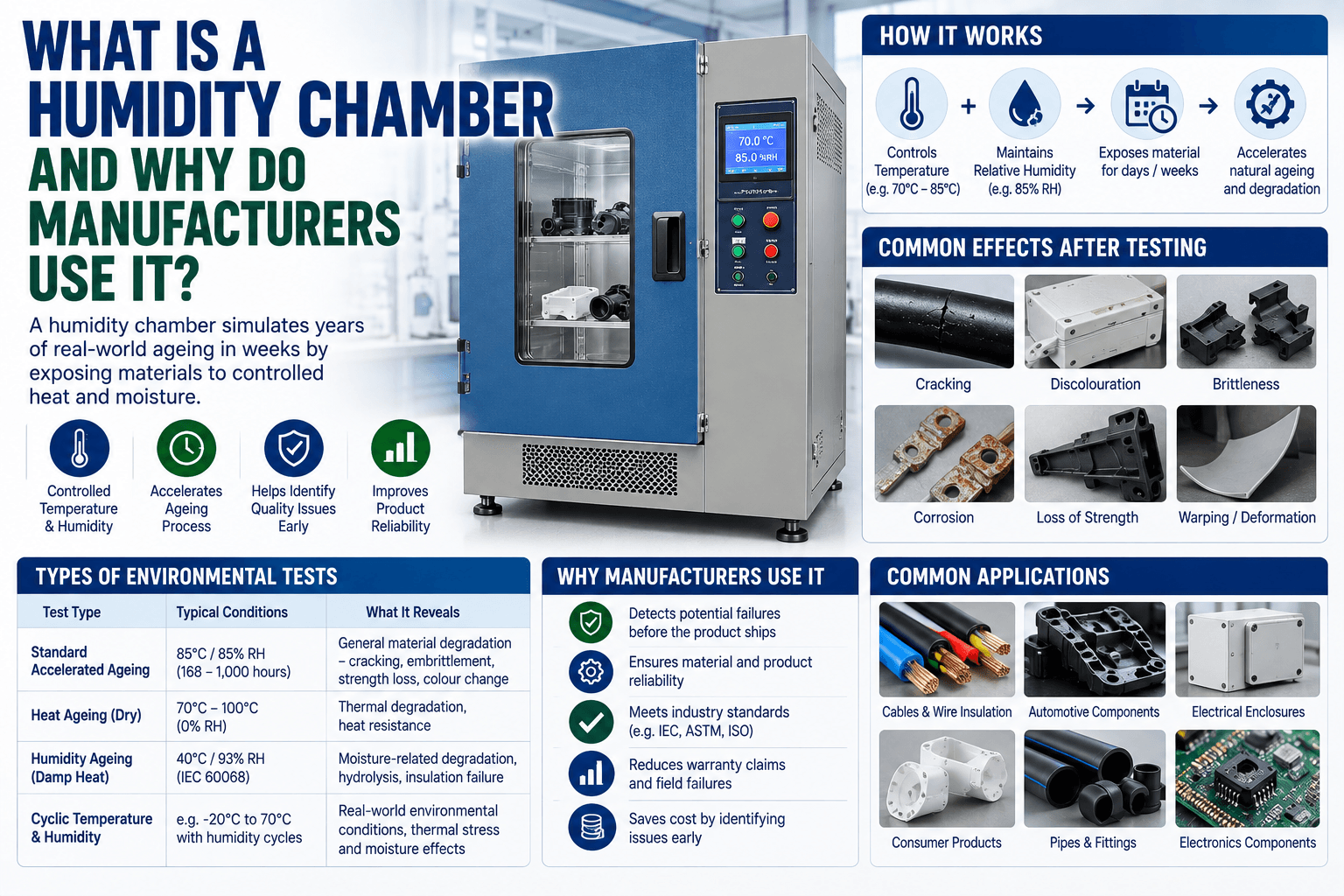
Real situation, name withheld: A packaging materials company supplying both a domestic BIS-certified product line and an ISO-certified export line was running two separate tensile testing setups – one older UTM dedicated to BIS testing, another newer UTM dedicated to ISO testing. Each machine sat idle roughly half the week, and they were paying for calibration, floor space, and maintenance on two machines effectively doing the same category of test. When we reviewed their setup, the two UTMs had nearly identical load cell ranges. The real difference was the grip set and the specimen dies – BIS-compliant dumbbells cut with one set of dies, ISO-compliant Type 1A dumbbells cut with another. We consolidated their testing onto a single UTM with a quick-change grip system and two sets of properly dimensioned specimen dies. They retired the second machine, cutting their annual calibration and maintenance cost roughly in half, and freed up lab floor space they redeployed for a new humidity chamber.
The core principle: a UTM’s load frame, crosshead, and load cell are largely standard-agnostic – they simply apply and measure force. What changes between standards is the specimen geometry (requiring different cutting dies), the grip type (sometimes), and the test speed setting (usually just a parameter change in the controller, not a hardware change). A well-specified UTM, MFI Tester, or Impact Tester can usually serve multiple standards with a change of fixture or specimen die, not a change of machine. Understanding why does specimen dimension differ ASTM ISO standard requirements is really the whole answer to why you need different dies rather than different machines – the load frame does not care which standard it is loaded under, but the specimen shape absolutely does.
Equipment | What Changes Between Standards | What Stays the Same |
Universal Testing Machine | Grip type (sometimes), test speed setting, specimen die used for cutting | Load frame, load cell, crosshead mechanism, controller |
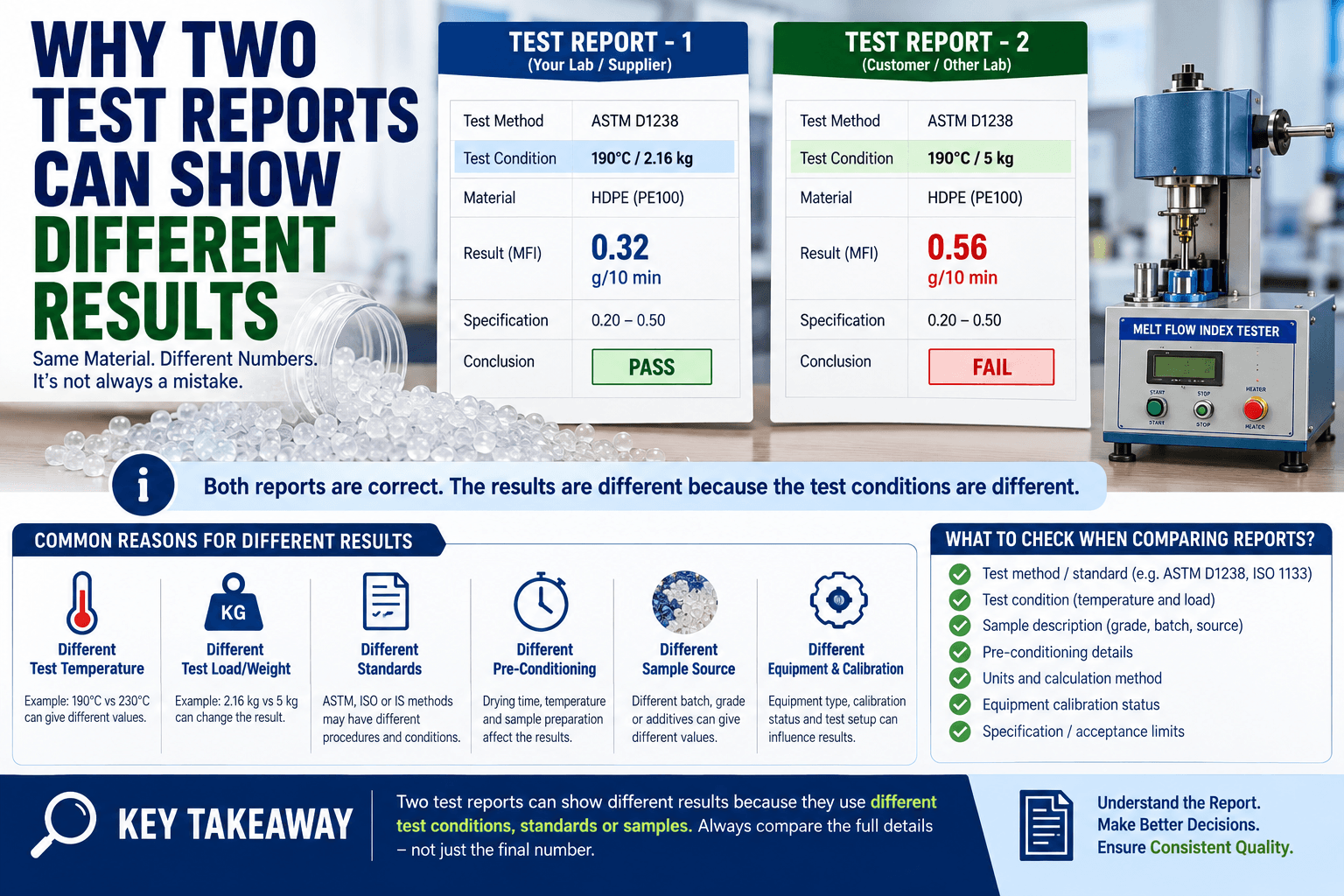
Melt Flow Index Tester | Test temperature and weight (per material, not per standard), preheat time (ISO requires slightly different protocol) | Barrel, die, heating system, timer |
Izod & Charpy Impact Tester | Specimen mounting configuration (Izod vertical vs Charpy horizontal), notch dimensions per standard | Pendulum, energy scale, frame |
Hardness Tester | None typically – ASTM D2240 and ISO 868 use nearly identical methodology | Indenter, spring mechanism, dial/digital readout |
HDT / VSP Apparatus | Load applied (ASTM uses different standard loads than ISO in some cases), oil bath heating rate | Oil bath, dial gauge/digital measurement system, frame |
The exception is when load capacity genuinely differs – for example, if your ISO testing involves much thinner film specimens than your BIS testing involves thick pipe wall specimens, you may need two different load cell ranges on the same machine (most computerised UTMs support interchangeable load cells) rather than two separate machines.
Final Thoughts
ASTM, ISO, and BIS are not competing systems you need to choose between once and commit to forever. They are three reference frameworks that different customers, markets, and regulators use – and as an Indian manufacturer serving a mix of domestic and export customers, you will likely need testing capability that spans more than one.
The standards mapping table in this blog covers the most common properties tested in plastic and rubber quality control. Bookmark it. The next time a customer’s spec sheet references a standard number you do not immediately recognise, you will have a fast way to identify the test category and the equipment required.
And remember the packaging company’s story: before assuming you need a second machine for a second standard, ask whether a change of grip, fixture, or specimen die on your existing equipment would do the job. In most cases, it will – and the saving in calibration, maintenance, and floor space is real money, not a marginal convenience.
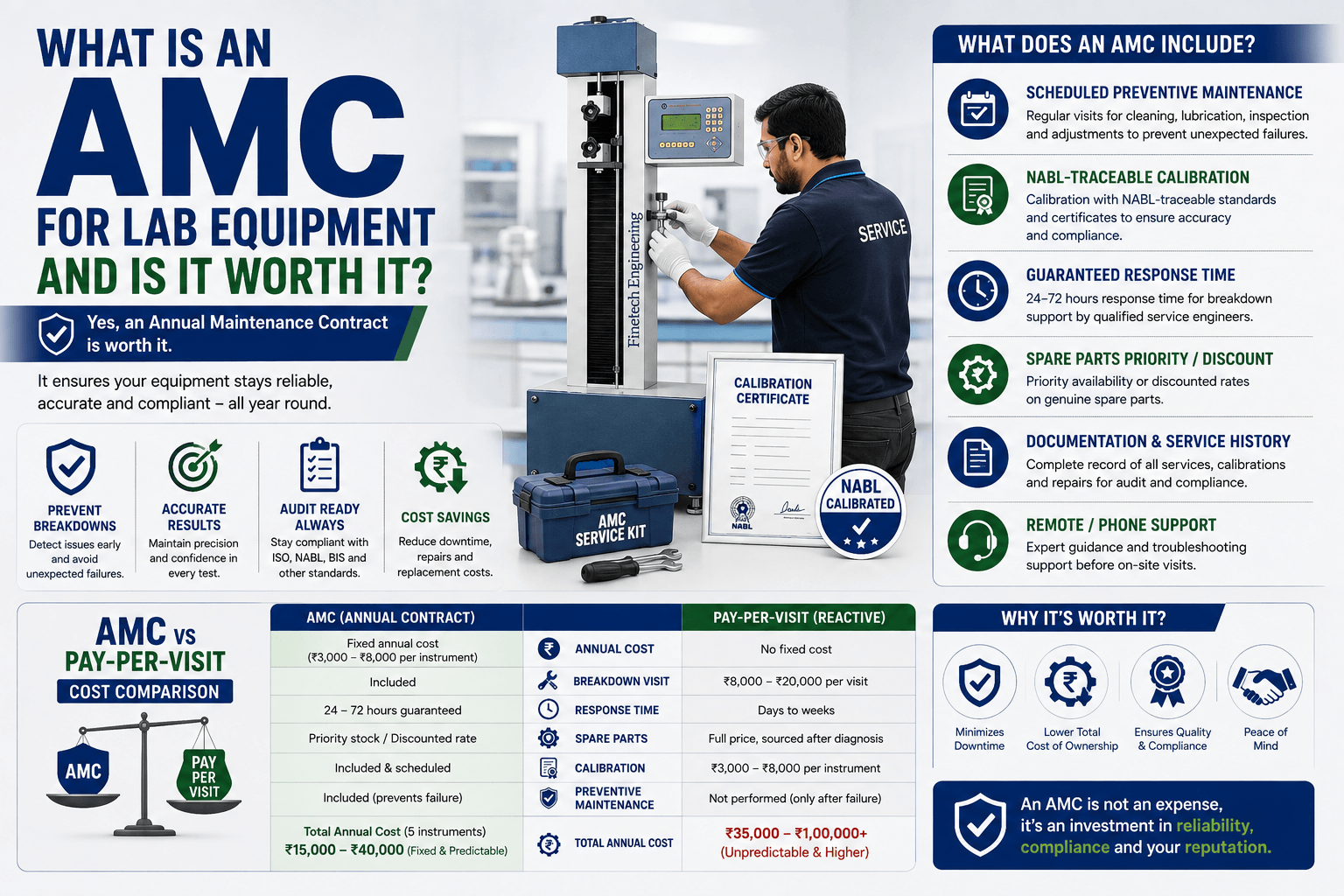
As a BIS certification testing equipment India manufacturers turn to alongside their ASTM and ISO requirements, at Finetech Engineering, we manufacture laboratory testing equipment configured to serve ASTM, ISO, and BIS requirements from the same base machines, with interchangeable grips, fixtures, and specimen dies. When you tell us which standards your customers require, we specify the equipment and fixtures to cover all of them – not just the first one you mention. Our calibration services keep every configuration audit-ready year-round.
Not Sure Which Standards Your Product Needs?
Call or WhatsApp: +91 93241 37971
Email: info@finetechengineer.com
Tell us your product, your export markets, and your customer’s spec sheet. We will tell you which standards apply and which equipment configuration covers all of them.
If you’d like to talk it through first, contact us and we’ll map your standards together.
– Santhosh Kumar VP, Founder & Managing Partner, Finetech Engineering