


HDT and Vicat Softening Point: What They Tell You About Your Plastic
If your product is exposed to heat, you need to know at what temperature it deforms. That is what HDT and Vicat measure – and if you do not test for it, you find out the hard way, usually in the field, usually after the product has already shipped.
I want to tell you about a situation involving an automotive component supplier near Chennai. They were supplying a moulded polymer bracket positioned close to the engine bay – an application with sustained exposure to elevated under-bonnet temperatures. The material datasheet looked adequate on paper. Nobody had specifically verified the compound’s heat deflection temperature against the actual service temperature the bracket would see in that mounting position. An HDT tester for automotive plastic components would have caught exactly this gap before the part ever reached a moulding tool, which is precisely why this story is worth telling in full.
Real situation, name withheld: Within a few months of vehicles reaching customers, the automotive OEM began receiving warranty claims for a bracket that had visibly warped and lost its mounting geometry. Investigation traced the failure to the bracket softening under sustained heat exposure near the engine bay – the polymer’s actual heat deflection temperature was lower than the application required, a mismatch that a routine HDT test, run before the part went into production, would have caught immediately. The supplier had to requalify the part with a higher-HDT compound, absorb the cost of the affected batch, and rebuild confidence with the OEM’s quality team. A test that takes roughly an hour to run, on equipment costing well under Rs 1.5 lakhs, would have flagged the mismatch before a single part was moulded.
This blog explains what HDT and Vicat Softening Point actually measure, how they differ, and when you need one, the other, or both.
What Is HDT (Heat Deflection Temperature)?
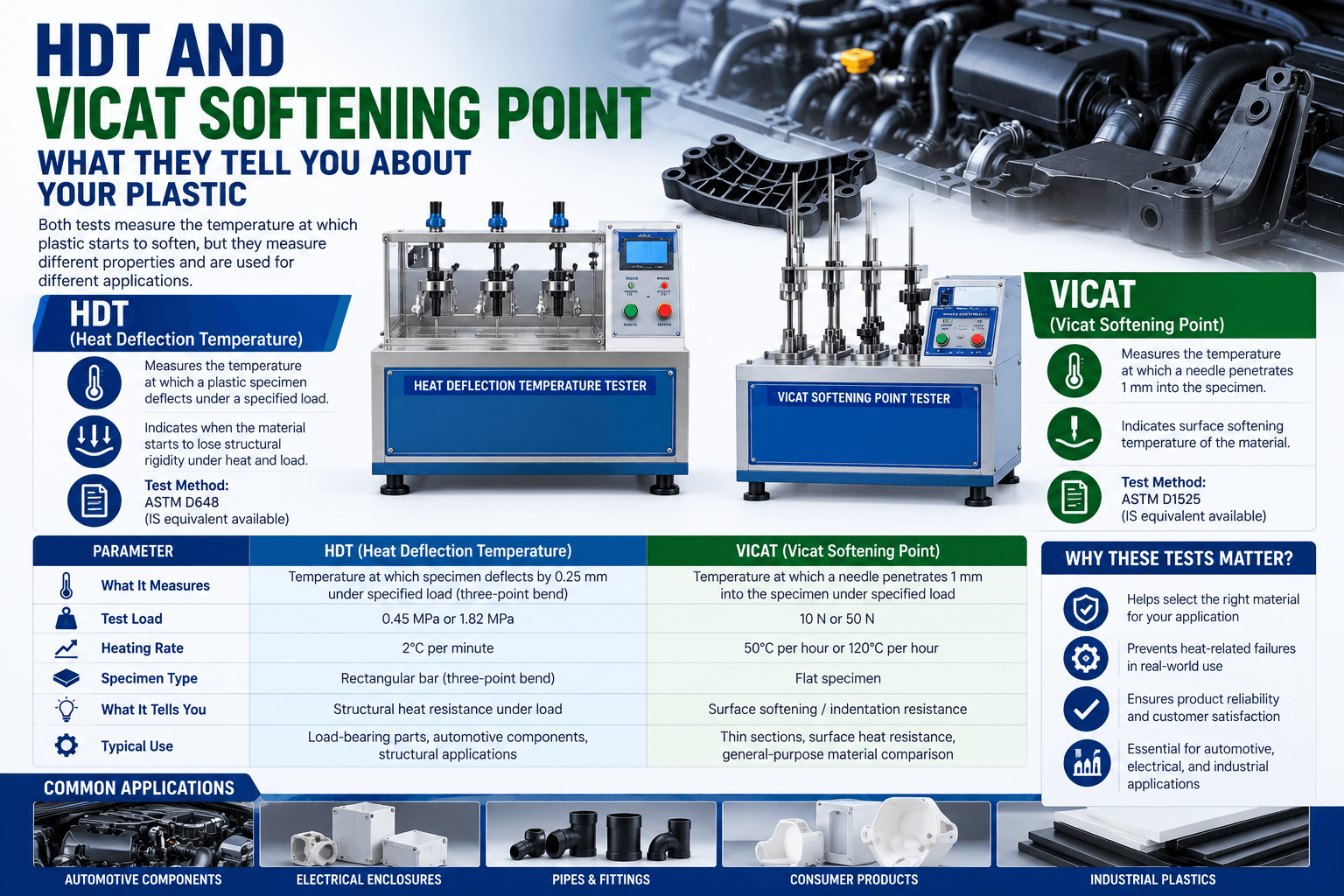
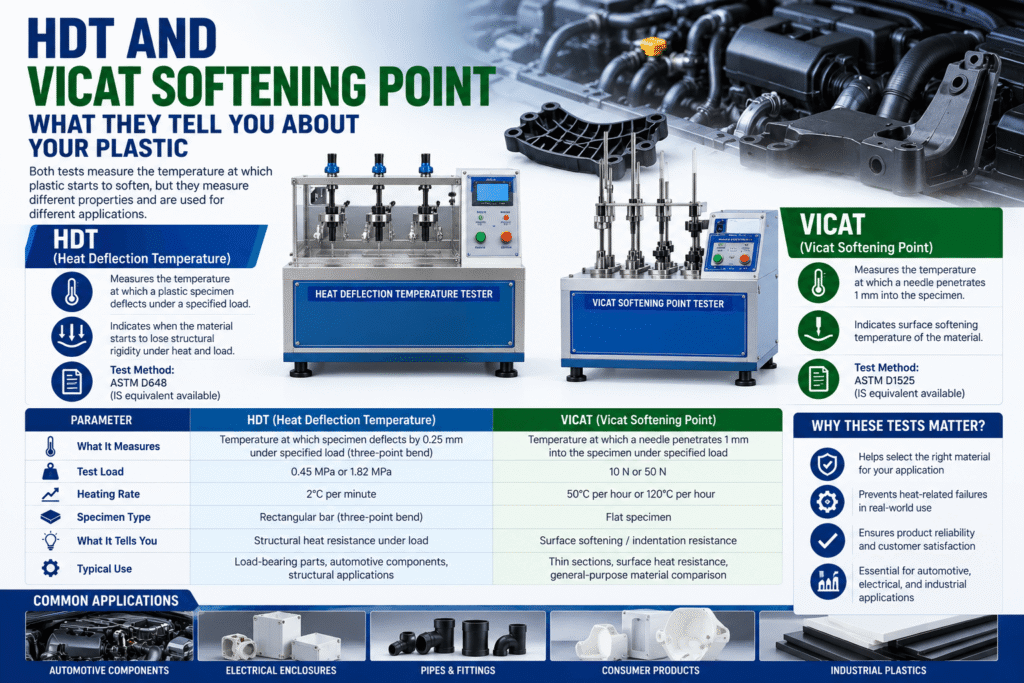
Heat Deflection Temperature (HDT), also called Heat Distortion Temperature, measures the temperature at which a plastic specimen deflects by a specified amount under a specified load, as the surrounding temperature is raised at a controlled rate. In practical terms: it tells you the temperature at which your material starts to lose its structural rigidity under load. Can HDT testing predict long-term heat performance on its own? Not directly – HDT is a single-point deflection reading under a fixed load and heating rate, not a long-term thermal-aging or service-life test; for genuine long-term heat degradation, a separate thermal-ageing study is the correct method, with HDT serving as a quick screening check rather than a substitute.
The test procedure, per ASTM D648: a rectangular bar specimen is placed in a three-point bend configuration, submerged in a temperature-controlled oil bath, and loaded with a specified stress – either 0.45 MPa (66 psi, the lower and more common stress level) or 1.82 MPa (264 psi, the higher stress level used for more demanding applications). The bath temperature is then raised at a controlled rate of 2°C per minute. The temperature at which the specimen deflects by 0.25 mm (0.010 inch) is recorded as the HDT.
HDT is reported as, for example, ‘HDT at 0.45 MPa: 85°C’ or ‘HDT at 1.82 MPa: 68°C’ – the same material typically shows a lower HDT at the higher stress level, since more load causes deflection to occur sooner as temperature rises. Always check which stress level a specification refers to before comparing values between materials or datasheets. What does HDT at 1.82 MPa mean on a material datasheet in practice? It tells you the deflection temperature under the higher, more demanding stress level – and answering why does the same material show different HDT at different stress levels directly: more load simply causes the specimen to reach its deflection criterion sooner as temperature rises, so the higher-stress figure is always the lower of the two numbers.
What Is Vicat Softening Point?
Vicat Softening Point (VSP) measures something related but distinct: the temperature at which a flat-ended needle, under a specified load, penetrates a specimen to a depth of 1 mm, as the specimen is heated at a controlled rate. Where HDT measures deflection under bending load, Vicat measures surface softening under a point load. Is Vicat softening point the same as melting point? No – Vicat measures the temperature at which a needle penetrates the material under load, which is typically well below true melt temperature for a crystalline polymer, and for an amorphous polymer there is no distinct melting point at all, only a broader glass transition.
The test procedure, per ASTM D1525: a specimen is placed under a needle-tipped indenter loaded with either 10 N (Load A) or 50 N (Load B). The specimen and needle are heated at a controlled rate – either 50°C per hour or 120°C per hour, depending on the specified test rate – and the temperature at which the needle penetrates 1 mm into the specimen is recorded.
Vicat Softening Point is particularly relevant for materials and applications where surface indentation or softening – rather than structural deflection under a distributed load – is the practical concern. It is widely used for PVC pipe and profile testing, where surface softening behaviour under heat is directly relevant to installation and service conditions. A Vicat softening point tester for PVC pipe and profile lines is one of the most commonly ordered configurations we build, precisely because surface softening under heat is a direct installation and service concern for that product category.
HDT vs Vicat: When to Use Which
Aspect | HDT (Heat Deflection Temperature) | Vicat Softening Point |
What it measures | Deflection under a distributed bending load as temperature rises | Needle penetration under a point load as temperature rises |
Typical standard | ASTM D648, ISO 75 | ASTM D1525, ISO 306 |
Best suited for | Structural components under sustained mechanical load and heat – brackets, housings, enclosures | Surface softening behaviour – pipes, profiles, sheet materials, film |
Load application | Specified stress applied across the specimen span (0.45 or 1.82 MPa) | Point load applied through a needle tip (10 N or 50 N) |
Typical industries | Automotive components, electrical enclosures, appliance housings, structural mouldings | PVC pipe and fittings, extruded profiles, packaging film, cable insulation |
Reported value tends to be | Generally lower than Vicat for the same material, since it measures a structural deflection criterion | Generally higher than HDT for the same material, since it measures a more localised softening criterion |
My practical guidance: if your product experiences sustained mechanical load in a heated environment – a bracket, a housing, a structural part – test HDT. If your product’s concern is more about surface behaviour under heat – a pipe wall, an extruded profile, a film – test Vicat. Many material datasheets report both values, precisely because different applications and different customer specifications reference one or the other, and sometimes both. If you are still asking how do I know whether to test HDT or Vicat for my product, use that structural-load-versus-surface-load distinction as your starting point. And answering why do datasheets report both HDT and Vicat values so often: a single material often serves customers in both structural and surface-critical applications, so the manufacturer runs both tests once rather than fielding repeat requests later.
Testing Methods - ASTM D648 and ASTM D1525
Standard | Full Title | Key Parameters |
ASTM D648 | Standard Test Method for Deflection Temperature of Plastics Under Flexural Load | Stress: 0.45 MPa or 1.82 MPa. Heating rate: 2°C/min. Deflection criterion: 0.25 mm |
ISO 75 | Plastics – Determination of Temperature of Deflection Under Load | Similar principle to ASTM D648, slightly different specimen dimensions and load options (methods A, B, C) |
ASTM D1525 | Standard Test Method for Vicat Softening Temperature of Plastics | Load: 10 N (Load A) or 50 N (Load B). Heating rate: 50°C/hr or 120°C/hr. Penetration criterion: 1 mm |
ISO 306 | Plastics – Thermoplastic Materials – Determination of Vicat Softening Temperature (VST) | Similar principle to ASTM D1525, four method combinations (A50, B50, A120, B120) |
A single HDT/VSP Apparatus with an oil bath, digital temperature controller, and interchangeable loading fixtures typically covers both test methods – the equipment shares the same heating and temperature-ramp mechanism, with different specimen holders and load configurations for each test.
Specimen preparation matters here as much as it does for tensile and impact testing. HDT bars require flat, parallel surfaces and consistent thickness – typically 3.2 mm to 12.7 mm depending on the standard’s specimen option. An improperly moulded or machined specimen with warped surfaces will contact the loading points unevenly, giving an inconsistent or premature deflection reading. If you are preparing specimens from compression-moulded plaques or machined stock rather than injection-moulded bars, use a proper specimen cutters and moulds setup rather than hand-cutting – the same principle we cover in our specimen preparation blog series for tensile and impact specimens.
Real-World Applications
Here is how HDT compares across common engineering plastics – useful context when evaluating whether a material is suited to a heat-exposed application:
Polymer | Typical HDT @ 0.45 MPa | Typical HDT @ 1.82 MPa | Common Heat-Exposed Applications |
Polypropylene (PP) | 100°C – 115°C | 55°C – 65°C | Automotive interior trim, appliance housings, battery cases |
ABS (Acrylonitrile Butadiene Styrene) | 95°C – 105°C | 85°C – 95°C | Electrical enclosures, automotive dashboards, appliance panels |
Nylon (PA6 / PA66, unfilled) | 150°C – 190°C | 60°C – 75°C | Under-bonnet automotive components, gears, bearing housings |
Nylon (PA66, glass-filled 30%) | 220°C – 250°C | 210°C – 240°C | High-temperature automotive components near engine bay |
HDPE | 75°C – 85°C | 45°C – 50°C | Pipes, containers, general-purpose mouldings |
Rigid PVC | 70°C – 80°C | 60°C – 70°C | Pipes, profiles, electrical conduit (Vicat more commonly referenced) |
Polycarbonate (PC) | 140°C – 145°C | 130°C – 138°C | Electrical housings, lighting components, transparent structural parts |
Notice the significant gap between unfilled and glass-filled Nylon in the table above – this is precisely the kind of distinction that matters for an application like the Chennai automotive bracket. An unfilled Nylon grade might be entirely adequate for an interior trim application but marginal or inadequate for a component mounted close to an engine bay, where glass-filled Nylon’s substantially higher HDT is often the correct specification. Testing is what catches this before the part is in a customer’s vehicle rather than after.
Beyond automotive, HDT and Vicat testing matter for appliance manufacturers (housings near heating elements), electrical component manufacturers (enclosures subject to self-heating from internal components), and any manufacturer whose product may sit in direct sunlight in a hot climate – a genuinely common condition across most of India for outdoor-installed plastic products, from water tanks to junction boxes. A thermal deflection testing machine supplier India appliance and electrical manufacturers can call on for both HDT and Vicat coverage saves the trouble of qualifying two separate vendors for what is, in practice, one instrument.
Final Thoughts
HDT and Vicat Softening Point are not exotic tests reserved for high-end engineering applications. Any product that will be exposed to elevated temperature – under a car bonnet, on a rooftop, near an appliance heating element, or simply outdoors in an Indian summer – benefits from knowing the actual temperature at which its material begins to lose structural integrity or soften.
The Chennai automotive bracket failure was preventable with a test that takes about an hour to run. The cost of not knowing was a field failure, a warranty claim, and a requalification process that almost certainly cost more than the testing equipment itself would have.
At Finetech Engineering, we manufacture HDT/VSP Apparatus at our Thane facility, capable of running both ASTM D648 and ASTM D1525 methods on the same oil bath system. If your product sees sustained heat in service – automotive, appliance, outdoor installation, or otherwise – this is one of the most cost-effective additions you can make to your laboratory testing equipment QC lab. On HDT and Vicat testing lab equipment cost India manufacturers typically budget, a combined unit covering both ASTM D648 and ASTM D1525 stays well within reach even for a small plastics QC lab just getting its testing capability off the ground.
Need to Verify Your Material’s Heat Performance?
Call or WhatsApp: +91 93241 37971
Email: info@finetechengineer.com
Tell us your polymer grade and the maximum service temperature your product will face. We will recommend the right HDT/VSP configuration for your lab.
If you’d like to talk it through first, contact us and we’ll map it out together.
– Santhosh Kumar VP, Founder & Managing Partner, Finetech Engineering