


Do You Really Need an AMC for Your Lab Testing Equipment? (Yes - and Here's Why)
I get asked this question at least once a week. A QC manager calls to enquire about a new UTM or an MFI tester, and at some point in the conversation, I mention our AMC. The response is almost always the same: “Let me first buy the machine. I will think about AMC later.” Honestly, do I need AMC for lab testing equipment is the single most common version of this question I hear, and my answer depends entirely on how many machines you run and how often.
I understand the hesitation. An AMC feels like paying for something you might not need. The machine is working fine today, so why sign a maintenance contract? It is a fair question, and I am going to answer it honestly – with real numbers, real stories, and a clear breakdown of when an AMC makes sense and when it does not.
The short answer: if your lab has three or more testing instruments and you run them regularly, an AMC will save you money, protect your data, and keep your lab audit-ready. If you have a single instrument that you use twice a month, a pay-per-visit arrangement might be more practical. Let me show you why. So, is AMC worth it lab equipment India teams should ask themselves before buying? If you run three or more instruments regularly, yes – the maths below explains why.
The Daman Story - What Happens When You Don't Have an AMC
A few months ago, a client in Daman called us in a panic. Their humidity chamber had stopped maintaining temperature during a 1000-hour ageing test for an export order. The test had been running for 700 hours. Seven hundred hours of carefully controlled exposure, and now the chamber was fluctuating between 65°C and 78°C instead of holding steady at 70°C.
They had no AMC. No service history. And the original supplier – a trader, not a manufacturer – had stopped responding to calls. They found our number on IndiaMART and called at 9 PM.
We sent our technician the next day. The fault was a failing thermostat relay – a component that costs about ₹800. Our technician replaced it, recalibrated the temperature controller, and the chamber was back to 70.0°C ±0.3°C within two hours. The 700 hours of test data was salvageable because the temperature excursion had lasted less than 6 hours.
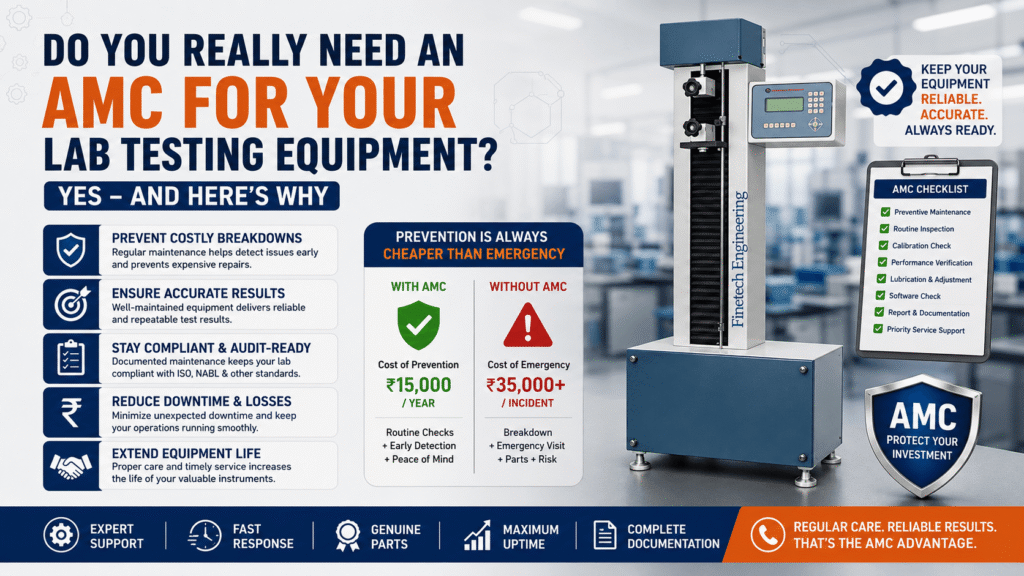
But here is the point: an AMC visit six months earlier would have caught the degrading relay during routine inspection. The technician would have noted the relay’s switching response was sluggish, recommended replacement, and swapped it during the visit. Total cost of prevention: zero (it would have been part of the AMC visit). Total cost of the emergency: ₹35,000 for the site visit plus parts, plus the stress and risk of losing an export order. The AMC itself would have cost about ₹15,000 per year.
₹15,000 per year for prevention. ₹35,000 for one emergency. That is the AMC argument in two numbers.
What Does a Good AMC Actually Include?
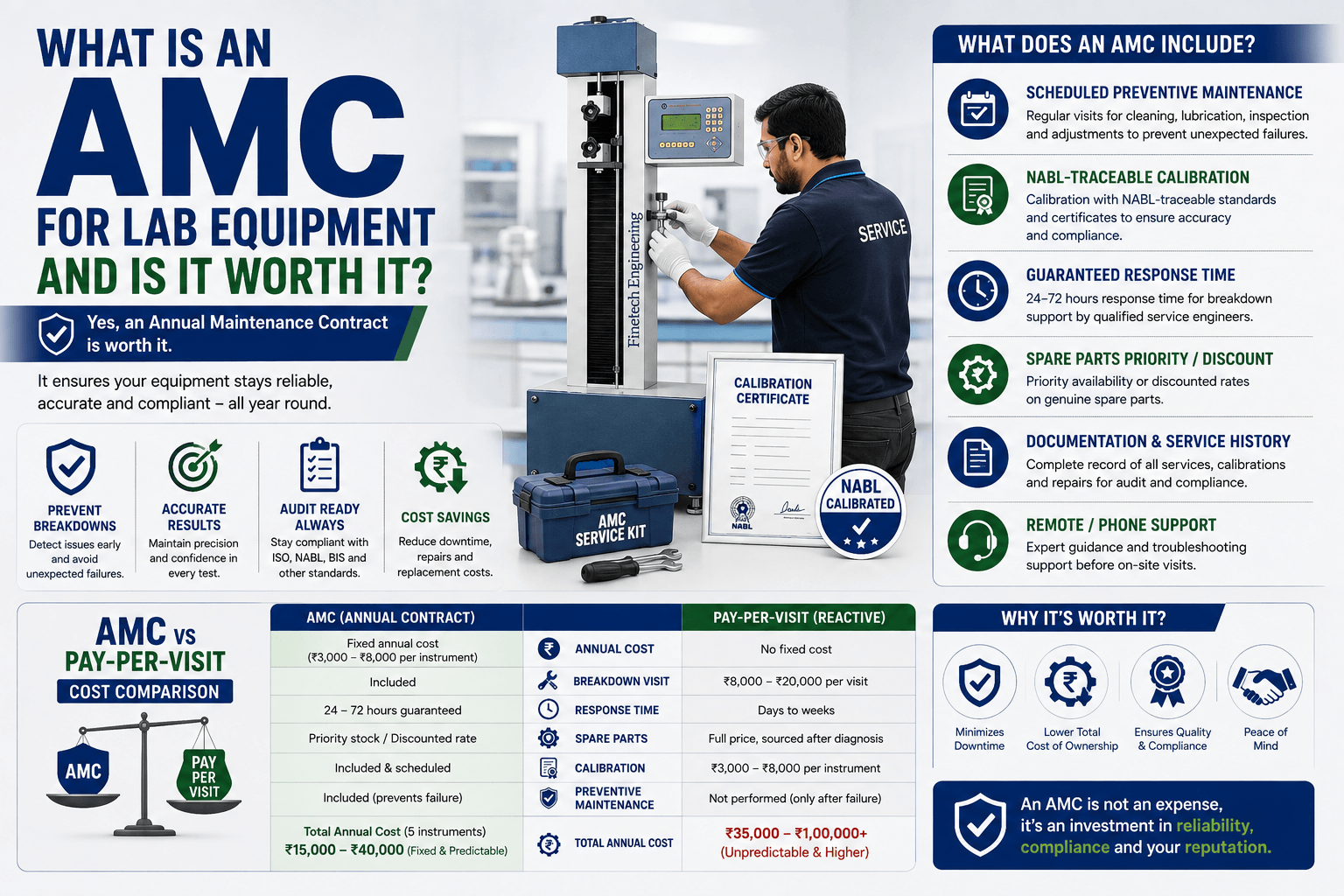
Not all AMCs are equal. Some are glorified visit contracts – a technician shows up, looks at the machine, signs a form, and leaves. That is not an AMC. That is a waste of your money. Answering “what is AMC lab equipment India” plainly: it is a scheduled, checklist-driven maintenance contract, not a once-a-year courtesy visit. Here is what a real AMC should include:
- Scheduled preventive maintenance visits – at least 2 per year. The technician follows an equipment-specific checklist, not a generic form.
- Calibration of all measurement systems – load cells on the UTM, temperature sensors on the MFI and humidity chamber, energy on the impact tester. Using traceable reference instruments, not just “checking if it looks right.”
- Calibration certificates – traceable documents that your NABL auditor will accept. Issued at every visit.
- Inspection report – a written document listing what was checked, what was measured, what was found, and what needs attention before the next visit.
- Wear part assessment – grips, jaw faces, door gaskets, seals, belts, fuses. The technician identifies parts that are wearing and recommends replacement before they fail.
- Priority breakdown response – if a machine goes down between scheduled visits, AMC customers get priority scheduling over non-AMC calls.
- Technical phone support – sometimes a 5-minute phone call can resolve the problem without a site visit. Unlimited phone support during the AMC period.
Now let’s put a number on it – here’s what that actually saves you over three years.
AMC vs Pay-Per-Visit - The Real Cost Over 3 Years
Let me give you a realistic cost comparison for a mid-sized QC lab with 5 instruments: one UTM, one MFI tester, one impact tester, one humidity chamber, and one Shore hardness tester. This AMC vs pay per visit lab equipment India comparison is the exact spreadsheet I walk clients through before they sign anything.
Cost Item | Without AMC (Pay-Per-Visit) | With AMC |
Annual calibration (5 instruments) | ~₹40,000–50,000 (outsourced to third-party lab) | Included in AMC |
Preventive maintenance visits | Not done (or done ad-hoc at ₹5,000–10,000 per visit) | Included (2 visits/year) |
Emergency breakdown call (assume 1 per year) | ~₹15,000–35,000 per incident (travel + diagnosis + parts) | Priority response included; parts at cost |
NABL audit preparation scramble | ~₹10,000–20,000 (rush calibration before audit) | Not needed – certificates always current |
Total over 3 years | ~₹2,40,000–3,60,000 | ~₹1,35,000–1,80,000 (AMC fee × 3 years) |
Hidden cost: wrong test data from uncalibrated equipment | Incalculable – rejected batches, customer complaints, re-testing | Avoided – equipment stays calibrated |
The AMC saves 30–50% over 3 years compared to reactive pay-per-visit servicing. And that does not include the hidden costs of wrong data, rejected batches, and NABL non-conformances. Once you look at AMC lab testing equipment cost India realistically, factoring in rejected batches and re-testing, the fixed annual fee almost always wins.
The 5 Things Your AMC Should Cover (And 3 Red Flags)
5 Must-Haves
- Equipment-specific checklists – not a one-page generic form for all machines. A UTM checklist should include load cell verification at 4 points, crosshead speed check, and grip inspection. An MFI checklist should include die cleaning, barrel temperature check, and piston weight verification.
- Traceable calibration certificates – with reference instrument details, measurement uncertainty, and traceability to national standards. Your NABL auditor will check.
- Written inspection report with actionable recommendations – not just “machine OK.” The report should tell you what was measured, what the tolerance is, and whether the reading was within spec.
- Priority breakdown response with a stated timeline – phone diagnosis within X hours, on-site within Y hours.
- Coverage for ALL your equipment, regardless of brand – one AMC for your entire lab, not separate contracts with each manufacturer.
3 Red Flags
- “We will come and check the machines” with no defined checklist or scope – you are paying for a visit, not for maintenance.
- No calibration certificates included – calibration is outsourced separately at extra cost. A good AMC includes calibration.
- The provider is a trader, not a manufacturer – traders resell service the same way they resell equipment. A manufacturer’s service team understands the machine at a component level.
What Happens When You Skip Maintenance - 3 More Real Scenarios
What happens if lab equipment not maintained India factories run without a contract? Three real examples make it concrete.
Scenario 1: The Drifting UTM Load Cell
A pipe manufacturer in Pune had not calibrated their UTM in 18 months. Their MFI tester was calibrated (because their resin supplier insisted), but nobody thought about the UTM. When we finally calibrated it during a new AMC visit, the load cell was reading 3.2% low. That means every tensile test they had run for 18 months – hundreds of test reports, dozens of customer certificates – had reported tensile strength 3.2% higher than reality. Fortunately, the margin of safety was large enough that no product failures occurred. But the lab manager turned pale when we showed him the calibration error. If you are asking do I need AMC for UTM India specifically, this Pune story is the answer – an 18-month calibration gap on a single machine, discovered only because an AMC visit finally checked it.
Scenario 2: The Clogged MFI Die
A compound manufacturer in Ahmedabad was getting MFI values that were 15% higher than the resin supplier’s certificate of analysis. They blamed the resin supplier. The supplier sent their own QC data showing consistent MFI values. The problem? The MFI tester’s die bore was partially clogged with degraded polymer from months of testing without proper cleaning. The restriction increased the apparent flow rate. A 10-minute cleaning with a brass rod and solvent – a standard AMC checklist item – fixed the problem immediately.
Scenario 3: The Leaking Humidity Chamber
A plastic testing lab in Chennai conditioned their impact test specimens in a humidity chamber. The door gasket had compressed and cracked over 3 years of use, and the chamber was leaking humid air from the bottom corner. The actual RH inside was 38–42% instead of the displayed 50%. Their impact test results were unusually high – because the specimens were drier than they should have been, making the plastic more brittle but also harder. An AMC visit would have caught the gasket degradation during routine inspection and recommended a ₹2,500 replacement. Instead, 6 months of impact data was unreliable.
How AMC Supports NABL Accreditation
If your lab is NABL accredited – or if you are applying for accreditation – an AMC is not just useful, it is practically essential. Lab equipment calibration how often India NABL assessors expect is twice a year for most instruments – which is exactly the cadence a standard AMC is built around. Here is why:
- NABL requires calibration records for all measuring instruments at defined intervals. AMC provides these automatically at every visit.
- NABL assessors check maintenance logs and service history. AMC inspection reports serve as your maintenance documentation.
- NABL requires measurement traceability. AMC calibration certificates provide the traceability chain from your equipment to national standards.
- NABL expects documented procedures for equipment management. Having an AMC contract demonstrates a systematic approach to equipment maintenance.
I have seen labs scramble for 2–3 weeks before a NABL assessment, trying to arrange calibration for 10 instruments simultaneously. With an AMC, every instrument is calibrated every 6 months. When the assessor walks in, your certificates are current, your maintenance logs are complete, and your equipment is verified. No scrambling. AMC NABL accreditation lab equipment India labs pursue almost always follows this same pattern – a scramble avoided simply because the paperwork was already current.
Frequently Asked Questions
For 1–2 instruments used infrequently, a pay-per-visit calibration arrangement may be more practical. AMC becomes cost-effective at 3+ instruments with regular use. That is really the heart of do I need AMC for lab testing equipment as a question — instrument count and usage frequency decide the answer, not the price tag.
Yes. Finetech provides AMC for ALL types and ALL brands of laboratory testing equipment. Your entire lab, one contract, one service team.
AMC customers receive priority breakdown response. Call us, and we aim for phone diagnosis within 24 hours and on-site within 48 hours. Our team frequently responds faster than these timelines.
Yes. AMC charges are a business operating expense and are typically deductible under normal business expenditure rules. Consult your CA for specifics.
Final Thoughts
I always tell my clients: lab equipment does not fail dramatically. It fails slowly, silently, and expensively. A load cell drifts 2% and you do not notice. A temperature sensor reads 1.5°C low and nobody checks. A door gasket cracks and the humidity drops 10%. None of these trigger an alarm. None of these stop the machine. But all of them corrupt your test data – and corrupted data is worse than no data, because you make decisions based on it.
An AMC catches these problems before they reach your test results. Two visits a year. A documented checklist. Traceable calibration. An inspection report that tells you exactly where your equipment stands. It is the simplest, most cost-effective way to protect the investment you have already made in your lab.
Finetech Engineering offers an annual maintenance contract for all types of laboratory testing equipment, from all manufacturers. Manufacturer, not trader – we build the machines ourselves, which is exactly why our AMC catches problems a reseller’s service desk would miss. One contract covers your entire lab. If you would like a quote, send us your equipment list – make, model, and quantity for each instrument – and we will prepare a customised proposal.
Want an AMC quote or need service & repair support? WhatsApp your equipment list to +91 93241 37971 or email info@finetechengineer.com. We’ll respond within 24 hours.
– Santhosh Kumar VP, Founder & Managing Partner, Finetech Engineering