


Manufacturer vs Trader: How to Know If Your Testing Equipment Supplier Is Genuine
The Indian testing equipment market has a problem nobody talks about. For every genuine manufacturer, there are five or six traders reselling machines with their own stickers. I have watched this problem cost factory owners lakhs of rupees in failed audits, broken machines, and vanished after-sales support. This blog is my attempt to give you a practical toolkit to tell the difference before you sign a purchase order. Answering ‘how to know if lab equipment supplier is genuine manufacturer’ honestly takes more than a company’s word for it – it takes the seven checks in this blog.
I am writing this as a manufacturer – Finetech Engineering, Thane – not as a disinterested observer. You should know that upfront. But the 7-point checklist in this blog applies to us as much as to anyone else. I would rather you run it on us and buy with confidence than skip it and regret the decision.
The Trader Problem in Indian Lab Equipment
Here is how the trader model works in India’s lab equipment market. A trading company – often registered in Mumbai, Ahmedabad, or Delhi – sources machines from small workshops in Ambala, Rajkot, or occasionally from Chinese imports. They attach their own brand label, print a product catalogue with professional photographs, and present themselves as manufacturers. Their website says ‘We manufacture testing instruments.’ Their invoices show their company name and GST number. Their sales team describes their ‘state-of-the-art manufacturing facility.’ This is exactly the fake testing equipment suppliers India warning I wish someone had given the quality manager in the story below, before the purchase order was signed.
None of that is illegal, strictly speaking. But when the machine fails, the problems begin.
Real situation, name withheld: A quality manager at a plastics factory in Thane purchased a Universal Testing Machine (UTM) for Rs 6 lakhs from what appeared to be a Mumbai-based manufacturer. The website showed factory photos, ISO certification, and a full product range. Eight months after delivery, the load cell failed during a routine tensile test. The quality manager called the supplier. The sales contact’s number was unreachable. The company email bounced. A visit to the registered address found a small office with no manufacturing activity. The machine had been sourced from a workshop in Ambala. No documentation for the original manufacturer existed. Spare parts were unavailable. The Rs 6 lakh UTM was effectively scrapped.
This is not a rare story. I hear versions of it regularly from customers who come to us after an experience like this. The trader had disappeared because they had no manufacturing infrastructure to protect, no reputation built over years, and no long-term stake in the transaction.
A genuine manufacturer cannot disappear. Our factory, our machines, our staff – they are all in the same place. We stand behind every instrument we sell because we built it. That is really the answer to why buy from manufacturer not trader lab equipment questions always come down to: permanence. A trader can vanish overnight. A factory cannot.
7 Ways to Verify a Supplier Is a Manufacturer
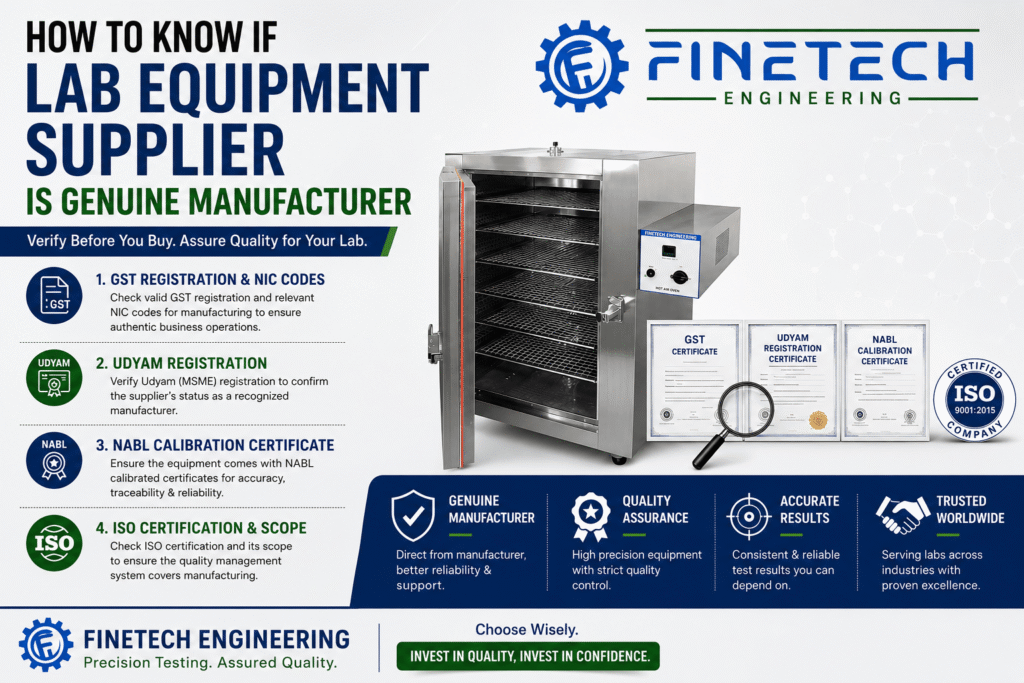
Use this checklist before placing any order for laboratory testing equipment. It takes less than two hours to run all seven checks. This is how to check if company is manufacturer not trader India buyers can apply to any supplier, not just us.
1. Ask to Visit Their Factory
This is the single most reliable check. A genuine manufacturer will invite you to their production facility without hesitation. A trader will delay, deflect, or show you a warehouse with assembled machines rather than a production floor.
When you visit, look for: raw materials and components in stock, machining or fabrication activity in progress, workers with manufacturing skills rather than just assembly or packing, and a facility that matches the scale of their claimed output. A company that says they manufacture 50 UTMs per year should have a production floor capable of that volume.
Tip: At Finetech Engineering, we welcome factory visits to our Wagle Estate, Thane facility by appointment. Call +91 93241 37971 to schedule.
2. Check GST NIC Codes
Every GST-registered business has a business activity code (NIC code) associated with their registration. A manufacturer’s GST registration will show manufacturing NIC codes – for example, NIC 2651 (Manufacture of instruments and appliances for measuring, testing and navigation) or NIC 2829 (Manufacture of other special-purpose machinery). This is the fastest GST NIC code manufacturer verification India buyers can run before ever picking up the phone.
A trading company’s GST registration will show trading or wholesale NIC codes – NIC 4659 (Wholesale of other machinery, equipment and supplies) or similar.
How to check: Go to the GST portal at www.gst.gov.in and use the taxpayer search function. Enter the supplier’s GSTIN (which must appear on their invoice). The public record will show their registered business nature and activity codes. This same approach is how to verify lab equipment supplier India buyers should apply to every one of the seven checks in this guide, not just this one.
Warning: A trading company can list multiple NIC codes, including a manufacturing code, without actually manufacturing anything. NIC code verification is a useful first filter – but combine it with the other checks, especially the factory visit.
3. Ask Who Makes the Critical Components
For a UTM, the critical components are the load cell, the crosshead drive mechanism, and the controller. For an MFI Tester, it is the temperature controller, the barrel, and the die. Ask your supplier directly: which of these components do you manufacture in-house, and which do you source?
Every manufacturer sources some components – nobody makes their own load cells from scratch. But a genuine manufacturer will be able to tell you exactly where each critical component comes from, what specification it meets, and how they verify it before assembly. A trader will give you a vague answer or claim everything is made in-house, which is almost never true.
4. Request NABL-Traceable Calibration Documentation
Every testing instrument sold in India should come with a calibration certificate traceable to the National Accreditation Board for Testing and Calibration Laboratories (NABL). This means the calibration was performed using reference instruments whose accuracy can be traced back to national measurement standards. A NABL-traceable calibration certificate manufacturer India issues in its own name is worth far more than a certificate from an unnamed third party.
Ask the supplier: ‘Can you provide the calibration certificate for this instrument, with NABL traceability, at the time of delivery?’ A genuine manufacturer either calibrates in-house with NABL-accredited reference standards, or sends instruments to a NABL-accredited lab for calibration.
A trader typically provides either no calibration certificate, or a certificate from an uncredited source that cannot demonstrate traceability to national standards. This calibration certificate is what your ISO auditor, BIS inspector, or NABL assessor will ask for. Without it, the machine’s data is not legally or technically defensible.
5. Ask About Spare Parts Stock
Ask this question specifically: ‘If this machine needs a replacement [name a critical part – load cell for UTM, die for MFI Tester, impact pendulum for impact tester], what is your lead time and what is the cost?’
A manufacturer will either have the part in stock or be able to manufacture it within a defined timeframe – typically 1 to 4 weeks for non-standard parts. They can tell you the material specification, the dimensional tolerance, and the cost. A trader either orders the part from the original workshop (4 to 8 weeks minimum, no guarantee), sources an unverified substitute, or simply does not know.
Ten years after you buy the machine, the manufacturer still has your configuration. The trader has moved on.
6. Check Udyam Registration
Udyam Registration is the Government of India’s MSME registration system, operated by the Ministry of MSME. Unlike a GST number, which any trading company can obtain, Udyam registration for manufacturing requires declaration of plant and machinery investment and manufacturing activity.
How to check: Go to udyamregistration.gov.in and use the ‘Verify Udyam Registration’ function. Enter the supplier’s Udyam Registration Number (which they can provide). The verified certificate will show their enterprise category, activity type (manufacturing or service or trading), and NIC code.
A manufacturing MSME will show activity type ‘Manufacturing’ on their Udyam certificate. A trading company will show ‘Trading’ or ‘Services.’ This is a public, government-verified record that is difficult to falsify.
7. Verify the ISO Scope
Many trading companies in India hold ISO 9001:2015 certified status. But the scope of the certificate matters enormously. Ask to see the actual ISO certificate – not just the logo on their letterhead.
A manufacturer’s ISO certificate scope will read something like: ‘Design, manufacture, and supply of laboratory testing instruments and related equipment.’ A trader’s ISO certificate scope will read: ‘Trading and supply of laboratory instruments’ or ‘Import and wholesale of testing equipment.’
The ISO certification body and scope are printed on the certificate itself. Verify the certificate by contacting the issuing certification body – their details are on the certificate – or check their online certificate database, which most accredited certification bodies maintain.
Your 7-Point Supplier Verification Checklist (Screenshot This)
- Factory visit accepted without deflection – production floor visible, not just a warehouse
- GST NIC code shows manufacturing activity (NIC 2651 or similar) – verify at gst.gov.in
- Supplier can name critical component sources with specifications – not a vague ‘all in-house’
- NABL-traceable calibration certificate provided at delivery – not optional, not extra cost
- Spare parts available within defined lead time – supplier can state cost and specification
- Udyam Registration shows ‘Manufacturing’ activity – verify at udyamregistration.gov.in
- ISO 9001:2015 certificate scope includes ‘manufacture’ – verify with issuing body
The Real Cost of Buying from a Trader
The trader’s machine is usually cheaper. Sometimes significantly cheaper. That price difference is real – but so is what it does not include.
Cost Factor | Genuine Manufacturer | Trader |
Purchase price | Rs 60,000 – Rs 2,50,000 (typical range) | Rs 40,000 – Rs 1,80,000 (lower upfront) |
Calibration at delivery | Included – NABL-traceable | Often excluded; may be extra Rs 3,000-8,000 from third party |
Training on installation | Included – by the team that built the machine | Often absent; operator reads manual alone |
Spare parts (3-year horizon) | Available from manufacturer; known cost | Unknown; may require full component replacement |
Service response time | Manufacturer engineer familiar with the machine | Depends on third-party service network |
Audit compliance | NABL-traceable calibration = audit-ready from day one | Certificate gaps may fail ISO, BIS, NABL audits |
Machine lifespan | 10-15 years with proper AMC | 5-7 years typical if critical components fail and are not replaceable |
Total cost (10 years) | Higher upfront; significantly lower total | Lower upfront; higher breakdown, replacement, and compliance cost |
The Thane UTM story I described earlier – Rs 6 lakh machine, 8 months, scrapped. The factory then purchased a replacement UTM from a verified manufacturer at Rs 1.8 lakhs more than the original trader price. They paid Rs 6 lakhs extra in total for the lesson. That is not an unusual outcome.
What Finetech Engineering Does Differently
I am going to apply the 7-point checklist to ourselves, because I think that is the only honest way to make this claim.
Check | Finetech Engineering’s Answer |
Factory visit | C-1 New Kalwa Industrial Premises, Wagle Estate, Thane (W) 400604. Visits by appointment, Monday to Saturday. |
GST NIC code | Manufacturing – NIC 2829 and related codes. GSTIN available on request. |
Critical components | Barrel and die machined in-house at Thane facility. Temperature controllers sourced from specified Indian and international brands. Load cells sourced from calibrated Indian suppliers. Full component disclosure available. |
NABL-traceable calibration | Provided with every instrument at delivery. Calibration traceable to NABL-accredited reference standards. Certificate issued in Finetech Engineering’s name. |
Spare parts | Standard wear parts (dies, grips, pendulums) stocked at Thane facility. Non-standard parts manufactured to order. Lead time communicated at time of enquiry. |
Udyam Registration | MSME Udyam registration – Manufacturing category. Certificate available on request. |
ISO scope | ISO 9001:2015 certified – scope covers design, manufacture, and supply of laboratory testing instruments, specimen cutters and moulds, and industrial knives and blades. CE certified. |
We are not a perfect company. We are a growing manufacturer, founded in 2023, building a reputation one instrument at a time. What we can promise is that the team you speak to when you enquire is the same team that will answer when you call three years later for a spare part or a calibration – or for a renewal of your annual maintenance contract. We have no incentive to disappear. This is our factory. This is our business. Read more About Us, or better yet, come see the factory yourself. We built this into a trusted lab testing equipment manufacturer India checklist precisely so you do not have to take our word for any of it.
Final Thoughts
The testing equipment manufacturer versus trader problem in India is not going to be solved by regulation anytime soon. The only protection a buyer has is to ask the right questions before placing an order. That manufacturer vs trader testing equipment India distinction is the single question this entire blog has been building toward.
The 7-point checklist in this blog takes less than two hours to run. A factory visit takes half a day. These are small investments compared to the cost of a failed audit, a scrapped machine, or months of unreliable test data that goes undetected until a customer complaint forces the issue.
If you are evaluating Finetech Engineering as a potential supplier of laboratory testing equipment, specimen cutters, or industrial knives and blades, we welcome every check on that list. Our GST is traceable, our Udyam certificate says manufacturing, our ISO scope covers manufacture, and our factory is in Thane – not in a brochure. We are a testing equipment manufacturer India genuine buyers can verify against every item on the checklist above, not just take our word for.
Run the checklist. Then call us.
Want to Verify Before You Buy? We Welcome Factory Visits.
Call or WhatsApp: +91 93241 37971
Email: info@finetechengineer.com
Visit: C-1 New Kalwa Industrial Premises, Wagle Estate, Thane (W) 400604
Run the 7-point checklist on us. We expect you to.
If you’d like to talk it through first, contact us and we’ll answer every question on the list.
– Santhosh Kumar VP, Founder & Managing Partner, Finetech Engineering