


Round Specimen Cutters Explained: Which Diameter for Compression Set, Hardness, and DIN Abrasion?
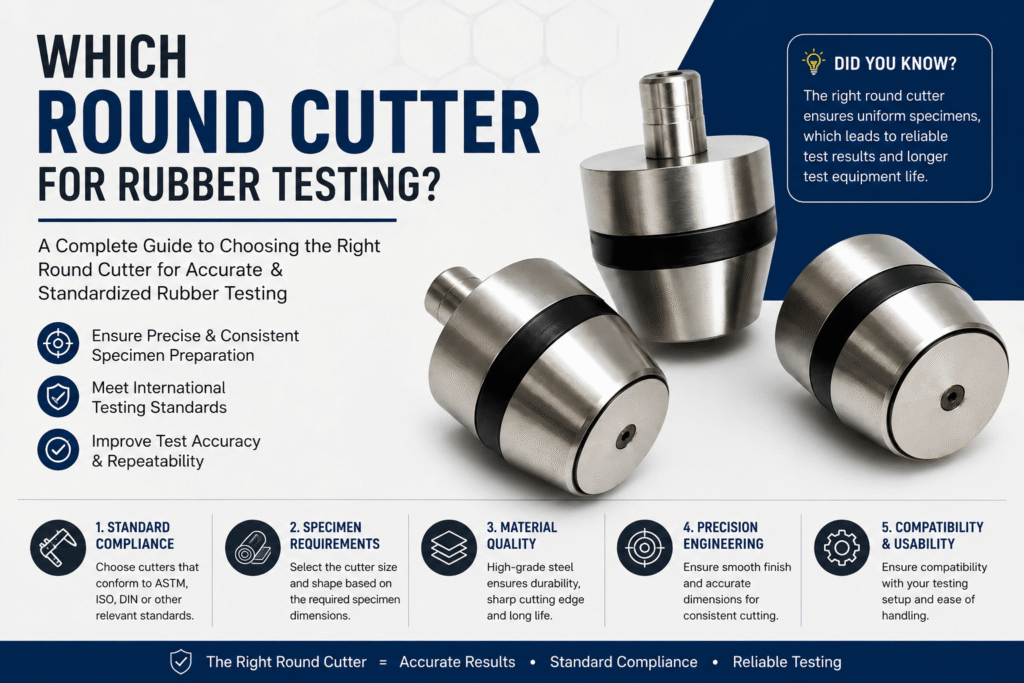
Which round cutter do you need for rubber testing? A round specimen cutter is a circular steel tube with a sharpened cutting edge. Push it through a rubber sheet with a press, and out comes a disc or cylinder. But round specimen cutter diameter rubber testing selection is critical – the wrong diameter means invalid results.
The complication is that different tests require different diameters. A DIN Abrasion Tester specimen needs a 16mm cutter. A Compression Set Apparatus needs a 29mm or 13mm cutter. Using the wrong diameter gives you specimens that do not fit the test apparatus, do not meet the standard, and produce invalid results.
This round specimen cutter diameter rubber testing guide maps every common diameter to its test, standard, and purpose. By the end, you will know exactly which round cutter for rubber testing your lab needs.
Why Round Cutters Are Confusing (And How to Fix That)
The confusion exists because round cutters are used across multiple testing standards, and each standard defines its own specimen size independently. As a leading round specimen cutter manufacturer India, Finetech publishes this guide to map all diameters to all tests in one place.
I visited a rubber compound testing lab in Pune last year. They had two round cutters: 25 mm and 30 mm. Neither matched any standard I could identify. When I asked where they came from, the QC manager said they had been there “since before he joined.” They were probably legacy tools from an older, non-standard testing protocol. The lab had been cutting specimens with them for years – for ASTM D395 compression set testing – and their results were consistently 10–15% different from their customer’s lab. The customer used the correct 29 mm cutter.
A ₹1,500 cutter was the difference between matching and failing the customer’s specification.
The Master Table: Every Round Cutter Diameter and What It’s For
Diameter | Test | Standard | Specimen Name | Thickness |
29.0 ±0.5 mm | Compression set | ASTM D395 Type 1, ISO 815 | Large button | 12.5 ±0.5 mm |
13.0 ±0.5 mm | Compression set | ASTM D395 Type 2 | Small button | 6.3 ±0.3 mm |
16.0 ±0.2 mm | DIN abrasion | DIN 53516, ASTM D5963 | Abrasion cylinder | 6–16 mm |
12.5 mm | ISO abrasion | ISO 4649 (some methods) | Abrasion disc | Variable |
29 mm | Hardness (Shore A/D) | ASTM D2240, ISO 868 | Hardness button | 6 mm min stack |
Various (38–50 mm) | Burst test (paper) | ISO 2758 | Burst disc | Material thickness |
10, 20, 25 mm | General purpose / R&D | Various | Discs for custom tests | As required |
Custom | Non-standard | Customer spec | Custom specimens | As specified |
Key takeaway: If your lab tests compression set AND DIN abrasion AND hardness, you need a minimum of three round cutters: 29 mm, 16 mm, and 13 mm. Most rubber QC labs need all three.
29 mm - Compression Set Testing (ASTM D395 Type 1)
So: what is compression set test rubber simple – it measures how much a rubber compound permanently deforms after being compressed. The compression set specimen cutter 29mm India produces the Type 1 button: 29.0 mm diameter, 12.5 mm thick, compressed to 75% of its original height in a compression set fixture, held at 70°C for 22 hours, then released and measured for recovery.
This is the standard specimen for evaluating whether a rubber compound will maintain its sealing force over time – critical for O-rings, gaskets, and seals.
The button can be cut from a vulcanised rubber sheet (if the sheet is 12.5 mm thick) or moulded directly using a compression set mould in a hydraulic press with heated platens.
13 mm - Compression Set Testing (ASTM D395 Type 2)
The 13 mm cutter produces the Type 2 compression set button: 13.0 mm diameter, 6.3 mm thick. This is the small button used when material availability is limited – for example, when testing the cross-section of a thin seal or a small moulded part.
Type 2 buttons give the same compression set percentage as Type 1 buttons when the compound is the same, but the smaller size makes them easier to produce from limited material.
16 mm - DIN Abrasion Testing (DIN 53516)
The 16 mm round cutter produces the cylindrical specimen for DIN abrasion testing: 16.0 mm diameter, minimum 6 mm thick (typically cut 10–16 mm for sufficient material). This specimen is pressed against P60 abrasive paper on the DIN abrasion tester drum and the volume of rubber worn away is measured.
DIN abrasion is one of the most important tests for tyre compounds, shoe soles, conveyor belt covers, and any rubber product exposed to frictional wear.
The 16 mm diameter is specific to DIN 53516 and ASTM D5963. Do not confuse it with the 12.5 mm cutter sometimes used for ISO 4649 – they are different sizes for different standard variants.
12.5 mm - ISO 4649 Abrasion Testing
Some methods within ISO 4649 specify a 12.5 mm diameter specimen instead of the 16 mm used in DIN 53516. If your customer or standard specifies ISO 4649 with a 12.5 mm specimen, you need the ISO 4649 specimen cutter 12.5mm India – a separate cutter from the 16 mm DIN die. Check your specific test method before ordering.
29 mm (Again) - Hardness Button Specimens
The 29 mm cutter doubles as a hardness specimen cutter. For Shore A and Shore D hardness testing, ASTM D2240 requires a specimen at least 6 mm thick with a flat surface. A stack of two or three 29 mm buttons cut from a rubber sheet (or a single moulded button from a hardness button mould) meets this requirement.
This means the same 29 mm cutter serves both compression set AND hardness testing. One cutter, two tests. See our Shore hardness tester range for the complete setup.
Other Diameters: Burst Test, General Purpose, Custom
Beyond the core three diameters (29, 16, 13 mm), round cutters are also available in:
- 38–50 mm for paper Burst Strength Tester specimen preparation (ISO 2758)
- 10 mm, 20 mm, 25 mm for general-purpose R&D specimen cutting
- Custom diameters for product-specific or customer-specified tests
Finetech manufactures round cutters in any diameter from 10 mm to 100 mm. If your standard or application requires a size not listed here, contact us with the diameter, tolerance, and standard reference.
The Ejector Pin: A Small Feature That Makes a Big Difference
When you punch a round cutter through a rubber sheet, the cut disc stays stuck inside the die. This is why the ejector pin specimen cutter rubber India product – matters: getting the specimen out without distorting it is the real challenge.
Cheap round cutters have no ejection mechanism. You poke the specimen out with a rod, a screwdriver, or your fingers – risking damage to the specimen edges and inconsistent results.
Finetech round cutters include an ejector pin as standard. After the cut, you push the pin from the top of the die, and the specimen drops out cleanly from below. No distortion, no edge damage, no fuss. It sounds like a small thing, but when you are cutting 20–50 specimens a day, it saves time and protects specimen integrity.
Ask your supplier: “Does your round cutter have an ejector pin?” If the answer is no, you will spend extra time and risk damaging specimens every time you extract one.
Which Press Should You Use With Round Cutters?
Round cutters need a press to push them through the rubber sheet. The choice depends on your volume and material:
- Pneumatic press – fastest option for high-volume labs. One stroke, consistent force, 50+ cuts per day.
- Hydraulic press – best for thick or hard rubber. Also doubles as a compression moulding press.
- Manual press – budget option for low-volume labs. Adequate for soft to medium rubber.
- Drill press (workshop type) – sometimes used for round cutters specifically. Works, but less controlled than a dedicated specimen press.
All Finetech round cutters fit all Finetech presses. No adaptor needed.
Frequently Asked Questions
At minimum, three: 29 mm (compression set specimen cutter 29mm India + hardness), 16 mm (DIN abrasion specimen cutter 16mm India), and 13 mm (small compression set buttons). If you also test to ISO 4649 with 12.5 mm specimens, add the ISO 4649 specimen cutter 12.5mm India as a fourth.
No. ASTM D395 specifies 29.0 ±0.5 mm. A 30 mm cutter is outside this tolerance. The compression set fixture spacer bars are calibrated for the 29 mm button diameter. Using an oversized specimen will not fit the fixture correctly and may produce incorrect results.
Both are acceptable per ASTM D395. Moulded buttons (using a compression set mould in a hydraulic press with heated platens) produce more dimensionally consistent specimens. Cut buttons (using the 29 mm round cutter on a vulcanised sheet) are faster and acceptable when the sheet thickness matches the required button height. Most labs use a combination of both.
Measure 5 specimens cut with the die. If the diameter standard deviation exceeds 0.2 mm, or if visible burrs appear on the specimen edges, the die is worn and needs re-sharpening or replacement.
Yes. We provide dimensional inspection certificates for every round cutter, verifying the bore diameter, wall thickness, and cutting edge geometry against the applicable standard.
Final Thoughts
Getting the right diameter for your round specimen cutter diameter rubber testing is deceptively important. Every circular die cutter for rubber testing India from Finetech has the diameter matched to the standard, an ejector pin fitted, and a sharp dimensionally-accurate cutting edge. Get these right and your compression set, abrasion, and hardness results will be valid and repeatable.
Finetech Engineering, your trusted round specimen cutter manufacturer India and ASTM D395 round cutter 29mm manufacturer India, manufactures round specimen cutters in every standard diameter. Every cutter includes an ejector pin, is made from hardened tool steel, and comes with a dimensional certificate. We also manufacture the compression set moulds, DIN abrasion moulds, hardness button moulds, and the presses to use with them.
Need round cutters? Tell us which tests you run and we’ll recommend the exact set of diameters your lab needs.
WhatsApp: +91 93241 37971 | Email: info@finetechengineer.com | Visit: /specimen-cutters-and-moulds/
– Santhosh Kumar VP, Founder & Managing Partner, Finetech Engineering