


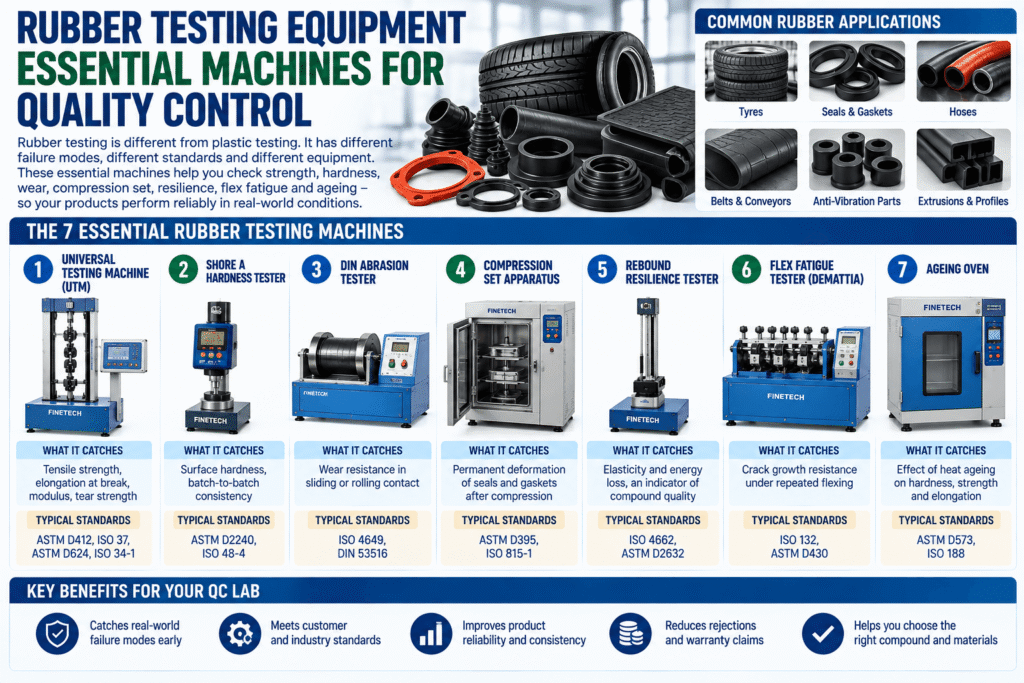
Rubber Testing Equipment: Essential Machines for Quality Control
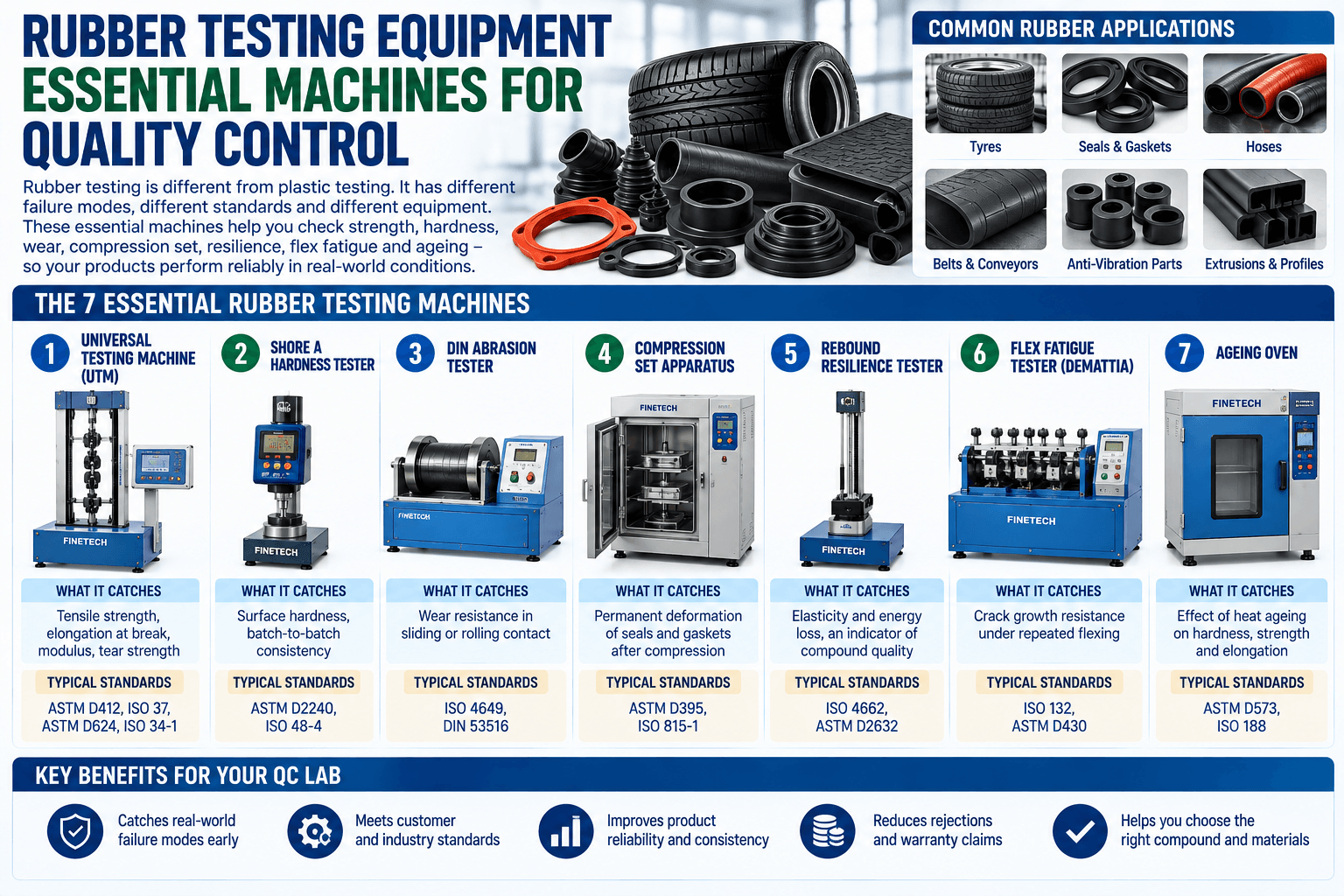
Rubber testing is a different beast from plastic testing. Different failure modes, different standards, different equipment. A plastic part usually fails by breaking. A rubber part usually fails by wearing, tearing, setting, cracking or going hard over time. If you test rubber the way you test plastic, you will miss most of the ways it actually fails in service.
I run into this regularly with rubber manufacturers around Thane, Navi Mumbai and the wider Mumbai rubber cluster. Many started as moulders or compounders and built their QC around the one test their first customer asked for. That works until a different failure mode shows up in the field.
Real situation, name withheld: A rubber gasket manufacturer in Thane was testing only one property on every batch: Shore A hardness. Every batch passed. The gaskets went into a customer’s assembly where they slid against a metal surface under light vibration. Within months, the customer reported gaskets thinning at the contact edge and leaking. The compound was within hardness specification, but its abrasion resistance was poor because the filler loading had been adjusted to hit the hardness number at lower cost. Hardness alone cannot see that. A DIN abrasion test on the compound, which takes a few minutes per specimen, would have shown the wear loss was far above what the application could tolerate. The factory ended up replacing the batch and requalifying the compound. One missing test, and an expensive lesson.
This blog lists the seven machines I recommend for a rubber QC lab, what each one catches, the standards behind them, and a realistic budget. Not every lab needs all seven on day one. Knowing which failure modes each machine covers lets you choose in the right order.
Why Rubber Testing Is Different
Rubber is an elastomer. It stretches several hundred percent, springs back, absorbs energy and slowly changes with heat, oxygen, ozone and repeated flexing. That behaviour changes how it is tested:
Large strains. Rubber tensile tests run to several hundred percent elongation. Grips, extension measurement and test speed (typically 500 mm/min for dumbbell tests) differ from rigid plastic testing.
Time and cycle dependent failure. Rubber seals fail from compression set, fatigue cracking and ageing, not just overload. These need dedicated tests, not a single strength number.
Wear matters. Soles, tyres, belts, rollers and gaskets in sliding contact fail by abrasion, which tensile and hardness tests do not predict.
Compound sensitivity. Small changes in filler, plasticiser or cure system can leave hardness unchanged while changing wear, rebound or set substantially. That is exactly what happened in the Thane gasket story.
Specimen preparation is critical. Rubber specimens are cut with dies or moulded, not machined. A blunt die or wrong thickness changes the result, a point we cover later in this blog.
The 7 Essential Machines
# | Machine | What It Catches | Typical Standards |
1 | Tensile strength, elongation at break, modulus, tear strength | ASTM D412, ISO 37, ASTM D624, ISO 34-1 | |
2 | Shore A Hardness Tester | Surface hardness, batch-to-batch consistency | ASTM D2240, ISO 48-4 |
3 | Wear resistance in sliding or rolling contact | ISO 4649, DIN 53516 | |
4 | Permanent deformation of seals and gaskets after compression | ASTM D395, ISO 815-1 | |
5 | Elasticity and energy loss, an indicator of compound quality | ISO 4662, ASTM D2632 | |
6 | Crack initiation and growth under repeated flexing | ISO 132, ASTM D813 | |
7 | Ageing Oven | Resistance to heat and oxidation, changes in properties after ageing | ASTM D573, ISO 188 |
1. Universal Testing Machine
The UTM is the workhorse. For rubber it measures tensile strength, elongation at break and modulus on dumbbell specimens, and tear strength on angle or trouser specimens. Choose the load cell to match rubber forces. Most rubber dumbbells break well under 1 kN, so a 1 kN or 2 kN cell is usually right, not a large-capacity one. Rubber also needs grips that do not slip or cut the specimen and a long enough crosshead travel for several hundred percent elongation. For more on sizing, see our UTM guide.
2. Shore A Hardness Tester
Shore A is the standard scale for soft and medium rubber. It is quick, cheap and the most commonly run rubber test. That is also its weakness: because it is so easy, many labs stop there. Hardness tells you about the surface stiffness, nothing about wear, set or fatigue. Treat it as a fast consistency check, not as proof that a compound is good.
3. DIN Abrasion Tester
A cylindrical rubber specimen is pressed under a fixed load against a rotating drum covered with abrasive sheet, and the volume lost over a fixed distance is reported in mm³. Lower is better. This is the test the Thane gasket manufacturer was missing. It matters for soles, belts, rollers, seals in sliding contact and any compound where filler or polymer was changed. Use the reference abrasive sheet and a reference rubber as specified in the standard, otherwise results will not be comparable between labs.
4. Compression Set Apparatus
Seals and gaskets must spring back after being squeezed. The compression set test compresses a specimen to a fixed percentage of its height, holds it at a set temperature for a set time (commonly 22 hours or 70 hours, at temperatures such as 70°C or 100°C), then measures how much it fails to recover. High compression set means a seal that goes flat and leaks. It is essential for any gasket, O-ring or sealing product.
5. Rebound Resilience Tester
A plunger or pendulum strikes the rubber and the rebound height is measured as a percentage of the drop height. Higher rebound means more elastic, lower hysteresis behaviour. It is sensitive to polymer, filler and cure state, so it is a useful way to catch compound variation that hardness will miss. It is widely used for tyre components, rubber rollers, sports goods and anti-vibration parts.
6. Flex Fatigue Tester (Demattia)
Flex cracking is a common service failure for footwear soles, hoses, belts, bellows and boots. The Demattia tester flexes a pierced or grooved rubber strip repeatedly and records crack growth against cycles. If your product bends in use, this test shows how long it survives before cracks open. Other flex testers such as Bennewart and Ross serve specific product types and standards, so confirm which one your customer specifies.
7. Ageing Oven
Rubber changes with heat and oxygen. A hot air ageing oven holds specimens at a set temperature for a set time (for example 70°C for 70 hours, or higher for heat-resistant compounds), after which you retest tensile and hardness and compare with unaged values. The percentage change in properties is what many customer specifications actually ask for. For humidity and combined ageing, a humidity chamber is the companion instrument.
Key Standards for Rubber
Rubber testing in India draws on three families of standards, much as in plastics. The Indian IS 3400 series covers methods of testing vulcanised rubber and is the reference for BIS-linked work, while ISO and ASTM methods are specified by most OEM and export customers. As we explain in our standards blog, always confirm the standard number on your customer’s specification, not just the property name.
Property | ASTM | ISO | BIS / IS |
Tensile properties | ASTM D412 | ISO 37 | IS 3400 (Part 1) |
Tear strength | ASTM D624 | ISO 34-1 | IS 3400 series |
Hardness (Shore A) | ASTM D2240 | ISO 48-4 | IS 3400 series |
Abrasion resistance | ASTM D5963 | ISO 4649 | IS 3400 series |
Compression set | ASTM D395 | ISO 815-1 | IS 3400 series |
Rebound resilience | ASTM D2632 | ISO 4662 | IS 3400 series |
Flex cracking (De Mattia) | ASTM D813 | ISO 132 | IS 3400 series |
Heat ageing | ASTM D573 | ISO 188 | IS 3400 series |
Tip: Check the specific part number of IS 3400 for the test you need against the current BIS publication before quoting it on a report. The series is split by property and we recommend confirming the exact part on bis.gov.in or your standards subscription.
Building a Rubber Lab: Budget
Here are realistic ranges for Indian-manufactured equipment. Actual prices depend on specification, automation level and supplier, so treat these as planning figures, not quotations.
Equipment | Approximate Price (INR) | Priority |
Universal Testing Machine (1 to 2 kN class, rubber grips) | Rs 1,20,000 – Rs 2,50,000 | Day one |
Shore A Hardness Tester | Rs 12,000 – Rs 30,000 | Day one |
Compression Set Apparatus | Rs 25,000 – Rs 60,000 | Day one for seals and gaskets |
DIN Abrasion Tester | Rs 80,000 – Rs 1,40,000 | Add early if wear matters |
Rebound Resilience Tester | Rs 40,000 – Rs 90,000 | Add within 12 months |
Flex Fatigue (Demattia) Tester | Rs 60,000 – Rs 1,20,000 | If product flexes in service |
Ageing Oven | Rs 40,000 – Rs 90,000 | Add within 12 months |
Specimen dies and cutters (dumbbell, tear, round) | Rs 30,000 – Rs 80,000 | Day one |
Lab setup (bench, power, ventilation) | Rs 30,000 – Rs 80,000 | Day one |
NABL-traceable calibration (initial, all instruments) | Rs 30,000 – Rs 60,000 | Day one |
Lab Configuration | What It Covers | Estimated Total (INR) |
Starter rubber lab | UTM, Shore A, compression set, dies, setup, calibration | Rs 2,50,000 – Rs 5,60,000 |
Standard rubber lab | Starter plus DIN abrasion tester and ageing oven | Rs 3,70,000 – Rs 7,90,000 |
Complete 7-machine lab | All seven machines, dies, setup, calibration | Rs 4,70,000 – Rs 10,00,000 |
Annual calibration + AMC (ongoing) | Scheduled calibration and maintenance | Rs 25,000 – Rs 70,000 per year |
The Thane gasket factory could have covered its missing failure mode by adding a single DIN Abrasion Tester, roughly Rs 1 lakh, to the three machines it already had. That is the pattern I see repeatedly: the gap is rarely the budget, it is knowing which test matches which failure.
Specimen Preparation for Rubber Testing
Every machine above gives data only as good as the specimen put into it. Rubber specimens are cut with sharp steel-rule dies or moulded to size, and each test needs its own geometry:
Tensile and elongation. Dumbbell dies to ISO 37 or ASTM D412 dimensions. See our guides on dumbbell cutting dies and on which dumbbell cutter to use for rubber.
Tear strength. Angle, trouser or crescent dies depending on the standard. See how to choose a tear specimen cutter.
Abrasion, compression set and rebound. Round cylindrical or disc specimens, cut with round cutters or moulded to standard size. See which round cutter to use for rubber testing.
A blunt die crushes the edge and starts failure early. A wrong thickness changes modulus and set. Moulded specimens must be cured to the same state as the production part, otherwise the data describes a different material. Treat dies as consumables: check the cutting edge, replace when worn, and keep a record of dimensional checks as part of your SOPs.
Final Thoughts
Rubber fails in more ways than plastic, so a rubber lab needs to be built around failure modes, not around a single number. Tensile and hardness are the starting point. Compression set protects your seals, abrasion protects anything that slides, rebound and flex catch compound and fatigue problems, and ageing shows what happens after a year in service.
If you are in the Thane, Navi Mumbai or wider Mumbai rubber belt and your lab only checks hardness today, add compression set and abrasion first. They are the two gaps I see most often turning into field complaints.
At Finetech Engineering we manufacture rubber testing equipment and specimen dies at our Thane facility. We are a manufacturer, not a trader, which means the team that builds your tester also calibrates and services it. We supply NABL-traceable calibration with each instrument and offer AMC support so your lab stays audit-ready.
Planning a Rubber Testing Lab? Start With the Right 3 Machines.
Call or WhatsApp: +91 93241 37971
Email: info@finetechengineer.com
Tell us your rubber product (gaskets, seals, hoses, footwear soles, tyre components) and the standards your customer requires. We will tell you which machines you need first, and which can wait.
– Santhosh Kumar VP, Founder & Managing Partner, Finetech Engineering