


How to Prepare QC Lab for BIS Inspection India: A Factory Owner's Guide to BIS Certification
BIS certification keeps expanding to more product categories. And if your product is covered, auditors will inspect your QC lab. They will look at the machines, the calibration stickers, the test records and the way your operators actually work. A lab that looks fine to you can still fail that inspection. If you are searching ‘how to prepare QC lab for BIS inspection India’, this blog is written for you.
I have helped more than fifteen factories set up or fix their labs for BIS. The pattern is remarkably consistent, and most of the problems are avoidable. Here is what I wish every factory owner knew before the first inspection. Later in this blog I list the reasons BIS licence application rejected factory lab cases have in common, so you can avoid them.
Warning: A note on roles: BIS decides certification. Finetech Engineering does not issue or guarantee BIS licences. We manufacture the testing equipment and help factories set up labs that meet the equipment, calibration and documentation expectations of the relevant IS standard. If you are unsure about the BIS Scheme-I vs Scheme-II licence difference for your product, confirm it with your BIS branch office before planning the lab.
What Is BIS Certification?
The Bureau of Indian Standards (BIS) runs the product certification scheme behind the ISI mark. Under the main route, called Scheme-I, a manufacturer applies for a licence, BIS inspects the factory, and samples are tested. If the product meets the relevant Indian Standard (IS number) and the factory shows it can keep making it to that standard, the licence is granted. Surveillance visits and sample tests continue afterwards. Answering ‘BIS Scheme-I vs Scheme-II licence difference’: Scheme-I is the ISI mark licence route with a factory and lab inspection, while Scheme-II is the registration route used mainly for electronics and IT goods, where products are tested at a BIS-recognised laboratory and registered rather than licensed after a factory inspection.
Whether certification is compulsory depends on the product. The government makes an Indian Standard mandatory for a product by issuing a Quality Control Order (QCO) under the BIS Act, 2016. For products under a QCO, you generally cannot manufacture, import or sell them in India without the ISI mark. For products without a QCO, certification is voluntary, but many buyers, including government tenders and large OEMs, still insist on it. Answering ‘QCO meaning for manufacturers ISI mark mandatory products’ in one line: once a QCO covers your product, the ISI mark becomes a legal condition of making and selling it, not a marketing choice.
This area moves quickly, so please do not rely on old information. If you are asking ‘is ISI mark compulsory for my product how to check QCO’, the only safe answer is to check the current list of products under compulsory certification on the BIS website against your exact product and IS number. Here is what has changed recently:
Development | What It Means for You |
Rapid growth in QCOs | Published analyses report products under QCOs growing from 88 in 2019 to 765 by December 2024, with many more added since. More product categories now need ISI certification |
Withdrawal of some QCOs (November 2025) | The government withdrew QCOs on certain chemical and polymer inputs on 12 November 2025. The list is not a one-way street, so always check the current status of your product |
Transition Facilitation (Quality Control) Order, 2026 (notified 25 June 2026) | A temporary route for ten listed QCOs, including rubber and polymeric footwear, toys and some electrical appliances, that lets firms source from Scheme-II licensed suppliers while their own certification is pending. It does not remove the obligation to obtain ISI certification |
Review of 600+ QCO products pending | Commentary indicates a large reassessment is still under way, including rubber and plastics inputs. Expect further changes |
Tip: Before you invest in a lab, confirm two things on the BIS and DPIIT websites or with your BIS branch office: is your product currently under a QCO, and which IS standard and Scheme of Testing and Inspection applies. Do not rely on a consultant’s summary or on this blog alone. As of October 2026 the list is still changing. Remember the QCO meaning for manufacturers ISI mark mandatory products: if the order covers you, certification is a legal requirement, not an option.
What BIS Auditors Check in Your Lab
During the factory inspection, BIS officers do not just read your documents. They walk the lab with the Scheme of Testing and Inspection for your product in their hands. That document lists the tests, the testing frequency and the equipment expected. Answering ‘what is scheme of testing and inspection STI BIS licence’: it is the product-specific BIS document linked to your licence that fixes which tests you run, how often, and with what equipment. And answering ‘what do BIS auditors check in a QC lab inspection’, in my experience they check the following:
BIS Factory Inspection Lab Checklist ISI Mark Applicants Should Follow
Every test in the Scheme of Testing and Inspection can be done in your lab, or an accepted outside arrangement exists for tests BIS allows to be outsourced (confirm which with BIS)
Equipment matches the IS standard: capacity, range, accuracy and fixtures are suitable for the specified test
Every instrument has a valid calibration certificate traceable to national standards, with calibration due dates tracked
Specimen dies, moulds and fixtures conform to the dimensions in the IS standard, and are measured and recorded
Test records exist for each batch at the specified frequency, are readable, signed and traceable to the batch
Operators can explain and perform the test, not just press the start button
Lab environment (temperature, humidity) suits the standard’s conditioning requirements
Raw material is tested or verified on receipt, not accepted purely on a supplier certificate
Samples are retained, and nonconforming product is identified and controlled
The factory is using the current version of the IS standard
Equipment Requirements by Product Category
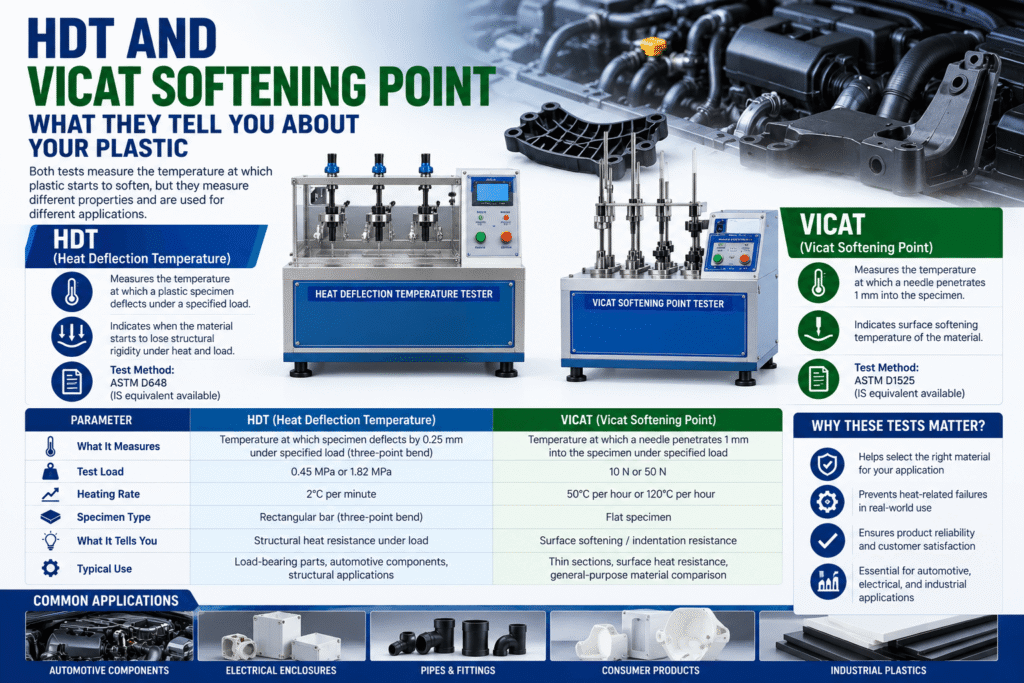
The exact equipment list comes from the IS standard and the Scheme of Testing and Inspection for your product. BIS publishes one for each product category, and your BIS branch office can tell you which applies. The table below shows the typical test families I see across categories our customers work in, as a planning guide, not as an official list. For pipe makers, the IS 4984 IS 4985 IS 15328 pipe testing equipment list usually starts with an MFI tester, a UTM, a hydrostatic pressure rig and HDT/VSP apparatus, plus an ESCR apparatus for PE grades, as the first row of the table shows.
Product Category | Typical IS Standards | Typical In-House Test Families | Typical Equipment |
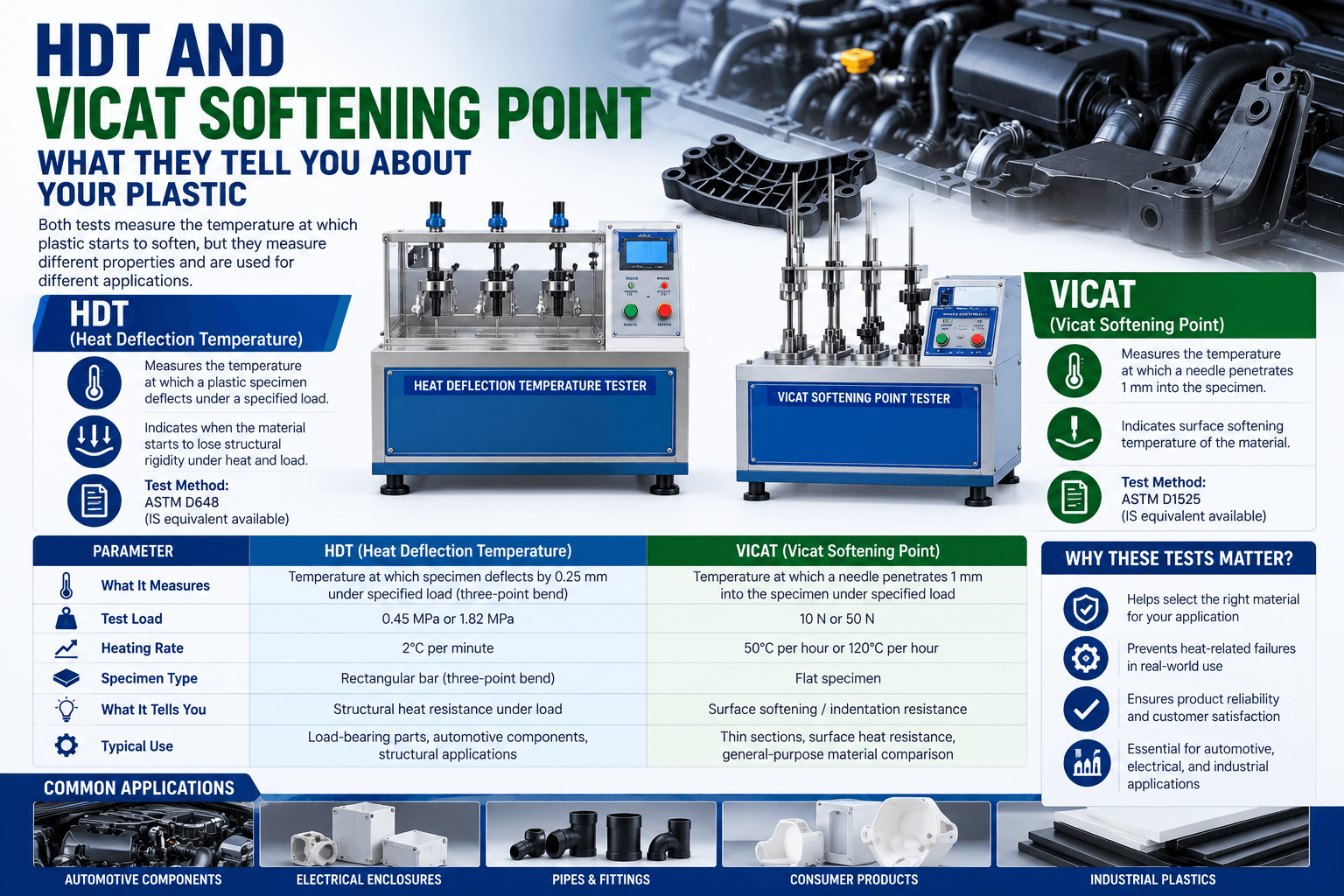
HDPE, PVC and PP-R pipes and fittings | IS 4984, IS 4985, IS 15328 | Melt flow, tensile, hydrostatic pressure, density, softening point, ESCR for PE grades | MFI Tester, UTM, hydrostatic pressure rig, HDT/VSP Apparatus, ESCR Apparatus |
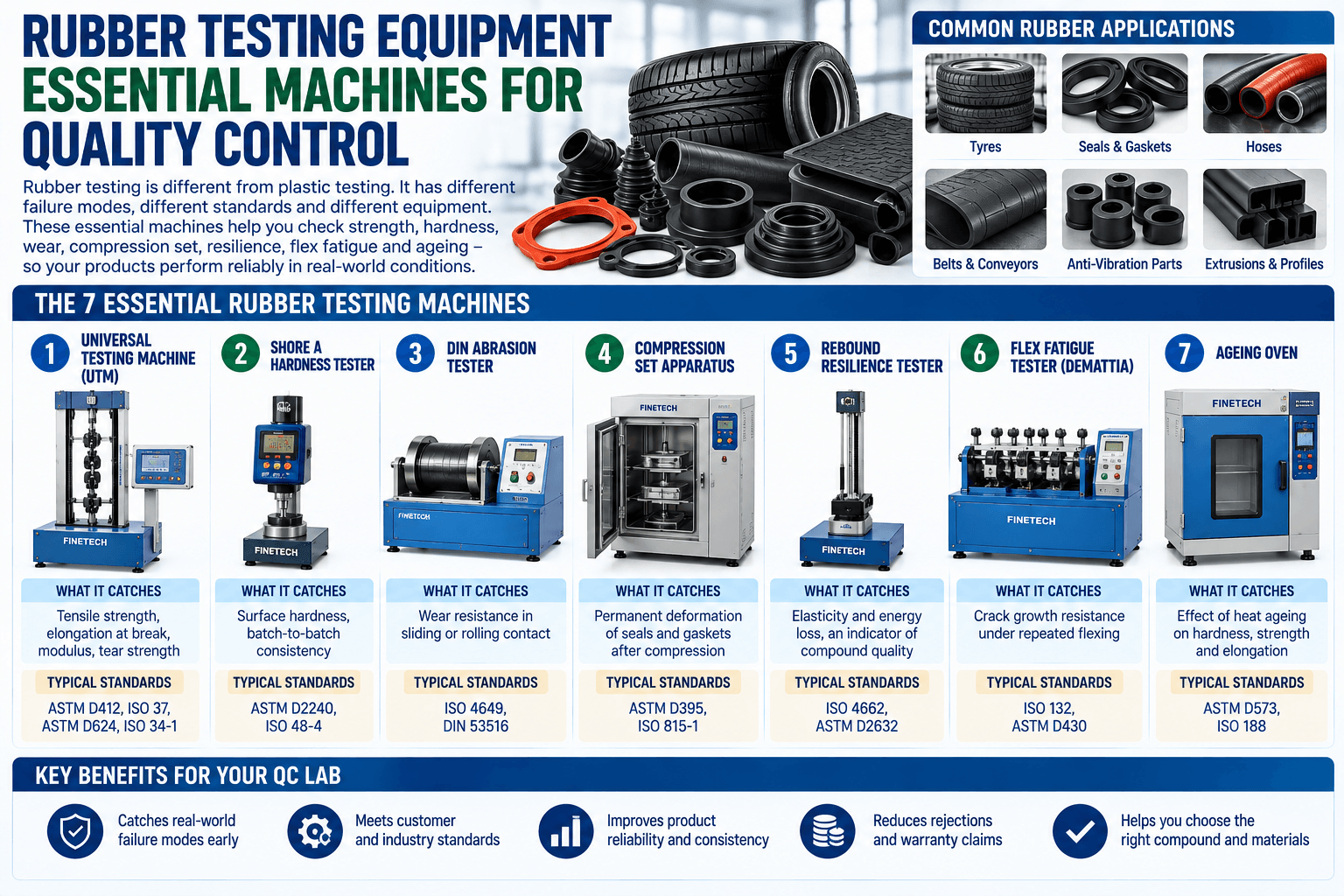
Rubber products and rubber or polymeric footwear components | IS 3400 series and the relevant product standard | Tensile and elongation, hardness, abrasion, compression set, ageing | UTM, Shore A Hardness Tester, DIN Abrasion Tester, compression set apparatus, ageing oven |
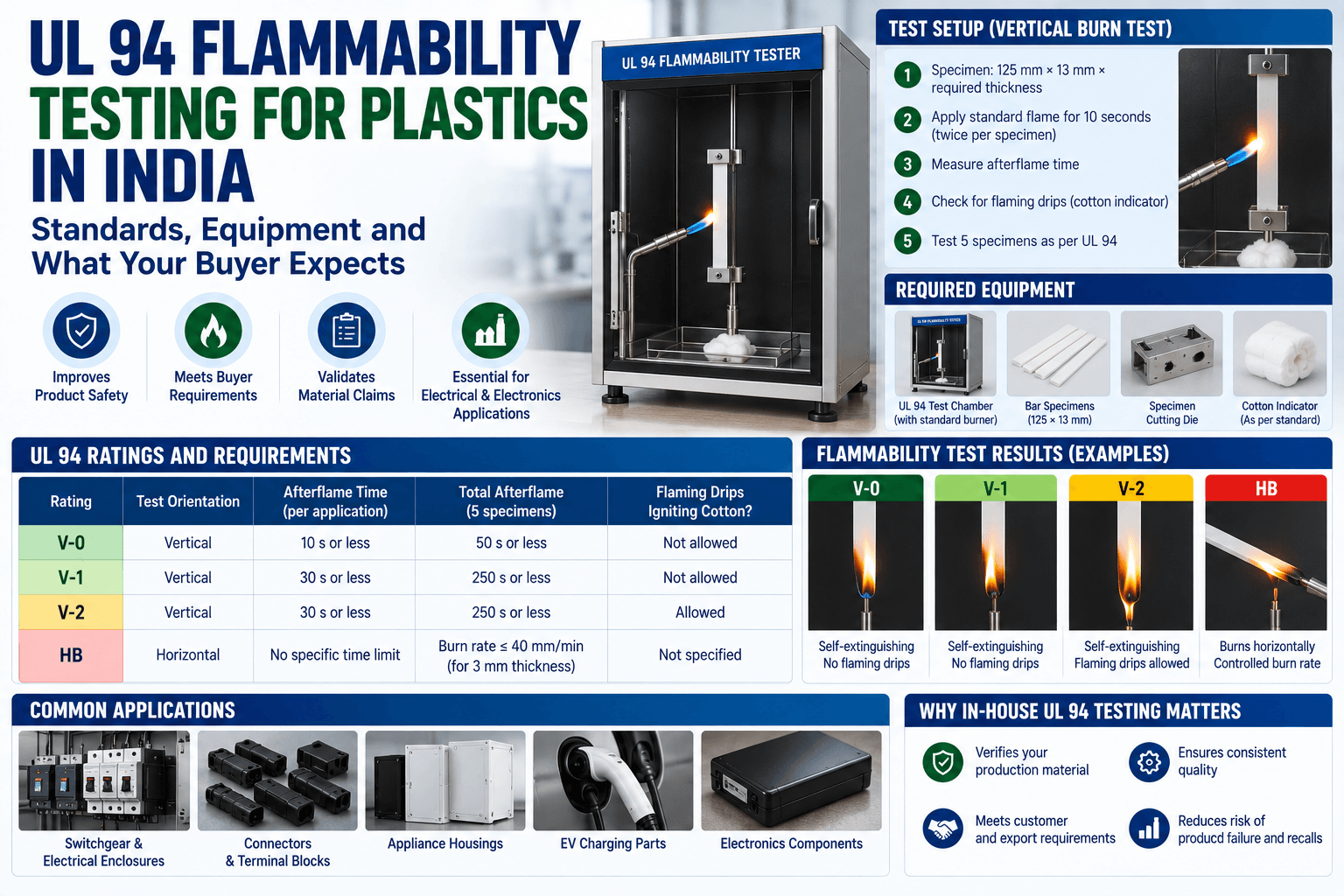
Plastic parts in electrical appliances and accessories | Relevant product safety standard | Flammability, impact, heat resistance | Flammability Tester, Izod/Charpy Impact Tester, HDT/VSP Apparatus |
Plastic toys and consumer plastic goods | Relevant product safety standard | Mechanical strength and impact, flammability | UTM, Impact Tester, Flammability Tester |
Even where certification is voluntary, as it may be for some pipe categories, buyers and tenders often ask for the ISI mark. Our blog on the five tests every plastic pipe manufacturer must perform lists the pipe-specific tests in more detail. Treat the IS 4984 IS 4985 IS 15328 pipe testing equipment list in the table as a starting point, then confirm it line by line against your own product’s STI.
Calibration and Documentation
Machines pass inspection or fail it on paper as much as on the bench. Auditors want to see that your numbers can be trusted, and that means calibration and records. Answering ‘BIS certification vs NABL accreditation difference for lab’: BIS certifies your product and your factory’s ability to make it, while NABL accredits laboratories to ISO/IEC 17025, which is why auditors look for calibration certificates from NABL-accredited calibration labs even though your own factory QC lab does not usually need NABL accreditation itself.
Calibration traceable to national standards. Use calibration from a competent, accredited source. A certificate with no reference standards, no uncertainty statement or no date is easily challenged. See our blog on why calibration matters for testing equipment. Knowing the BIS certification vs NABL accreditation difference for lab work helps here: BIS judges your factory, NABL accredits the calibration lab.
A tracked calibration schedule. Keep an equipment register with each instrument’s ID, last calibration date and due date. Overdue instruments are among the most common findings.
Calibration after repair or relocation. If a load cell is replaced or a machine is moved, recalibrate before using it for certified testing.
Complete test records. Batch number, date, standard and method, specimen dimensions, raw readings, result, operator and approver. If it is not written down, it did not happen.
SOPs for each test. Short, practical procedures, written with your own operators, that match your actual instruments.
Maintenance cover. An annual maintenance contract helps you keep calibration and servicing on schedule. See what an AMC covers and whether it is worth it.
Common Rejection Reasons
Let me start with the single most common mistake I have seen across the factories I have helped: die dimensions that do not match the IS standard. Of all the reasons BIS licence application rejected factory lab files share, this one is the easiest to prevent.
Real situation, name withheld: A manufacturer had bought a generic dumbbell die from a local supplier for tensile testing. It looked right and cut clean specimens. During the BIS inspection, the officer measured the die against the dimensions in the IS standard. The gauge width and the shoulder radius were slightly off. That meant every tensile result recorded on that die was questioned, not only for the audit but for months of earlier batches. The factory had to buy a correct die, repeat the testing, and re-document. The machine was fine. The die was the problem. I have seen versions of this in several factories, which is why we always ask for the standard number before supplying any die.
Here are the reasons BIS licence application rejected factory lab outcomes most often trace back to:
Reason | What Happens | How to Avoid It |
Die or fixture dimensions do not match the IS standard | Test results are not valid. Past records are questioned | Buy dies made to the specific standard, and measure them on receipt. See our dumbbell dies guide |
Equipment missing or unsuitable for a required test | BIS cannot see the test performed in your lab | Get the Scheme of Testing and Inspection for your product first, then list equipment against it |
Expired or untraceable calibration | Instrument readings cannot be trusted | Track due dates and use traceable calibration |
Incomplete or backdated records | No proof that testing is done at the required frequency | Record at the time of testing. Keep logs simple and consistent |
Untrained operators | Test is performed incorrectly even with good equipment | Train on the actual machines and keep training records |
Uncontrolled lab conditions | Specimens are not conditioned as the standard requires | Control temperature and humidity where the standard requires it |
Raw material accepted on supplier certificate alone | No in-house verification of input quality | Test incoming lots yourself, for example MFI for polymers |
Outdated version of the IS standard in use | Methods or limits are not current | Keep the current version of each standard on file and review on revision |
Final Thoughts
BIS certification is a factory-level approval, not a one-time test. Auditors judge whether your lab can keep proving, batch after batch, that your product meets the standard. That depends on the right equipment, correct dies and fixtures, traceable calibration and honest records. That is also the short answer to what do BIS auditors check in a QC lab inspection: whether your lab can keep proving it, not whether it passed once.
If your product is already under a QCO, or you expect it to be, start with the Scheme of Testing and Inspection and work backwards to the equipment list. If certification is voluntary for you today, remember that your buyers may still ask for it, and the lab you build now will serve you either way. If you are still unsure, put the question ‘is ISI mark compulsory for my product how to check QCO’ to your BIS branch office, and request the document that answers what is scheme of testing and inspection STI BIS licence holders must follow for your IS number.
At Finetech Engineering we manufacture laboratory testing equipment and specimen dies at our Thane facility, and we have helped more than fifteen factories set up labs for BIS audits. We are a manufacturer, not a trader, so the machines, the dies, the calibration and the annual maintenance come from one team. Our plastic testing lab setup guide covers budgets and layout, and our team can review your IS standard and equipment list with you. That is how to prepare QC lab for BIS inspection India factories can rely on: one accountable team for machines, dies and calibration. We are ISO 9001:2015 and CE certified, at C-1 New Kalwa Industrial Premises, Wagle Estate, Thane (W).
Preparing Your Lab for a BIS Inspection?
Call or WhatsApp: +91 93241 37971
Email: info@finetechengineer.com
Send us your product, its IS standard number and your current equipment list. We will tell you what your lab is missing and what can wait. We will also walk you through the BIS factory inspection lab checklist ISI mark applicants are judged on.
– Santhosh Kumar VP, Founder & Managing Partner, Finetech Engineering