


Do I Need a Light Booth for Colour Approval? Colour Matching Cabinets Explained
Colour mismatch is not cosmetic. In packaging and automotive, it means rejections and brand damage. A customer who sees two parts of the same product in slightly different shades does not think ‘lighting difference’. They think ‘quality problem’. If you have ever wondered why colour matches in lab but fails at customer inspection, the answer is almost always lighting.
So do you really need a colour matching cabinet? Sometimes no. Often yes. Let me explain how to tell, starting with a story that I hear in different versions from masterbatch and packaging customers. It is the same question buyers type into Google as ‘do I need a light booth for colour approval’, and the honest answer depends on your product.
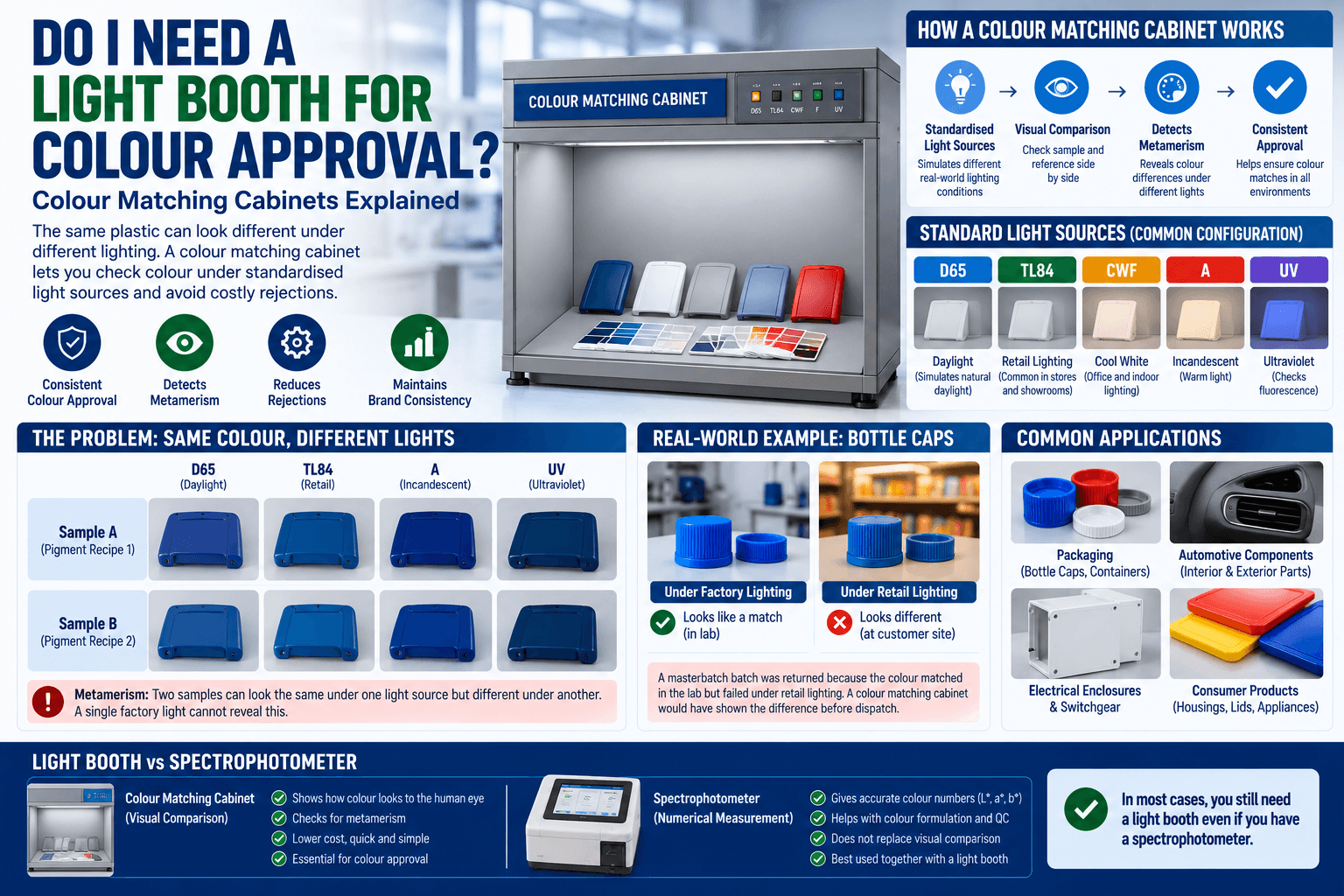
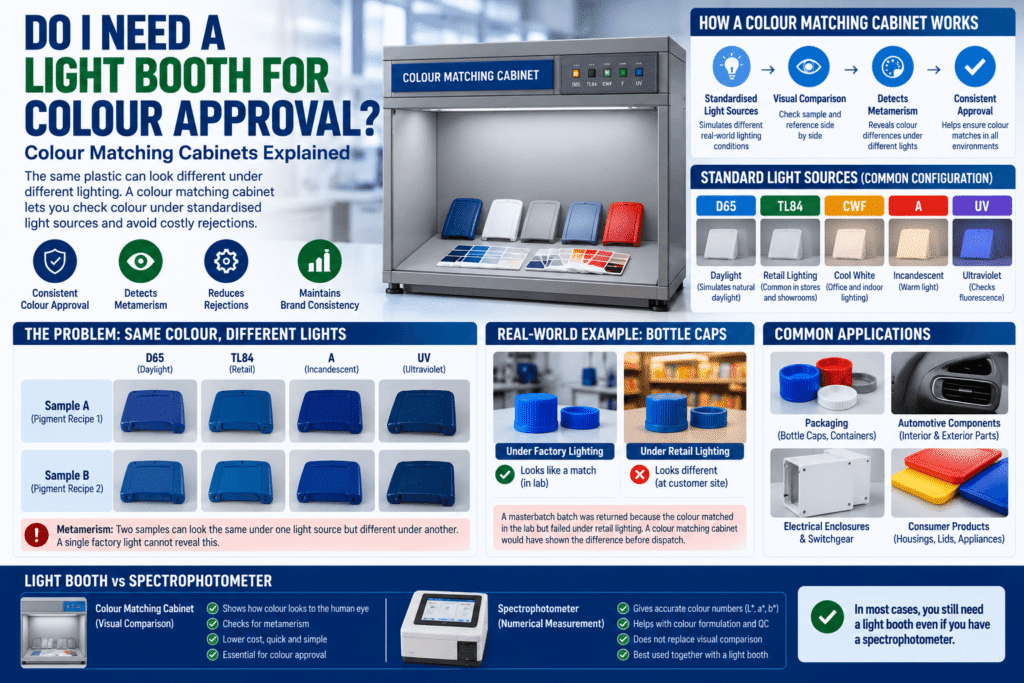
Real situation, name withheld: A masterbatch manufacturer supplied a colour batch for bottle caps. In their lab, under the ordinary fluorescent tube lights on the QC bench, the cap colour matched the customer’s approved standard perfectly, so the batch was released. When the caps reached retail shelves, the brand owner noticed they looked different from the standard bottle body. The match had held under one light and failed under another. The batch was returned, and the compounder lost both the batch and a good deal of the customer’s confidence. The cause was metamerism, which I explain below, and a cabinet with the right light sources would have shown the problem before dispatch. It is a textbook masterbatch batch returned colour mismatch retail shelves case, and a clear metamerism example plastic bottle caps masterbatch buyers will recognise.
What Is a Colour Matching Cabinet?
A colour matching cabinet, also called a light booth or colour viewing cabinet, is an enclosed box with neutral grey interior walls and several standardised light sources you can switch between. You place a sample and a reference side by side inside it and compare them under controlled, repeatable lighting.
It does not measure colour with a number. It lets human eyes judge colour under defined conditions, which is how most customers finally judge your product. A spectrophotometer measures colour numerically and the two tools complement each other. The cabinet is much cheaper and answers a different question: will these two samples look the same to a person in the real world? Answering ‘do you still need a light booth if you have a spectrophotometer’ directly: in most cases yes, because the instrument gives you a number while your customer gives you a visual verdict.
Why Ambient Light Is Your Enemy
The colour you see is not a property of the object alone. It depends on the light falling on it. Morning daylight, a fluorescent tube, an LED shop light and a warm retail spotlight each contain different mixes of wavelengths, so the same surface looks different under each. That is the core reason why colour matches in lab but fails at customer sites: the light on your QC bench and the light in their store are not the same.
Here is metamerism in simple terms. Imagine two black socks that look identical in the shop but turn out to be black and dark navy when you step outside into sunlight. They matched under one light and not under another. That is metamerism. Two samples can be made with different pigment combinations that reflect light differently across the spectrum. Under one light source they look the same, under another they do not. Answering ‘metameric pair meaning two samples same colour one light’ in one line: a metameric pair is two samples that look like the same colour under one light but separate under another.
This is exactly what caught the masterbatch manufacturer. Their sample and the standard used different pigment recipes, so they were a metameric pair. Under the bench tube light they matched, under retail lighting they drifted apart. A single ambient light on your QC bench, whatever it is, cannot reveal that. If you searched ‘metameric pair meaning two samples same colour one light’, this cap batch is the real-world version of that definition.
Warning: Never approve a colour under only one light source, and never under the general lighting of your factory floor. Daylight from a window changes through the day, and the bench lamp changes as it ages. That single rule is the heart of how to check metamerism in QC lab conditions.
Light Sources: D65, TL84, UV
A good cabinet carries several standard light sources so you can check for metamerism. Answering ‘how many light sources does a colour cabinet need D65 TL84 minimum’: D65 plus TL84 is the practical minimum for most plastics and packaging, with CWF, A and UV added to suit where the product is seen. These are the ones that matter most:
Light Source | What It Represents | When You Use It |
D65 | Artificial daylight, about 6500 K. The standard reference for colour judgement (see ISO 3664 and ASTM D1729) | Primary check for almost every product. Start here |
TL84 | Narrow-band fluorescent, about 4000 K, typical of shop and store lighting | Products sold in retail stores and supermarkets, packaging, textiles |
CWF (Cool White Fluorescent) | Typical office and commercial fluorescent lighting | Products used or inspected in offices and commercial buildings |
A (Incandescent / Horizon) | Warm, yellowish light, about 2856 K, like household bulbs | Home furnishings, consumer products used indoors in the evening |
UV (ultraviolet) | Long-wave UV that excites fluorescent materials | Detecting optical brighteners and fluorescent whitening agents in white plastics, paper, textiles and packaging |
The right set depends on where your customer’s product is seen. A bottle cap on a supermarket shelf sees TL84-type store lighting. Home textiles are judged under warm household light. White plastics and packaging with brighteners need the UV source, because the brightener makes whites look different under UV-containing light. For the UV light source optical brighteners white plastics check, compare sample and standard under UV alone first, then under D65, and look for any difference in the blue-white glow between them.
Do You Actually Need One? (Honest Answer)
I would rather tell you when you do not need one than sell you a machine that sits unused. Here is how I advise customers who ask ‘do I need a light booth for colour approval’:
Your Situation | Do You Need a Cabinet? |
You supply coloured plastic, masterbatch, packaging, labels, textiles or paint and your customer approves colour against a standard | Yes. Colour is a specification, and the customer will judge it under their own lights |
Your product is multi-part and parts from different suppliers must match (caps and bottles, trims and panels) | Yes. This is where metameric mismatch shows up most |
Your product is sold under retail or showroom lighting | Yes, with at least D65 and TL84 |
You only make natural, black or a single hidden-use colour and colour is never questioned | Probably not yet |
You already have a spectrophotometer and colour software | Possibly still yes. Numbers do not replace the human visual check customers actually make, and the cabinet is the lower-cost complement |
On cost, a colour matching cabinet typically costs in the range of Rs 25,000 to Rs 60,000 for Indian-manufactured units with three to five light sources, depending on the lamp set and cabinet size. Compare that with the cost of one rejected batch of masterbatch or packaging. For anyone searching ‘how much does a colour viewing cabinet cost India’, that range is the realistic planning figure, and a single masterbatch batch returned colour mismatch retail shelves incident usually costs more than the cabinet itself.
How to Use It Correctly
Owning a cabinet is not enough. Colour judgement is easy to get wrong, and the routine below is also my practical answer to how to check metamerism in QC lab work, so follow it:
Colour Matching Cabinet Routine
Warm up the lamps for the time recommended by the manufacturer (usually 10 to 15 minutes) before judging
Place the sample and the approved standard side by side, same size, same surface finish, same orientation
Judge under the primary light (D65) first, then under the other relevant sources, then UV if brighteners are present. If you are unsure how many light sources does a colour cabinet need D65 TL84 minimum, these two are the floor
Look at the samples from the same angle and distance every time. Do not tilt one sample differently from the other
Keep the cabinet interior clean and neutral. Do not stand bright or coloured objects inside it
Wear neutral clothing. A bright coloured shirt reflects onto the samples and distorts judgement
Use trained observers and have their colour vision tested periodically, since eyesight varies between people
Record which light source you used and the result for every batch, so approvals are traceable
Track lamp hours and replace lamps as the manufacturer specifies. Lamps age and shift in colour, which undermines every judgement
For standard methods, ASTM D1729 covers visual appraisal of colours and colour differences of diffusely illuminated opaque materials, and ISO 3664 covers viewing conditions for graphic technology. Your customer may specify which they follow. The UV light source optical brighteners white plastics check is usually defined in the customer’s own specification, so confirm it alongside the D65 and TL84 requirements.
Final Thoughts
A colour matching cabinet is a small, inexpensive instrument that protects against an expensive problem. The masterbatch story is typical: nothing was wrong with the factory’s own judgement, it was simply made under one light. Metamerism is invisible until the product leaves your factory. It is still the clearest metamerism example plastic bottle caps masterbatch suppliers can learn from, and it explains why colour matches in lab but fails at customer end in one line: the lab saw one light, the customer saw another.
If your customers approve colour against a standard, if your product is sold in stores, or if parts from different sources must match, a cabinet with at least D65 and TL84 is one of the best returns you can get in a QC lab. If colour truly never matters for your product, save the money for a machine that does. And if you are asking ‘do you still need a light booth if you have a spectrophotometer’, my view stays the same: yes, the two tools work best together.
At Finetech Engineering we manufacture colour matching cabinets at our Thane facility. We are a manufacturer, not a trader, so lamp sets, spare lamps and calibration checks come from the same team. If you are setting up a new lab, our plastic testing lab setup guide shows where a colour cabinet fits among the other instruments. And if you are choosing a supplier, our manufacturer-versus-trader checklist will help you verify who you are dealing with. We are ISO 9001:2015 and CE certified, based at C-1 New Kalwa Industrial Premises, Wagle Estate, Thane (W), and if you want a quote rather than the general answer to how much does a colour viewing cabinet cost India, call us with your product and lamp-set needs.
Not Sure Whether Colour Is Costing You Rejections?
Call or WhatsApp: +91 93241 37971
Email: info@finetechengineer.com
Tell us your product and where it is sold or used. We will tell you honestly which light sources you need in a cabinet, and whether you need one at all.
– Santhosh Kumar VP, Founder & Managing Partner, Finetech Engineering