


UL 94 Flammability Testing for Plastics in India: Standards, Equipment and What Your Buyer Expects
If your plastic parts go into electrical products, flammability testing is not optional. It is a safety requirement your buyer will enforce, and UL 94 is the standard they will name. A part that burns on and drips flaming plastic inside a switchboard or appliance is a fire hazard, and no buyer will accept a guess that it is probably fine. That is why UL 94 flammability testing for plastics in India belongs inside your own QC routine, not just on a supplier’s datasheet.
I want to start with a story from a switchgear manufacturer near Nashik, because it shows how easily this goes wrong.
Real situation, name withheld: A Nashik switchgear manufacturer had been ‘testing’ flammability in-house for years. The method was a gas lighter and a stopwatch. A technician held a lighter flame to a strip of the moulded material, counted seconds, and wrote ‘self-extinguishing, V-0’ on the report. Their customers were being told the material was V-0. When the company finally commissioned a proper test, with a calibrated flame, controlled enclosure, cotton indicator and five conditioned specimens, the result was different. The material met only V-2. Burning drips were igniting the cotton, which V-0 does not allow. The grade had to be changed to a properly flame-retardant compound and every affected supply batch reviewed. Nothing had caught fire. But for years the company had been claiming a rating it never verified. This is the textbook answer to why lighter and stopwatch test cannot give UL 94 rating: the flame was never the standard flame.
A lighter flame is not a standard flame. A stopwatch is not a test method. This blog explains what UL 94 actually requires, what the ratings mean, what equipment you need, and the mistakes that produce false confidence. Answering ‘why lighter and stopwatch test cannot give UL 94 rating’ in one line: neither the flame nor the timing is controlled, so the result cannot be repeated or compared with the rating limits.
Why Flammability Testing Matters
Plastics used in switchgear, enclosures, connectors, appliance housings, EV charging parts and electronics sit next to heat and electrical faults. If a fault ignites the plastic, you want it to stop burning quickly and not drip burning material onto other parts. Flammability testing measures exactly that.
Buyers specify a UL 94 rating on the drawing or material specification. Exporters meet it for their overseas customers, and product safety standards for electrical products commonly require it. The rating lives in your raw material datasheet, but a datasheet is a claim about a laboratory plaque, not about your production batch. That is why in-house verification matters. This datasheet UL 94 rating vs production batch coloured grade gap is where most false V-0 claims begin.
Tip: An in-house UL 94 test verifies your production material against the rating your buyer expects. It does not replace UL recognition or third-party certification where those are required. Think of it as your batch-level quality check, not a certificate. Answering ‘in-house UL 94 test vs UL certification difference’ directly: the in-house test proves your batch, while UL certification proves the material through an independent listing.
UL 94 Ratings: V-0, V-1, V-2, HB
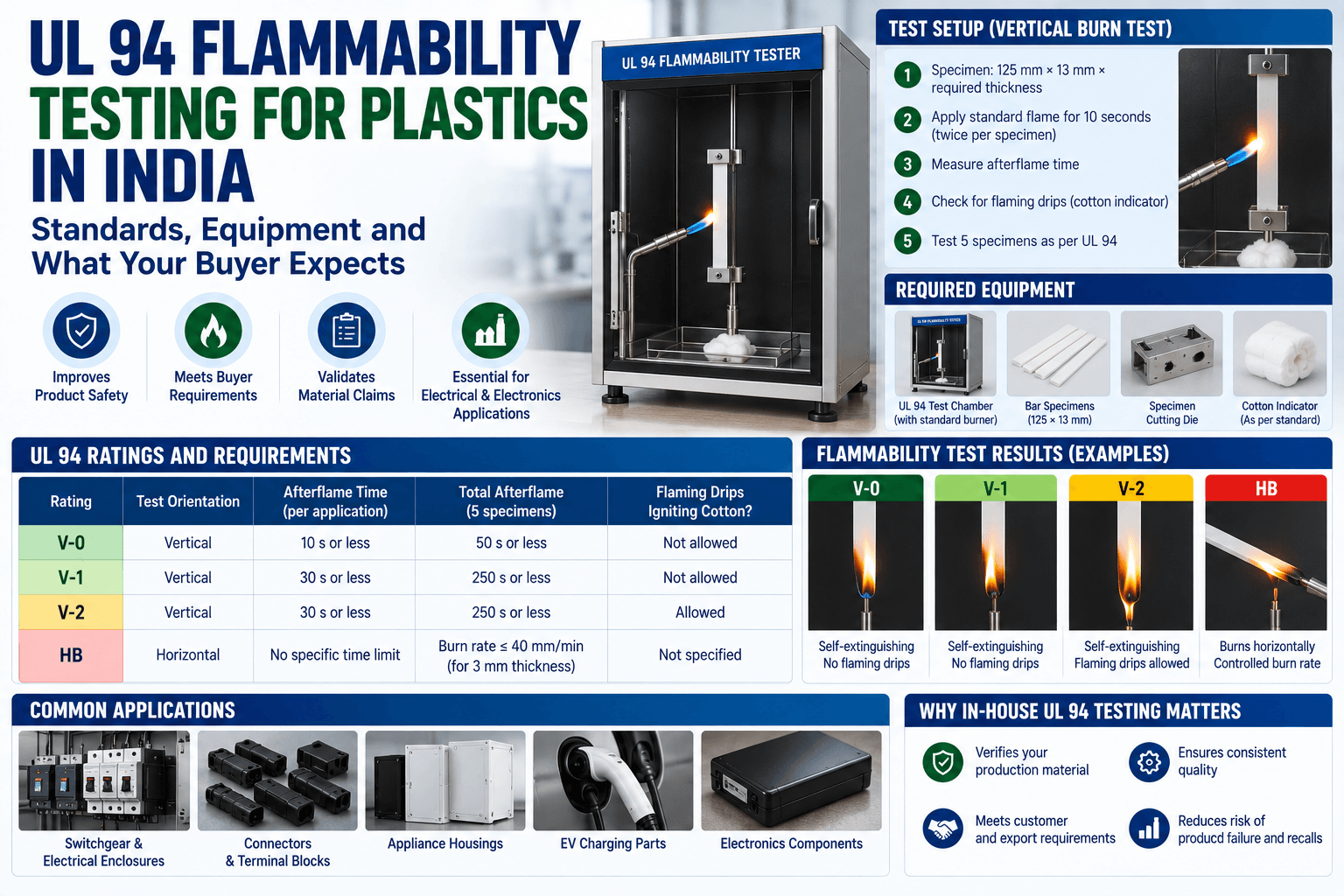
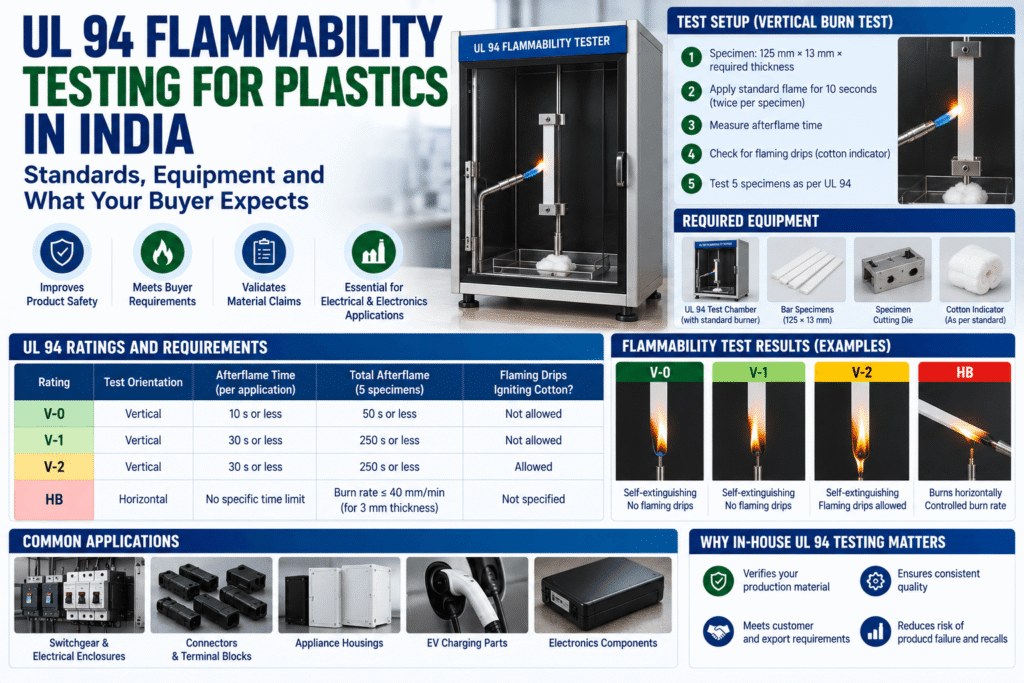
UL 94 rates a plastic by how it behaves after a small flame is applied to a bar-shaped specimen, typically 125 mm long and 13 mm wide, at the thickness being tested. Answering ‘how many specimens needed for UL 94 vertical test’: a set of five bars per conditioning condition, typically one set as conditioned at 23°C and 50% RH and one set after oven ageing. Here are the main ratings, from most to least demanding:
Rating | Test Orientation | Afterflame Time per Application | Total Afterflame (5 specimens) | Flaming Drips Igniting Cotton? |
V-0 | Vertical | 10 s or less | 50 s or less | Not allowed |
V-1 | Vertical | 30 s or less | 250 s or less | Not allowed |
V-2 | Vertical | 30 s or less | 250 s or less | Allowed |
HB | Horizontal | Burning rate limit instead of afterflame time (for example, not above 40 mm/min for specimens 3 to 13 mm thick) | Not applicable | Not applicable |
Read it this way. V-0 is the best of the vertical ratings: flames die out within 10 seconds each time and nothing burning drips onto the cotton below. V-1 allows longer burning. V-2 allows the same burning as V-1 but accepts flaming drips that ignite the cotton, which is why it is the weakest vertical grade. HB is the basic horizontal burn rating and the lowest bar. There are also higher ratings such as 5VA and 5VB for more severe flame exposure, and VTM ratings for thin flexible films. Answering ‘UL 94 V-0 afterflame time 10 seconds total 50 seconds meaning’ plainly: each specimen must stop flaming within 10 seconds after each flame application, and the afterflame times of all five specimens added together must not exceed 50 seconds. As for the UL 94 5VA 5VB VTM ratings meaning, 5VA and 5VB use a much larger 125 mm flame for enclosure materials, with 5VA also allowing no burn-through of a flat plaque, while VTM-0, VTM-1 and VTM-2 apply the vertical logic to thin films that would distort in a normal bar clamp.
Two details catch people out. First, the rating applies to the thickness tested. A material that is V-0 at 3.0 mm may only reach V-2 at 0.8 mm, so always check the rating at your actual part thickness. Second, colour and additives can change the result, so a natural-colour datasheet value is not automatically valid for your coloured production grade. Answering ‘does UL 94 rating change with specimen thickness’: yes, which is why a rating is always quoted together with the thickness it was earned at. The same thinking drives the datasheet UL 94 rating vs production batch coloured grade problem: the plaque on the datasheet is not your moulded part.
Horizontal vs Vertical Burn
Aspect | Horizontal Burn (HB) | Vertical Burn (V-0, V-1, V-2) |
Specimen position | Held horizontally, supported along its length | Clamped vertically at the top, hanging free |
Flame application | Flame applied to the free end for 30 seconds | Flame applied to the bottom edge for 10 seconds, removed, then applied again for another 10 seconds |
What is measured | Whether it burns past marks and at what rate (mm/min) | Afterflame and afterglow times, and whether burning drips ignite cotton placed below |
Severity | Less severe | More severe, because a vertical flame climbs the specimen and drips fall away |
Typical use | Enclosures where ignition risk is lower, general plastics | Electrical parts, switchgear, connectors, appliance components |
Related standards | ASTM D635, IS 11731 horizontal method | ASTM D3801, IEC 60695-11-10, ISO 1210 |
For electrical and electronics applications, buyers nearly always ask for a vertical rating, usually V-0. ASTM D635 and ASTM D3801 are the ASTM counterparts, and IEC 60695-11-10 and ISO 1210 are the international equivalents. As we explain in our standards blog, the methods are close but not identical, so confirm which your customer specifies. If your product is also tested for glow wire ignition (IEC 60695-2-11), that is a separate test with a separate instrument. For switchgear, connector and EV-charging buyers, UL 94 flammability testing for plastics in India therefore centres on the vertical V-0 test.
Equipment Needed
A proper UL 94 setup is more than a flame. The larger-flame tests behind the UL 94 5VA 5VB VTM ratings meaning need their own flame setting and fixtures, so confirm which ratings you must cover before buying. For the standard vertical and horizontal tests, these are the elements the method depends on:
Element | What It Does | Why It Matters |
Test enclosure (draught-free chamber) | A closed chamber of specified minimum volume with a viewing window and fume extraction | Air movement changes how the flame behaves and how the specimen burns. Open-room tests are not repeatable |
Burner with calibrated flame | A Bunsen-type burner producing a 20 mm blue flame with the specified gas | Flame size and heat input must be the same every time. A lighter flame cannot be calibrated |
Specified fuel gas | Methane of the required purity (or other gas permitted by the method) | The standard defines the gas. Lighter gas or mixed LPG can give a different flame |
Specimen holder and stand | Clamps the specimen at the right height and angle | Distances between burner, specimen and cotton are fixed by the method |
Cotton indicator | Dry cotton pad placed below the specimen | It detects flaming drips, which separate V-0 and V-1 from V-2. This is flaming drips cotton indicator V-0 versus V-2 explained in one line: ignited cotton means V-2 at best |
Timer and flame height gauge | Measure burn times and set the 20 mm flame | Afterflame times are the pass or fail numbers. This is where the UL 94 V-0 afterflame time 10 seconds total 50 seconds meaning becomes a recorded number |
Conditioning facility | Controlled room or chamber for conditioning specimens before test | Standard conditioning (for example 48 hours at 23°C and 50% RH, plus aged sets) is part of the method |
A dedicated flammability tester built for UL 94 combines the enclosure, burner, timers and fixtures in one unit, which is far more reliable than assembling parts on a bench. For labs setting up from scratch, our plastic testing lab setup guide shows where it fits as a Tier 2 instrument, with indicative pricing of about Rs 60,000 to Rs 1,00,000 for Indian-manufactured testers. For anyone asking ‘how much does a UL 94 flammability tester cost in India’, that Rs 60,000 to Rs 1,00,000 range is the realistic planning figure, with the final price depending on chamber size, timer automation and the ratings the configuration must cover.
Common Mistakes
Mistake | What Goes Wrong | How to Avoid It |
Using a lighter and stopwatch | Flame size and position are not controlled. Results are not reproducible and cannot support a rating | Use a calibrated burner in a test enclosure, as in the Nashik story |
Testing the wrong thickness | Rating is valid only at the tested thickness. Thin sections perform worse | Test at the minimum wall thickness of your actual part. Asking ‘does UL 94 rating change with specimen thickness’ always gets the same answer: yes |
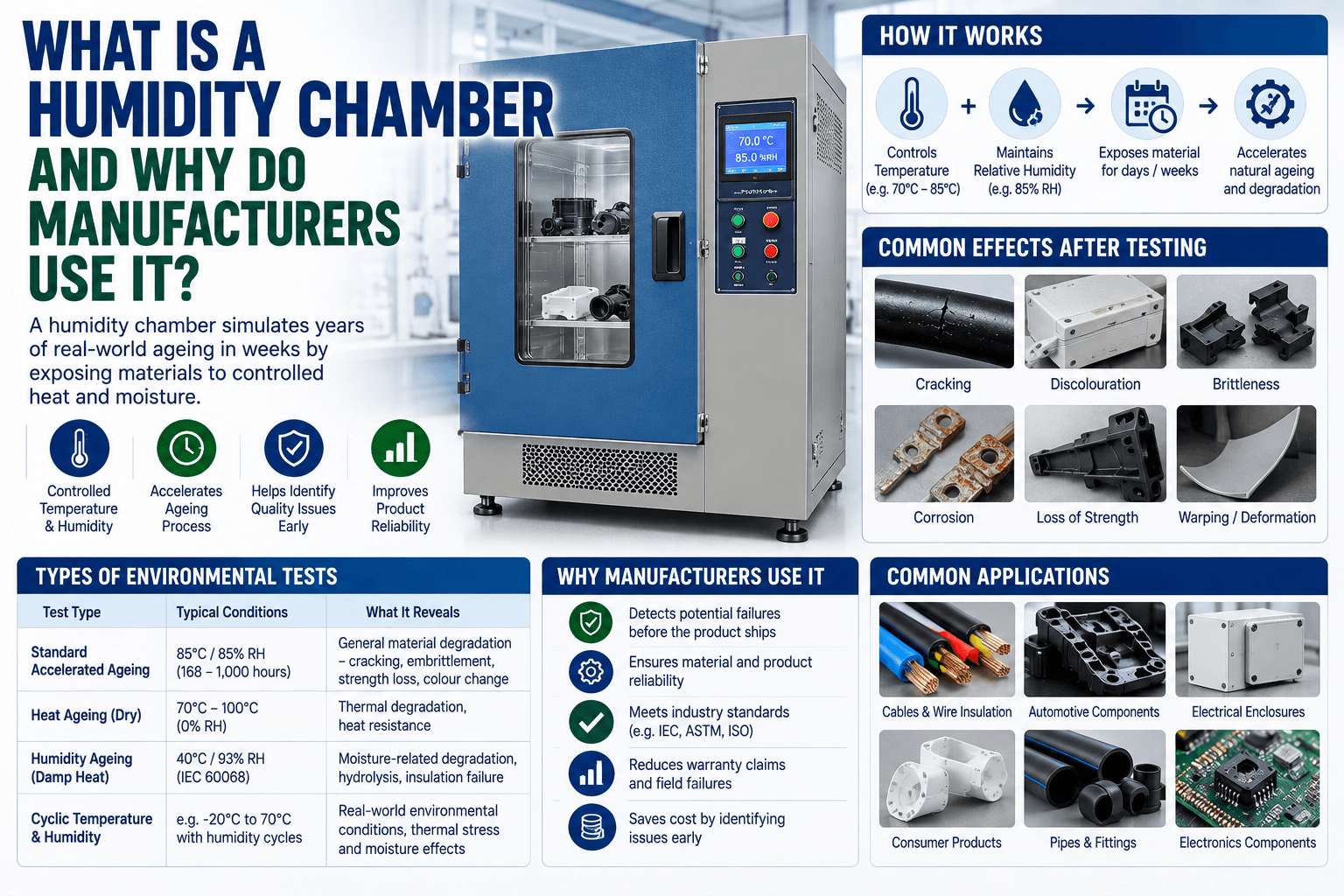
Skipping conditioning | Moisture content and ageing change burning behaviour | Condition specimens as the method requires. A humidity chamber helps |
Testing too few specimens | One good bar proves nothing. The method needs a set of five per condition | Always test the full set and record every result. If unsure how many specimens needed for UL 94 vertical test, plan five per condition |
Ignoring the cotton indicator | Flaming drips go unnoticed and a V-2 material gets reported as V-0 | Place fresh cotton every time and record any ignition |
Relying on the datasheet | The raw material plaque rating may not match your coloured, regrind or modified production grade | Verify production batches yourself, especially after colour or additive changes. The datasheet UL 94 rating vs production batch coloured grade check is a batch-level job |
Testing in a draughty room | Air currents change flame shape and burn time | Always test inside a closed enclosure with controlled extraction |
Warning: Do not report a UL 94 rating from an informal test. A wrongly reported V-0 on a safety-critical part is a liability, not just a quality issue.
Final Thoughts
Flammability is one of the few tests where being roughly right is the same as being wrong. The Nashik switchgear manufacturer was not careless. It simply believed a lighter and a stopwatch were close enough. The first proper test showed a V-2 material being sold as V-0. It is also the clearest case of flaming drips cotton indicator V-0 versus V-2 explained in practice: the ignited cotton was the whole difference between the claimed grade and the real one, and it is exactly why lighter and stopwatch test cannot give UL 94 rating evidence a buyer can rely on.
If your plastic parts go into electrical or electronic products, verify them against the vertical rating your buyer specifies, at the actual thickness and colour you ship, using a calibrated flame in a proper enclosure. That is what a UL 94 flammability tester is for. Keep the in-house UL 94 test vs UL certification difference in mind too: your own tester checks every batch, while certification is still needed wherever your buyer asks for a UL listing.
At Finetech Engineering we manufacture flammability testers at our Thane facility. We are a manufacturer, not a trader, so the team that builds your tester also supports its calibration and annual maintenance contract. If you are not sure which rating your buyer needs, send us the drawing or specification and we will tell you what to test. If you are comparing quotes and wondering how much does a UL 94 flammability tester cost in India for your exact ratings, we will price the configuration you actually need. We are ISO 9001:2015 and CE certified, at C-1 New Kalwa Industrial Premises, Wagle Estate, Thane (W).
Is Your Material Really V-0? Find Out Before Your Buyer Does.
Call or WhatsApp: +91 93241 37971
Email: info@finetechengineer.com
Tell us your product, wall thickness and the rating your buyer specifies. We will tell you which tests and which tester configuration you need.
– Santhosh Kumar VP, Founder & Managing Partner, Finetech Engineering